

Signature-Duft: Wie er Ihre Duftsammlung prägt
A unique signature scent is proven to make people perceived up to 80 percent more distinctly and is often unconsciously associated with a specific person. For fragrance enthusiasts in the UK, building a diverse personal collection has become a statement of style and individuality. Learn here how high-quality signature scents and affordable dupes can be purposefully combined to create a distinctive olfactory profile.
Table of Contents
- What exactly is a signature scent?
- Recognizing typical characteristics and variants
- Signature scent vs. dupes: Understanding the differences
- Tips for choosing the right signature scent
- Avoiding mistakes when building a signature fragrance collection
Key takeaways
| Point | Details |
|---|---|
| Signature scent | A signature scent is an olfactory business card that reflects personal identity and is associated with it. |
| Fragrance families | There are various fragrance families, each with its own characteristic notes and personality that influence the choice of scent. |
| Signature scent vs. dupes | Dupes offer an affordable alternative to signature scents, though they often have lower quality and longevity. |
| Individual selection | When choosing a signature scent, long-term, individual testing is crucial to avoid bad purchases. |
What exactly is a signature scent?
A signature scent is more than just an arbitrary perfume – it is an olfactory business card of one's personality. A signature scent refers to a perfume that represents a fixed component of one's identity and impresses with its unique recognizability.
This personal fragrance not only reflects individual character but is also purposefully associated with the wearer by other people. It is the conscious result of careful selection, where aspects such as the harmony of scent notes, wearability, and emotional resonance play a decisive role.
From a social-psychological perspective, the signature scent functions as a subtle communication tool. It allows one to send a message without words – about style, personality, and self-perception. The perception of a specific, recurring scent is considered an expression of individuality, consciously chosen for one’s appearance in various areas of life.
Pro tip: Take your time to explore your signature scent and experiment with different fragrances until you have found the perfect representative of your personality.
Recognizing typical characteristics and variants
Signature scents can be categorized into different fragrance families, each of which has characteristic features. Perfumes can be divided into various types based on their scent composition, such as floral, oriental, woody, or fresh, with each category possessing its own olfactory personality.
Here is an overview of the most important fragrance families and their characteristic properties:
| Fragrance family | Dominant notes | Typical impression |
|---|---|---|
| Floral | Rose, jasmine, violet | Elegant and romantic |
| Oriental | Vanilla, amber, spices | Warm and sensual |
| Woody | Sandalwood, cedar | Masculine and earthy |
| Fresh | Citrus, mint, aqua | Lively and invigorating |
The complex structure of a signature scent is determined by three essential components: top note, heart note, and base note. This sequence of notes describes the evolution of the scent from the first perception to the final development. The chemical basis comprises a multitude of natural and synthetic molecules, whose specific combinations shape the olfactory identity, with concentration and molecular structure being decisive factors for intensity and character.

There are different fragrance intensities, from light Eau de Cologne to concentrated Eau de Parfum. The variants differ in their aroma content and longevity: while Eau de Cologne contains about 2-4% fragrance oils, Eau de Parfum has a 15-20% concentration, which leads to a significantly longer scent development.
Pro tip: Test different fragrance intensities and families to find out which variant best suits your personality and skin chemistry.
Signature scent vs. dupes: Understanding the differences
Dupes are an interesting alternative to original signature scents that are significantly more accessible in price. A dupe mimics the appearance or composition of a high-end perfume at a low cost without being considered a counterfeit or imitating trademarks), making it a legal and attractive option for fragrance lovers.
The central difference lies in originality and exclusivity. While a signature scent represents a unique olfactory identity, dupes consciously offer an affordable, inspired alternative without claiming exclusivity. They are oriented toward well-known fragrance compositions, but remain limited in their overall effect and inspiration.
Qualitatively, there are significant differences: original signature scents usually impress with higher-quality ingredients, more complex fragrance notes, and longer longevity. Dupes, on the other hand, focus on a cost-efficient imitation that is attractively priced but does not reach the full olfactory depth and nuance of the original.
The following table summarizes the differences between signature scents and dupes compactly:
| Criterion | Signature scent | Dupe |
|---|---|---|
| Originality | Unique and individual | Imitation of known scents |
| Ingredients | High-quality and complex | Inexpensive and simplified |
| Longevity | Long-lasting | Usually shorter development |
| Price | High to exclusive | Affordable |
Pro tip: Test dupes as a clever alternative to explore different fragrance directions without financial risk.
Tips for choosing the right signature scent
Selecting a signature scent requires careful consideration and an individual approach. The perfect scent should not only reflect your personality but also fit various life situations. It is about finding a scent that feels like a second skin – authentic and confident.
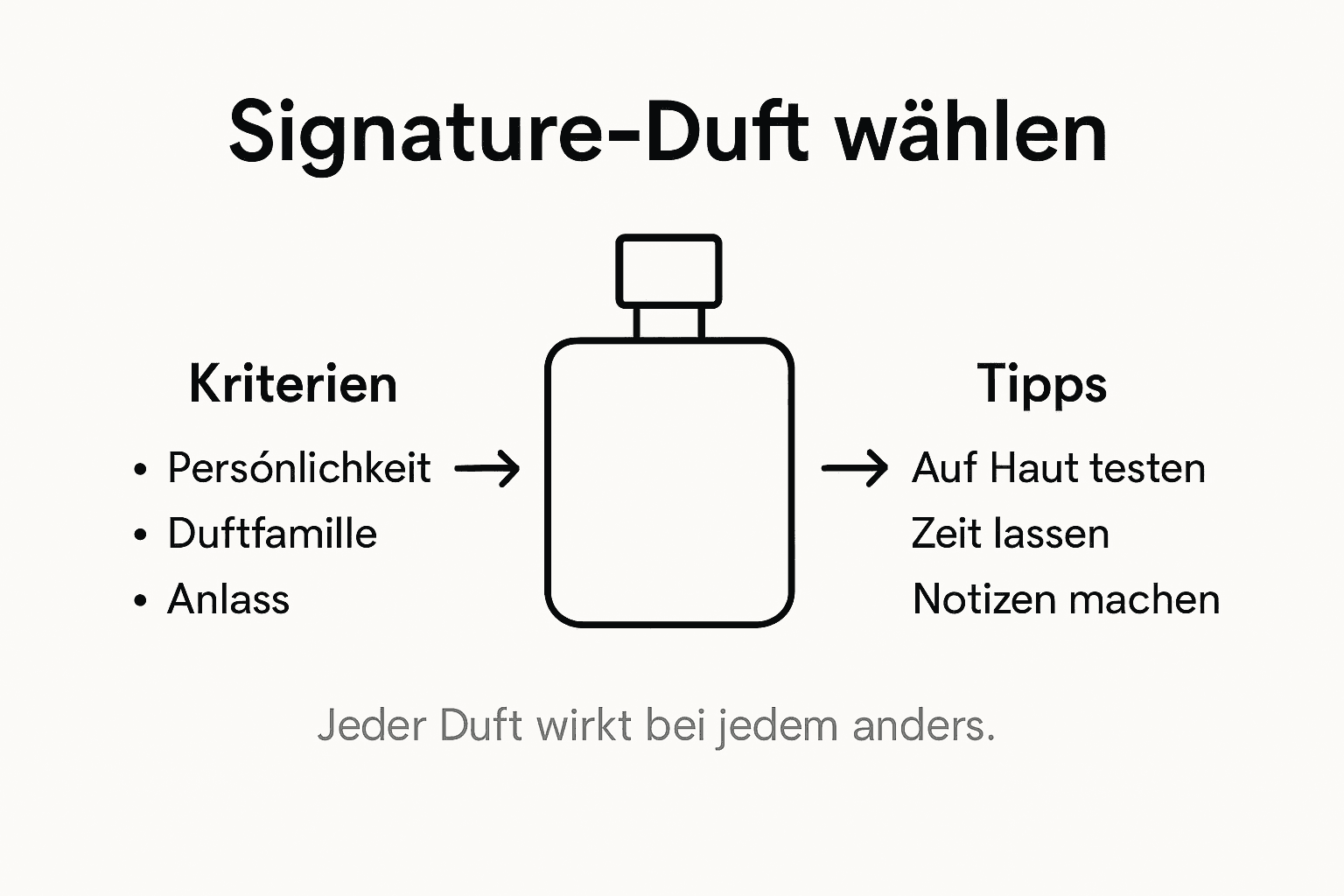
Several criteria are decisive in the selection. The conscious choice of a perfume requires knowledge of fragrance families, intensity, and chemical composition. Look for balanced compositions that harmonize with both your personality and different life circumstances. Consider aspects such as your individual skin chemistry, seasonal suitability, and recognizability.
It is best to test potential signature scents over a longer period. Avoid hasty decisions based on fashion trends or fleeting recommendations. It is important that the scent develops pleasantly throughout the day and that you feel comfortable and confident wearing it. Also, consider the sillage – the reach of the scent – and how it bonds with your natural body chemistry.
Pro tip: Visit perfumeries and have scents tested on your skin, because every scent develops individually and differently than it does in a glass bottle.
Avoiding mistakes when building a signature fragrance collection
A reflected approach to mistakes when building a fragrance collection is crucial to avoid long-term disappointments. Many collectors often fall into the impulse of acquiring scents randomly without checking their actual suitability. A well-thought-out approach means critically questioning every scent and not letting oneself be swayed by short-term fashion trends or advertising promises.
The most common mistakes arise from a lack of research and unreflected purchasing decisions. A systematic analysis helps to identify causes for bad purchases and to make future investments more targeted. Be careful not to buy too many similar scents or to focus exclusively on luxury brands. Instead, your collection should reflect variety, individuality, and personal development.
When purchasing, consider the compatibility with your personality, skin chemistry, and the various life situations. A scent that smells great in the shop can develop completely differently on the skin. Take your time to test, let samples work on your skin, and observe their development over several hours.
Pro tip: Keep a fragrance journal to document your experiences and reactions to different scents and to develop your collection in a targeted and reflected manner.
Find your perfect signature scent with AlexandriaUK
The challenge in building a unique fragrance collection is choosing a personal signature scent from the multitude of fragrance families and variants that really suits your personality. Many fragrance lovers struggle with choosing the right perfume and the question of whether to opt for an original Eau de Parfum or a high-quality dupe. It is important to discover scents that impress with quality while simultaneously making an authentic olfactory statement.

Discover a carefully selected collection of scents and dupes at AlexandriaUK that focus on quality and individuality. Use the opportunity to expand your fragrance collection in a targeted manner and avoid bad purchases. Immerse yourself in the world of fragrance families and find your signature scent that accompanies you with confidence. Start your fragrance journey on AlexandriaUK now and experience the art of personal scent selection!
Frequently asked questions
What is a signature scent?
A signature scent is a perfume that reflects a person's individual identity and is associated with them by others.
How do I choose the right signature scent?
The selection should be made individually by considering fragrance families, intensity, and one’s own skin chemistry. A scent should fit different life situations and develop pleasantly.
What is the difference between a signature scent and a dupe?
A signature scent is unique and represents an individual olfactory identity, while a dupe is an affordable imitation of a well-known perfume that does not offer the same exclusivity and depth.
What fragrance families are there and how do they differ?
There are various fragrance families such as floral, oriental, woody, and fresh. Each family has characteristic features and influences the olfactory personality of the scents.


