Wie lange hält Duft – Wirkung und Haltbarkeit gezielt verstehen
Over 50% of fragrance fans do not know how strongly fragrance concentration influences the longevity of their favorite perfume. Knowing the difference between perfume, eau de parfum, and eau de toilette allows for more targeted selection and longer-lasting enjoyment of your own scent. Here you will learn how concentration, skin type, and proper application interact, and what really matters when it comes to storage, so that every fragrance delights with full intensity.
Table of Contents
- Fragrance types and wear time by fragrance concentration
- Fragrance notes: Explained from top to base
- Influence of skin, climate, and application
- Effectively using storage and bottle shelf life
Key Takeaways
| Point | Details |
|---|---|
| Fragrance Concentration | Higher concentrations ensure longer longevity; perfume lasts 6-8 hours, while eau de toilette only lasts 3-4 hours. |
| Influencing Factors | Skin type and ambient temperature significantly influence fragrance perception and longevity. |
| Optimal Application | Apply fragrance to pulse points to maximize fragrance development. |
| Proper Storage | Perfumes should be kept cool and dark to preserve quality. |
Fragrance types and wear time by fragrance concentration
The world of fragrances is fascinating and complex. Depending on the fragrance concentration, the wear time of a perfume varies significantly. Different fragrance categories have specific concentration levels that directly influence longevity and intensity.
With perfumes, we find the highest fragrance concentration between 15-30%. This means an intense scent note that lasts particularly long – often 6-8 hours. Eau de Parfum is in the middle intensity league with a 10-15% fragrance content and typically lasts 4-6 hours. Eau de Toilette with about 5-10% fragrance remains perceptible for approximately 3-4 hours. The lightest variant, Eau de Cologne with only 2-4% fragrance concentration, evaporates after about 2-3 hours.
However, wear time is not only determined by fragrance concentration. Factors such as skin type, temperature, humidity, and individual body chemistry play a decisive role. For example, people with dry skin should seal their fragrance area after application with an unscented body lotion to extend longevity.
Pro-tip for fragrance lovers: Apply your fragrance to pulse points such as wrists, the crook of the neck, or the collarbone. These areas have a higher body temperature and help to activate and diffuse the fragrance longer.
For a better overview, the most important fragrance types are summarized here by concentration, wear time, and recommended application:
| Fragrance Type | Fragrance Concentration | Typical Wear Time | Suitable Occasions |
|---|---|---|---|
| Perfume | 15-30% | 6-8 hours | Special evenings, events |
| Eau de Parfum | 10-15% | 4-6 hours | Office, everyday life, meetings |
| Eau de Toilette | 5-10% | 3-4 hours | Sports, leisure, daytime |
| Eau de Cologne | 2-4% | 2-3 hours | Refreshment, short-term use |
Fragrance notes: Explained from top to base
The character of a perfume is created through a complex interplay of different fragrance notes, which are structured like a musical composition. These notes are traditionally divided into three main levels: top note, heart note, and base note.
The top note is the first impression of a fragrance. It is light, fresh, and volatile – usually with citrusy, fresh, or floral aromas such as lemon, bergamot, or lavender. This note determines the first impression and lasts only about 15-30 minutes. The heart note develops directly after the top note and forms the true centerpiece of the fragrance. Here, more complex aromas like jasmine, rose, or spices come into play, remaining present for 2-4 hours.
The base note is the anchor of the entire fragrance. It consists of heavy, long-lasting notes such as musk, vanilla, sandalwood, or patchouli. These components fix the fragrance and can remain perceptible for 4-6 hours or even longer. The base note ultimately determines the depth and longevity of a perfume.
Pro-tip for perfume enthusiasts: Test a perfume on your skin for at least 30 minutes before buying it. This allows you to experience the full developmental arc from top to heart to base note and assess its true character.
Influence of skin, climate, and application
A perfume's scent is a complex interaction between perfume composition and individual environmental factors. The perception and effect of fragrances vary depending on personal sensitivity, which underscores the uniqueness of the perfume experience.
Skin type plays a decisive role in fragrance development. Dry skin absorbs scents faster and lets them fade more quickly, while oily skin stores fragrance notes longer and releases them with a delay. People with sensitive skin should pay particular attention to alcohol content and ingredients, as these can cause irritation. Body temperature additionally influences fragrance development – warmer skin areas such as wrists, the crook of the neck, or the collarbone enhance fragrance nuances.
Climatic conditions change fragrance perception significantly. In warm, humid environments, fragrances spread faster and more intensely, while in cold, dry regions, fragrance notes appear more compact and muted. Humidity, temperature, and air circulation influence not only fragrance diffusion but also its longevity and intensity.
Pro-tip for perfume fans: Keep your fragrances in a cool, dark place and avoid direct sunlight. This prevents loss of quality and significantly extends the life of your perfumes.
Effectively using storage and bottle shelf life
Fragrances are sensitive to environmental influences, which is why proper storage is crucial for the longevity of a perfume. The quality and effect of a fragrance depend directly on its storage conditions.
Temperature is the most critical factor in perfume storage. Extreme temperature fluctuations – whether heat or cold – can permanently alter the chemical composition of the fragrance components. Ideally, perfumes should be stored at a constant 15-18 degrees Celsius, away from direct sunlight and heat sources. Bathrooms are unsuitable despite their perceived convenience, as high humidity and temperature changes quickly impair perfume quality.
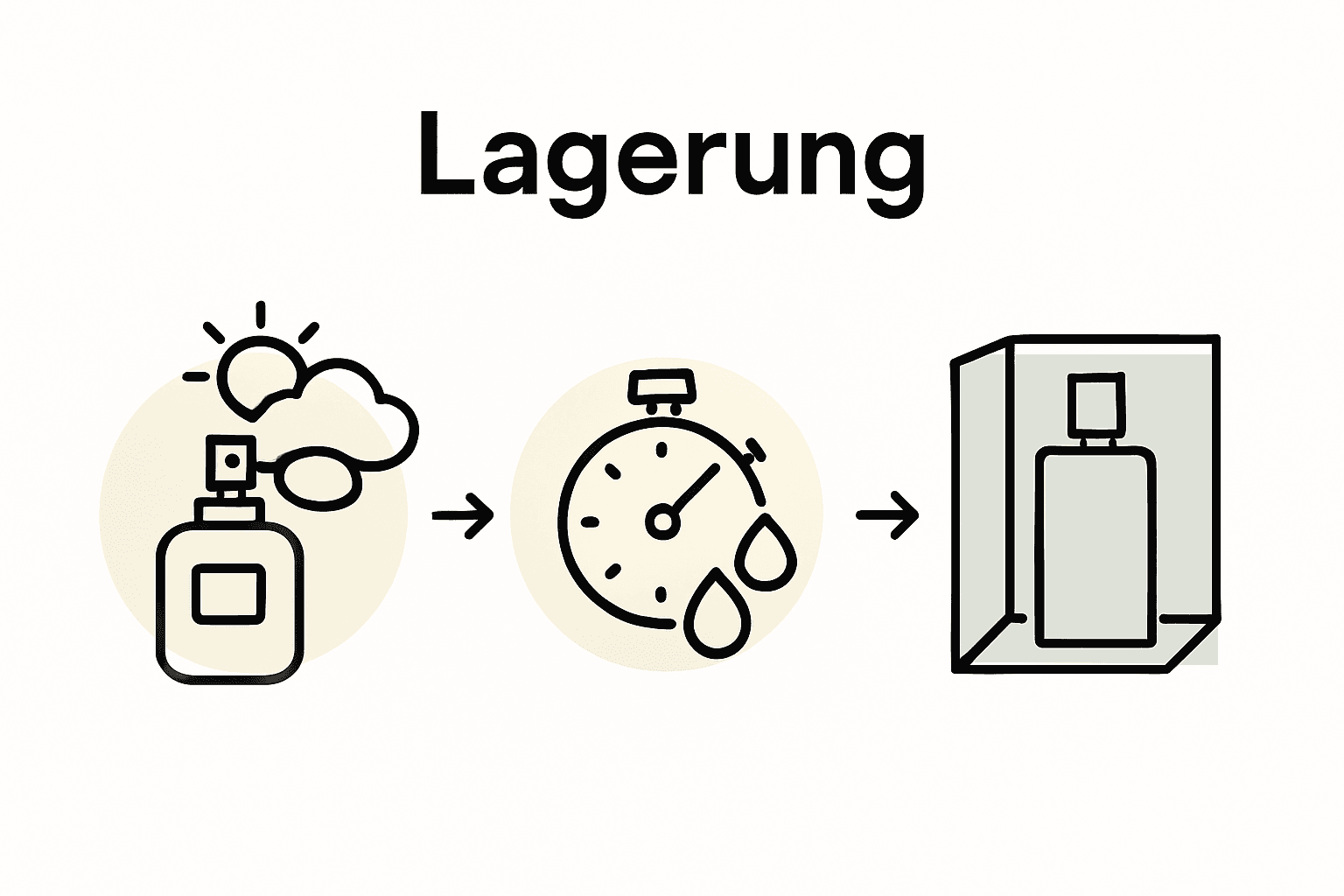
The bottle's quality also plays a decisive role. Dark glass bottles protect the ingredients from light exposure better than transparent ones. Carefully close the bottle after each use to minimize oxidation and evaporation. Avoid constant opening and closing, as this causes unnecessary air contact and thus loss of quality.
Pro-tip for the fragrance-conscious: Keep your fragrances upright in a closed box or a dark cupboard to ensure maximum longevity. Avoid storing in the kitchen, bathroom, or in direct sunlight.
The following overview shows the influence of different factors on fragrance development and longevity:
| Influencing Factor | Effect on Fragrance | Tips for Optimization |
|---|---|---|
| Skin type | Longer longevity with oily skin | Use lotion for dry skin |
| Temperature | Heat intensifies fragrance | Apply perfume to warm body parts |
| Humidity | Fragrance spreads faster in humidity | Spray less on hot days |
| Bottle storage | Incorrect storage accelerates decay | Keep cool and dark |
Discover the perfect long-lasting fragrance for your everyday life
The question "How long does fragrance really last" occupies many fragrance lovers who value quality and longevity. This knowledge is crucial to avoid false expectations and to find the perfect companion for every occasion. At AlexandriaUK, we understand the importance of intense fragrance notes and optimal longevity exactly and offer you an exclusive selection of high-quality fragrances that are carefully tailored to your needs.

Transform your fragrance choice into a sustainable experience with unique perfumes that perfectly showcase both base and top notes. Visit our website and find your new favorite scent at AlexandriaUK that underscores your personality and lasts all day. Don't wait any longer and experience quality that you can feel. Discover our range now and enjoy the art of fragrance at the highest level!
Frequently Asked Questions
How does fragrance concentration influence the longevity of a perfume?
The longevity of a perfume depends heavily on the fragrance concentration. Perfumes with 15-30% fragrance components usually last 6-8 hours, while Eau de Toilette (5-10%) lasts about 3-4 hours and Eau de Cologne (2-4%) only 2-3 hours.
What role does skin type play in fragrance development?
Skin type influences the longevity and intensity of a perfume. Dry skin absorbs scents faster and lets them fade more quickly. Oily skin, on the other hand, stores the fragrance notes longer, so they remain perceptible more intensely and for longer.
How can I extend the wear time of my perfume?
To extend the wear time of your perfume, you can apply it to pulse points such as wrists, the crook of the neck, or the collarbone. Additionally, sealing the fragrance after application with an unscented body lotion helps.
Which environmental factors influence fragrance perception?
Temperature, humidity, and air circulation are decisive factors. In warm, humid environments, fragrances spread faster and more intensely, while they are perceived as more muted in cold, dry regions.