Why some scents project further than others: the science
Most fragrance enthusiasts assume that a higher oil concentration means a scent will project further and command more attention. It is a logical assumption, but it is largely wrong. Projection is shaped by molecular chemistry, skin biology, environmental conditions, and deliberate perfumer decisions, not simply by how much fragrance oil sits in the bottle. Understanding these forces will change how you choose, wear, and evaluate every fragrance you encounter.
Table of Contents
- What does scent projection actually mean?
- The science behind scent projection: molecules at work
- Concentration and projection: myth versus fact
- The wearer’s skin and environment: the hidden variables
- Perfumer craft: balancing projection by design
- Elevate your fragrance experience with expert-crafted scents
- Frequently asked questions
Key Takeaways
| Point | Details |
|---|---|
| Projection vs longevity | Projection describes how far a scent radiates, while longevity is how long it lasts on the skin. |
| Molecular weight matters | Lighter, more volatile molecules drive stronger scent projection than heavier bases. |
| Concentration isn’t everything | More oil does not always mean more projection; balance and diffusion rates are crucial. |
| Skin and climate impact | Your skin type and environment can significantly alter how a scent projects. |
| Perfumers design for balance | Projection is often carefully balanced through blending and the use of fixatives. |
What does scent projection actually mean?
Projection is one of those terms that gets used loosely, even among serious fragrance lovers. At its core, projection refers to how far a scent radiates from the body when you are stationary, driven primarily by the volatility and evaporation rate of its molecules. It is not the same as longevity or sillage, and confusing them leads to poor purchasing decisions.
Here is how the three terms differ:
- Projection: The radius of scent around you while you stand still. Think of it as your personal scent bubble.
- Sillage: The trail a fragrance leaves behind as you move through a space. A scent can have modest projection but a dramatic sillage.
- Longevity: Simply how long a fragrance remains detectable on skin. You can explore perfume longevity as a separate dimension entirely.
Projection is also influenced by volatility, molecular weight, and environmental conditions. A fragrance built from lighter, faster-evaporating molecules will project outward quickly. One built from heavier, slower molecules may cling beautifully to skin for hours but never truly fill a room. If you have ever worn a fragrance that others could not detect until they leaned in close, you have experienced low projection firsthand. For those seeking long-lasting fragrances, it is worth noting that longevity and projection often pull in opposite directions.
Projection is not about strength. It is about how freely a molecule can escape the skin and travel through the air around you.
With our terms clear, we can now look at the actual science behind what makes a scent project.
The science behind scent projection: molecules at work
Every fragrance ingredient is a molecule, and molecules behave according to physics. The key properties that determine projection are molecular weight, volatility, and polarity. Lighter molecules with lower molecular weight evaporate quickly and diffuse outward rapidly. Heavier molecules, such as those found in resins and woods, evaporate slowly and tend to stay close to the skin.
| Ingredient type | Molecular weight | Volatility | Projection behaviour |
|---|---|---|---|
| Citrus (top notes) | Low | High | Strong initial projection |
| Florals (heart notes) | Medium | Medium | Moderate, sustained projection |
| Woods (base notes) | High | Low | Intimate, skin-close presence |
| Resins and ambers | Very high | Very low | Longevity over projection |
This is why a citrus cologne can seem to fill a room within seconds of application, while a rich oud or sandalwood fragrance stays intimate and personal. Light molecules such as citrus evaporate quickly for strong initial projection, while heavier molecules like resins and woods contribute to longevity over projection. The science is precise enough that ML models predict odour strength with a correlation of r=0.87, confirming that molecular properties like lower molecular weight, higher volatility, and balanced polarity enable stronger projection.

Polarity also matters. A molecule’s polarity affects how it interacts with skin and air. Balanced polarity allows a molecule to leave the skin surface more readily, which supports diffusion into the surrounding air. Understanding perfume concentration types is useful here, because concentration affects which molecules dominate the formula.
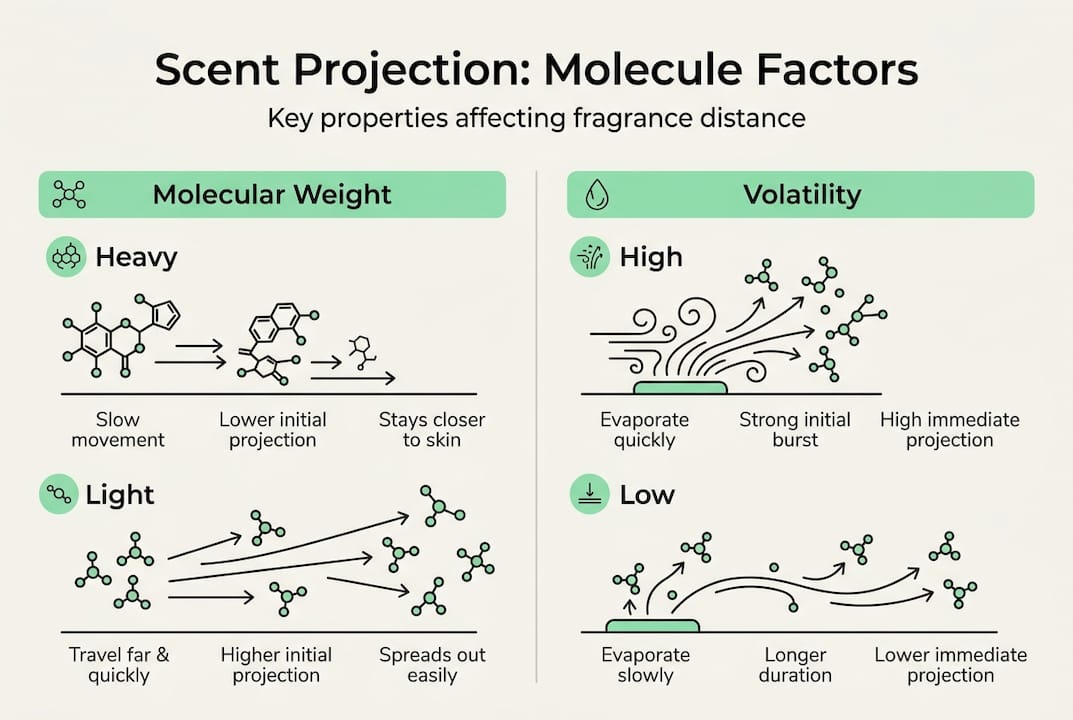
Pro Tip: If you want maximum projection from a fragrance, look for formulas rich in citrus, ozonic, or green top notes. These are the molecular lightweights that travel furthest and fastest.
Now we understand what is happening at the molecular level, let us examine how the concentration of a fragrance comes into play.
Concentration and projection: myth versus fact
The fragrance world is full of myths about concentration, and most of them lead enthusiasts to spend more money than necessary. Here are three of the most common misconceptions, and what is actually true.
- Myth: Extrait de Parfum always projects the most. In reality, higher concentrations like EDP often project better than EDT, but pure Extrait may project less due to slower diffusion. The thick oil slows evaporation, keeping the scent close to skin.
- Myth: Eau de Toilette is too weak to project. Some EDTs, particularly those built on citrus or aromatic notes, project aggressively because their molecules are inherently volatile. Concentration is secondary to molecular composition.
- Myth: More sprays equal more projection. Over-application can actually create an olfactory wall rather than elegant projection. The molecules compete and the scent becomes a dense cloud rather than a radiating presence.
| Concentration type | Oil percentage | Typical projection | Longevity |
|---|---|---|---|
| Eau de Cologne (EDC) | 2 to 4% | High initial, fades fast | 2 to 3 hours |
| Eau de Toilette (EDT) | 5 to 15% | Good projection, moderate | 3 to 5 hours |
| Eau de Parfum (EDP) | 15 to 20% | Strong, balanced | 5 to 8 hours |
| Extrait de Parfum | 20 to 40% | Intimate, skin-close | 8 to 12+ hours |
For a deeper look at how these formats compare, the EDP vs Extrait de Parfum guide is worth reading. Similarly, if you are weighing up lighter options, the Cologne vs Perfume concentration comparison clarifies the practical differences.
Pro Tip: If you love the character of an Extrait but want more projection, try applying it to pulse points and layering a matching EDT on top. The lighter formula projects outward while the Extrait anchors the scent for hours.
But concentration is only part of the story. The scent’s projection can change dramatically depending on who is wearing it and their environment.
The wearer’s skin and environment: the hidden variables
Two people can wear the exact same fragrance and experience completely different levels of projection. This is not a placebo effect. It is biology and physics working together in ways that are genuinely fascinating.
Skin type plays a significant role. Oily skin enhances retention and projection because the natural sebum acts as a carrier, helping fragrance molecules stay active on the surface longer. Dry skin absorbs fragrance quickly, which reduces projection and longevity simultaneously.
Environmental factors are equally powerful:
- Heat: Warmth accelerates evaporation, which boosts projection. A fragrance that seems quiet indoors can become assertive in summer heat.
- Humidity: Moisture in the air helps carry scent molecules further. Humid climates amplify projection noticeably.
- Wind: Moving air disperses projection rapidly, which can make a fragrance seem weaker outdoors on a breezy day.
- Layering products: Applying an unscented moisturiser before fragrance gives molecules something to cling to, extending both projection and longevity.
Sweat can intensify certain fragrances, particularly those with musky or animalic components, because body heat and moisture activate the molecules. However, sweat can also distort lighter, more delicate scents. Learning how to make perfume last longer often starts with understanding your skin type. If you are unsure how a fragrance will perform on your skin specifically, the best ways to test perfume will help you evaluate projection before committing.
Pro Tip: Apply fragrance immediately after a shower, while skin is still slightly warm and pores are open. This is the single most effective way to maximise projection without adding extra sprays.
Finally, let us look at how perfumers create scents and intentionally balance projection.
Perfumer craft: balancing projection by design
A skilled perfumer does not simply blend ingredients that smell appealing together. They engineer a volatility curve, a carefully considered sequence of evaporation rates that controls how a fragrance behaves from the first spray to the final dry-down. Projection is not an accident. It is a decision.
“Too light and the fragrance fades before anyone notices it. Too heavy and it never truly projects. The art is in the balance.”
Perfumer design balances the volatility curve precisely for this reason: fixatives like musks and ambers anchor lighter notes and aid sillage without overwhelming the formula’s ability to project. Here is how the key tools work in practice:
- Fixatives: Ingredients like musks, ambers, and resins slow the evaporation of lighter molecules, extending their presence without killing their diffusion.
- Volatility balancing: Perfumers layer fast-evaporating top notes over slower base notes to create a projection arc that evolves over time.
- Molecule selection: Synthetic molecules like Iso E Super or Ambroxan are chosen specifically for their ability to project at low concentrations, often creating a skin-scent effect that others notice without being able to identify.
- Blending ratios: The proportion of each ingredient determines whether a fragrance opens with a burst of projection or builds gradually.
This is why the same scent can behave differently for everyone. The perfumer sets the parameters, but your skin, environment, and habits determine the result. To understand more about the creative and technical process, the guide on how perfumers create scents is genuinely illuminating. If projection longevity is your priority, exploring fragrances that last longest will help you identify formulas engineered for staying power.
With all these insights in mind, let us summarise the key principles and point toward more ways to explore fragrance knowledge.
Elevate your fragrance experience with expert-crafted scents
Understanding projection changes everything about how you shop for fragrance. You stop chasing the highest concentration and start asking better questions: What molecules dominate this formula? How will this perform on my skin type? Is this built for presence or intimacy? These are the questions that lead to genuinely satisfying fragrance choices.
At Alexandria, we build our inspired fragrances with exactly these principles in mind. Every formula is crafted to deliver balanced projection, whether you prefer a scent that commands a room or one that draws people closer. Our catalogue spans a wide range of projection profiles, from bold, diffusive openers to intimate skin scents with remarkable longevity. If you are ready to experience the difference that thoughtful scent design makes, explore Alexandria fragrances and find your ideal projection match today.
Frequently asked questions
Does a strong fragrance always mean better projection?
No. A high oil concentration can increase longevity but often reduces projection because the dense oil slows evaporation. Extrait de Parfum lasts longer but projects less aggressively than EDP for this reason.
How can I enhance my perfume’s projection?
Apply fragrance to moisturised or naturally oily skin and wear it in warm, humid conditions. Oily skin enhances projection and heat amplifies diffusion, so both factors work in your favour.
Why do citrus or fresh notes seem to fill a room more?
Citrus and fresh notes are built from lighter, more volatile molecules that evaporate and diffuse rapidly. Light molecules evaporate quickly for strong initial projection, which is why they feel so immediate and expansive.
Can two people wearing the same perfume experience different projection?
Absolutely. Differences in skin type, body chemistry, and environment mean a scent can project very differently from person to person. Skin chemistry modulates projection in ways that no two people share identically.
What role do fixatives play in scent projection?
Fixatives like musks and ambers anchor lighter notes and help a fragrance linger, but their primary role is balancing the volatility curve rather than boosting projection directly. Fixatives aid sillage by slowing the evaporation of the notes they support.
Recommended
- Understanding Long-Lasting Perfume Explained: The Secrets Behind Scent
- How perfumers create scents: a behind-the-scenes guide
- Why perfumes tell stories: scent’s narrative power
- Why Some Scents Last Longer: What Every UK Perfume Lover Should Know
- What affects perfume performance: fragrance guide – ThePerfumeSampler