Master Signature Fragrance Selection for Lasting Impressions
Most british fragrance lovers are surprised to learn that personal chemistry can make the same perfume smell completely different from one person to another. This fascinating reality turns the search for a signature scent into a deeply individual journey fueled by both science and intuition. By tapping into expert research and practical testing strategies, you can find a fragrance that suits your personality and lifestyle just as uniquely as your own fingerprint.
Table of Contents
- Step 1: Identify Your Personal Scent Preferences
- Step 2: Explore Fragrance Families And Note Profiles
- Step 3: Compare Quality Dupes And Originals
- Step 4: Test Selections On Your Skin
- Step 5: Confirm Longevity And Versatility
Quick Summary
| Key Insight | Explanation |
|---|---|
| 1. Identify your scent preferences | Explore your olfactory preferences and document which fragrance notes you naturally gravitate towards to find your signature scent. |
| 2. Understand fragrance families | Familiarise yourself with distinct fragrance families and their note profiles to navigate the perfume selection process effectively. |
| 3. Compare quality between dupes and originals | Evaluate the ingredient composition and sensory performance of both original perfumes and their affordable alternatives for informed choices. |
| 4. Test fragrances on your skin | Apply perfume to pulse points and observe how it evolves over time, ensuring it harmonises with your unique body chemistry. |
| 5. Assess longevity and versatility | Track a fragrance’s performance across different settings and activities to determine its suitability for your lifestyle and preferences. |
Step 1: Identify your personal scent preferences
Discovering your signature fragrance requires understanding the intricate relationship between personality, body chemistry, and olfactory preferences. Advanced research demonstrates that fragrance selection involves complex psychological and physiological interactions, suggesting our perfume choices reflect deeper aspects of our individual identity.
Begin by exploring your sensory landscape through methodical self-investigation. Consider the fragrances you currently enjoy and analyse their common characteristics. Are you drawn towards fresh citrus notes, warm woody undertones, or perhaps sweet gourmand accents? Studies reveal individuals naturally select perfumes that complement their unique body odours, indicating an intuitive matching process between personal scent and chosen fragrance.
To refine your approach, experiment systematically. Visit fragrance counters and sample multiple scent families without immediate purchase. Apply small amounts on your skin and observe how each fragrance evolves over several hours. Your body heat and natural chemistry will interact uniquely with different perfume compositions, revealing subtle nuances that cannot be detected through initial sprays. Pay attention to how each scent makes you feel emotionally your reaction matters as much as the technical fragrance profile.
Tip: Keep a fragrance journal documenting your impressions, noting top notes, heart notes, and base notes that resonate most strongly with your personal aesthetic. This methodical approach transforms scent selection from guesswork into a personalised scientific exploration.
Step 2: Explore fragrance families and note profiles
Understanding fragrance families and note profiles is essential for selecting a signature scent that truly resonates with your personality. Comprehensive guides from fragrance experts reveal the intricate world of perfume classification, offering insights into the complex characteristics that define different scent categories.
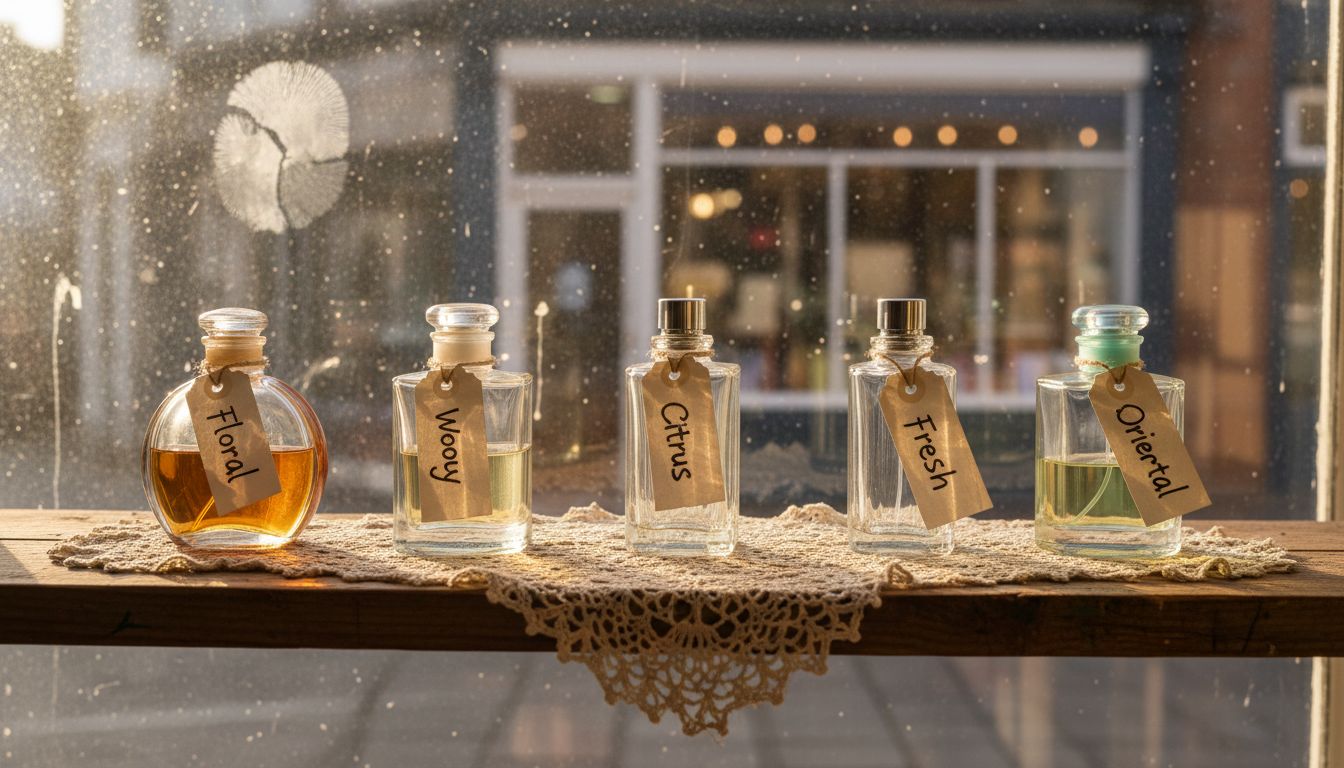
Fragrance families represent distinct aromatic profiles that help you navigate the expansive world of perfumery. Broadly, these include floral, fresh, woody, oriental, and citrus categories. Professional fragrance guides outline the nuanced characteristics of each family, helping you understand how different notes interact and create unique sensory experiences. For instance, floral fragrances typically feature rose, jasmine, and lily notes, while woody scents incorporate cedar, sandalwood, and patchouli.
To explore these families effectively, visit fragrance counters and systematically sample different profiles. Pay attention to how top, heart, and base notes evolve on your skin. Top notes provide the initial impression, heart notes represent the core character, and base notes create lasting resonance. Experiment with sample sets or discovery kits that allow you to experience multiple fragrance families without significant investment.
Tip: Create a personal fragrance map documenting your reactions to different scent families. Note which notes intrigue you, which feel uncomfortable, and how your perception changes over hours of wear. This methodical approach transforms fragrance selection from random sampling to a personalised sensory journey.
Step 3: Compare quality dupes and originals
Navigating the world of fragrances requires a discerning approach to understanding the nuanced differences between original perfumes and their more affordable counterparts. Comprehensive fragrance guides offer insights into evaluating the quality and characteristics of both original and alternative scents, enabling consumers to make informed purchasing decisions.
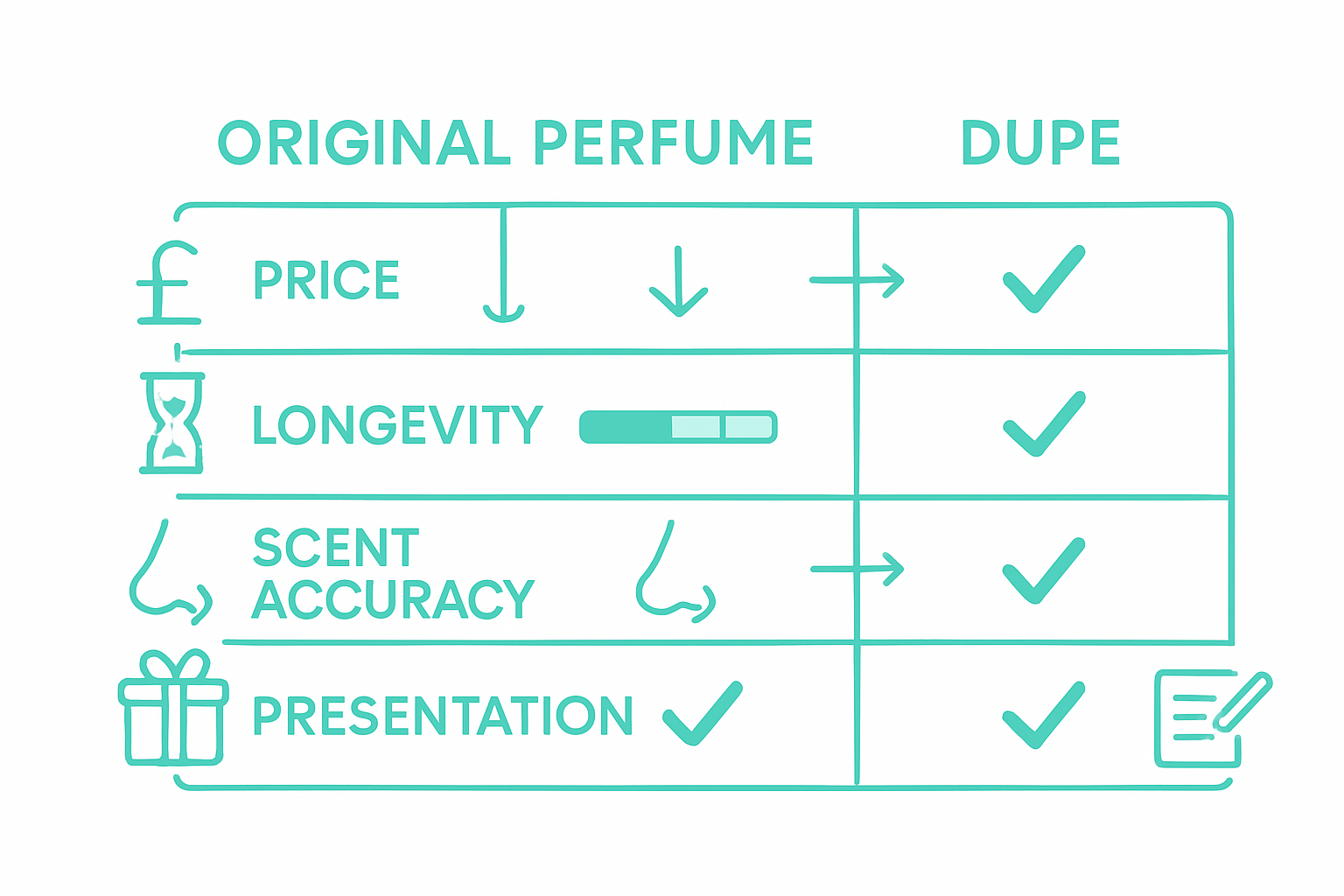
When comparing dupes and originals, focus on several critical elements. First, examine the ingredient composition. Authentic designer fragrances typically use higher concentration of pure essential oils and more complex molecular structures. Dupes often replicate the primary scent profile but may compromise on subtle nuance and longevity. Professional fragrance experts recommend careful sensory evaluation to distinguish between authentic and alternative scents, suggesting methodical testing approaches.
To conduct a thorough comparison, acquire sample sizes of both the original and dupe fragrances. Apply each on separate pulse points and observe their performance over several hours. Note the initial projection, how the scent evolves through its top, heart, and base notes, and the overall wearing experience. Pay particular attention to sillage (scent trail), longevity, and how the fragrance interacts with your unique body chemistry.
Tip: Create a comparison matrix documenting key characteristics such as price, ingredient quality, longevity, and personal sensory response. This systematic approach transforms fragrance selection from subjective preference to an informed, analytical process.
Step 4: Test selections on your skin
Discovering your perfect signature fragrance requires more than casual sampling. Professional fragrance experts emphasise the critical importance of skin testing to understand how a scent truly interacts with your unique body chemistry, revealing nuanced characteristics invisible during initial application.
When testing fragrances, select strategic pulse points that generate natural warmth. These include your inner wrists, neck, and behind the ears. Comprehensive fragrance guides recommend applying small amounts to these areas and allowing the scent to develop naturally, observing how the fragrance transforms over several hours. Your body heat will activate different molecular layers, releasing subtle notes and helping you understand the scent’s true personality.
Avoid testing multiple fragrances simultaneously, which can overwhelm your olfactory senses. Instead, apply one fragrance to each wrist and wait at least four hours to assess its complete evolution. Pay attention to how the scent changes initial sharp top notes gradually transition into deeper heart and base notes. Consider factors like projection, longevity, and emotional response the fragrance evokes.
Tip: Always test fragrances in a neutral environment, avoiding strong competing scents like coffee or food. Wear light, unscented clothing to ensure an authentic sensory experience that allows you to fully appreciate the fragrance’s unique character.
Step 5: Confirm longevity and versatility
Selecting a signature fragrance extends beyond initial appeal to understanding its performance across different environments and timeframes. Fragrance experts emphasise that true versatility depends on complex interactions between scent composition and individual body chemistry, making comprehensive testing essential.
Evaluate a fragrance’s longevity by wearing it through a complete daily cycle. Comprehensive guides recommend assessing how the scent adapts to various lifestyle contexts and environmental conditions, from professional settings to social environments. Track how the fragrance performs during different activities such as working in an office, exercising, or attending evening social events. Note the scent projection at different stages track how long the fragrance remains detectable and how its character transforms.
Consider the concentration of the fragrance as a key indicator of its staying power. Eau de parfum typically offers longer longevity compared to eau de toilette, with higher essential oil concentrations providing more sustained performance. Pay attention to how the fragrance interacts with your skin chemistry observe how quickly the scent fades and whether it maintains its core character throughout the day.
Tip: Create a detailed log documenting the fragrance performance across different scenarios. Note the initial application time, subsequent projection intervals, and how environmental factors like temperature and humidity influence the scent profile. This methodical approach will help you determine whether the fragrance truly meets your versatility requirements.
Unlock Your Perfect Signature Scent with Confidence
Selecting a signature fragrance can feel overwhelming especially when balancing your unique body chemistry with fragrance families and quality dupes as highlighted in the article Master Signature Fragrance Selection for Lasting Impressions. The challenge lies in finding a lasting scent that not only evolves beautifully on your skin but also offers versatility throughout your daily life. With concerns around fragrance longevity, note profiles and authentic ingredient quality it is easy to feel uncertain about which perfume truly matches your personality and lifestyle.
At Alexandria UK we specialise in providing high quality perfumes and expertly curated dupes that meet your individual preferences without compromise. Our collection enables you to explore diverse fragrance families confidently while experiencing fragrances that project and last as promised. Discover how ease and quality combine by shopping our exclusive selections designed for those seeking a truly personal and enduring scent.
Elevate your fragrance journey today.
Explore our exceptional range now and master the art of scent selection with expert guidance and premium options. Start your signature fragrance adventure at Alexandria UK and experience quality that impresses every sense.
Frequently Asked Questions
How do I determine my personal scent preferences for signature fragrance selection?
Understanding your personal scent preferences begins with exploring the fragrances you currently enjoy. Identify common characteristics such as citrus, woody, or gourmand notes, and keep a fragrance journal to document your impressions and reactions.
What are the main fragrance families I should consider when selecting a signature scent?
The main fragrance families include floral, fresh, woody, oriental, and citrus. To explore these families, sample various profiles from each category, noting which scents resonate with you and how they develop on your skin over time.
How can I compare the quality of original perfumes versus their dupes?
To compare original fragrances with their cheaper alternatives, assess the ingredient composition and observe the scent’s performance over time. Test both scents on separate pulse points and make a note of aspects like longevity and how the fragrance evolves over several hours.
Why is skin testing important in the fragrance selection process?
Skin testing is crucial because a fragrance interacts uniquely with your body chemistry, revealing its true character. Apply fragrances to warm pulse points and observe how they develop over a few hours, noting changes in their projection and overall scent profile.
How can I assess the longevity and versatility of a fragrance?
Evaluate a fragrance’s longevity by wearing it through various daily activities and assessing how it performs in different environments. Document your findings regarding its lasting power and adaptability, which will inform your choice based on your lifestyle needs.