

How to sample new fragrances on a budget: a guide
TL;DR:
- Sampling fragrances before purchasing helps prevent costly scent mismatches and disappointment.
- Use proper tools and methods to evaluate notes, performance, and how scents evolve on skin.
- Fragrance dupes offer affordable alternatives, but real-world testing ensures the best match.
Buying a full bottle of perfume without testing it first is one of the most common and costly mistakes a fragrance lover can make. You fall for a beautiful bottle, a glowing review, or a seductive name, only to discover the scent simply does not suit your skin or your lifestyle. The good news is that a smarter, far more rewarding approach exists. Sampling lets you explore the full richness of the fragrance world without the financial sting of a regrettable purchase. This guide walks you through the most effective, budget-conscious strategies for discovering new scents, testing dupes, and building a collection you will genuinely love.
Table of Contents
- What you need to sample new fragrances on a budget
- Step-by-step: How to sample fragrances like an expert
- Sampling fragrance dupes: Maximising variety for less
- Expert troubleshooting: Maximising scent discovery and avoiding pitfalls
- Why real-world sampling is the secret to scent satisfaction (and what most guides miss)
- Explore unique, affordable scents with AlexandriaUK
- Frequently asked questions
Key Takeaways
| Point | Details |
|---|---|
| Focus on small samples | 1–2ml vials give you multiple tests without overspending or cluttering your collection. |
| Test fragrances the right way | Limit sessions to 2–4 scents and let each develop fully on your skin before deciding. |
| Dupes provide affordable variety | Fragrance dupes and alternatives let you enjoy popular scents at a fraction of the price. |
| Real-world context matters | A fragrance always reveals its true character in daily life—don’t rely solely on reviews or hype. |
What you need to sample new fragrances on a budget
Before you begin your sampling journey, it helps to understand exactly what tools and channels are available to you. The world of affordable fragrance sampling has expanded considerably, and today’s options are genuinely impressive in both variety and value.
Sample sizes typically range from 1ml to 8ml, and each serves a distinct purpose. A 1ml vial gives you enough for two or three wears, which is sufficient to assess top and heart notes. A 2ml sample allows you to live with a scent for several days and observe how it performs across different environments. An 8ml decant, meanwhile, offers a longer trial period before you invest in a full bottle. Costs range from approximately £2 for a 1ml vial to £15 for a larger decant, depending on the fragrance house.
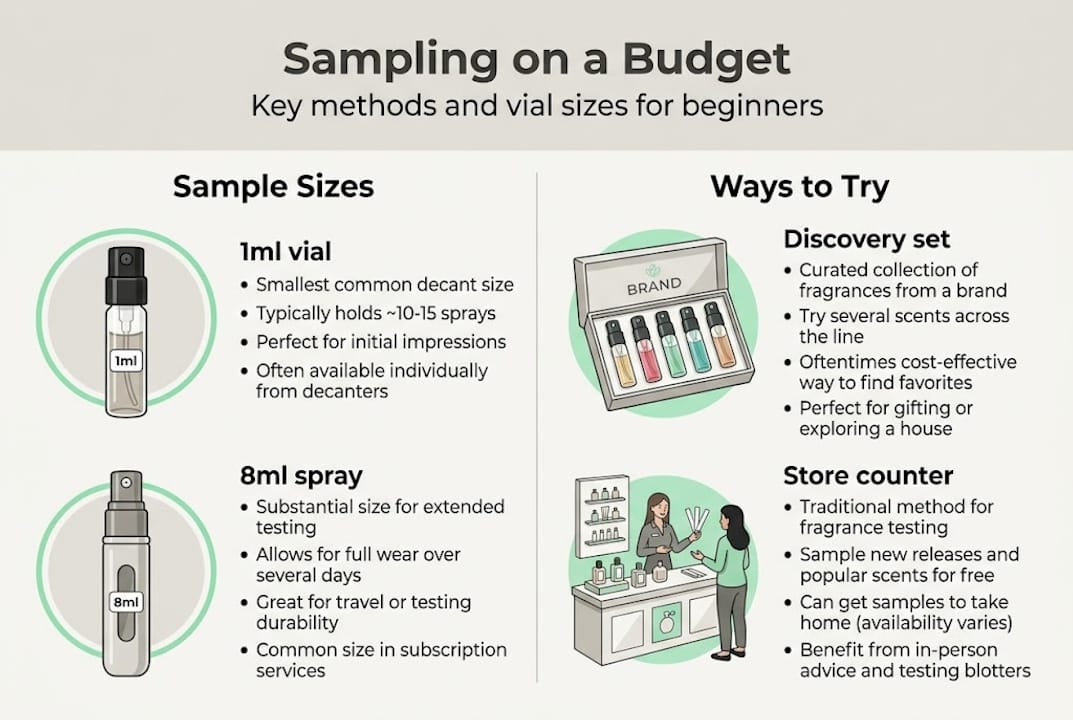
Here is a quick overview of the most popular sampling methods:
| Method | Cost range | Best for |
|---|---|---|
| Subscription boxes | £10–£20/month | Discovering new releases regularly |
| Decant sites | £2–£15 per sample | Targeted sampling of specific scents |
| Discovery sets | £15–£40 per set | Exploring a brand’s full range |
| In-store samples | Free to low cost | Testing before buying locally |
Fragrance subscription box options such as those reviewed by InStyle include services that send curated monthly samples, making them an excellent entry point for those new to structured sampling. Expert perfume sampling goes beyond simply sniffing a strip, and having the right materials to hand makes the process far more informative.
Before you begin, gather the following essentials:
- Blotter strips: Unbleached paper strips for initial scent assessment
- A fragrance notebook: To record impressions, notes, and ratings
- Sample vials: For organising and labelling your decants
- Unscented wipes: To cleanse skin between tests
- A coffee jar or neutral cloth: To reset your olfactory palate
Department store counters remain a surprisingly effective resource. Building a rapport with the fragrance consultant at your local counter can yield complimentary samples, particularly when a new launch is being promoted. It costs nothing to ask politely.
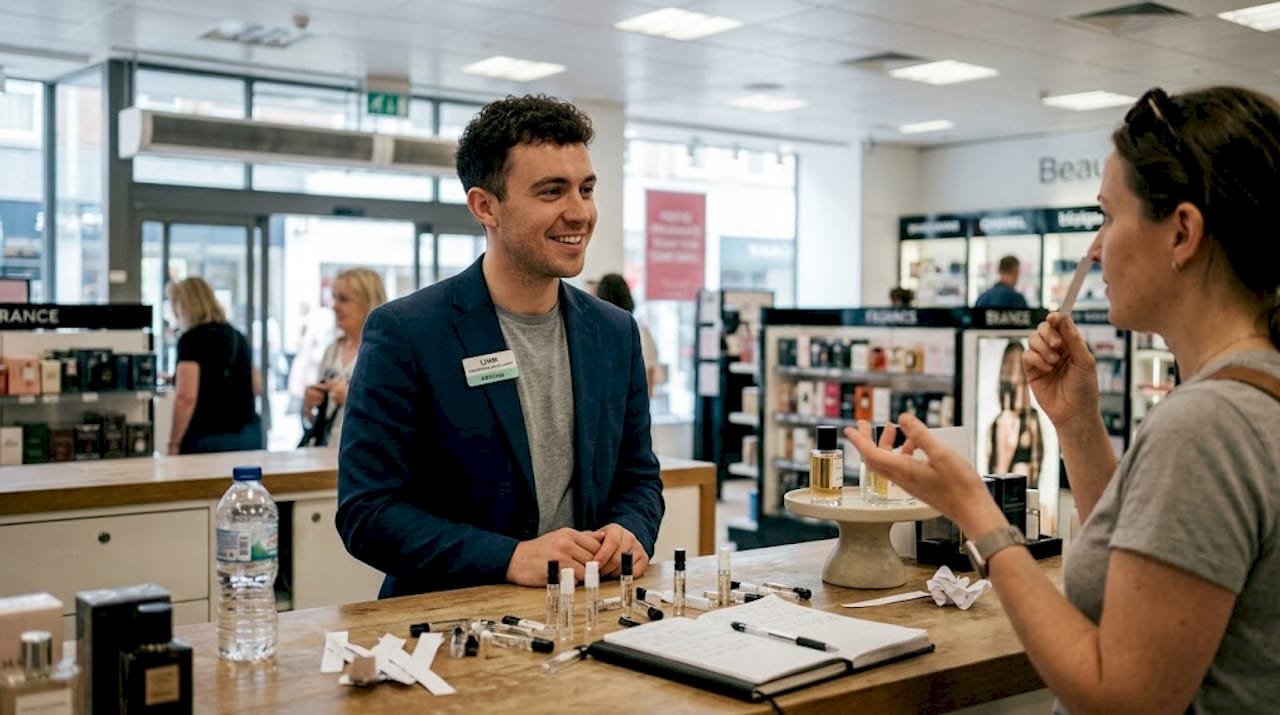
Pro Tip: Prioritise 1–2ml decants and discovery sets to stretch your budget furthest. They offer enough wear time to form a genuine opinion without the financial commitment of a full bottle.
Step-by-step: How to sample fragrances like an expert
With your tools assembled, the next stage is adopting a methodology that mirrors how industry professionals approach scent evaluation. Rushing this process leads to poor decisions. Patience and structure are your greatest allies.
Follow these steps for each sampling session:
- Start with blotters: Spray or dab each fragrance onto a labelled blotter strip. This gives you a safe first impression without committing the scent to your skin.
- Limit your session: Test no more than three or four fragrances per sitting. Sensory overload will cloud your judgement.
- Assess the top notes: Within the first 15 minutes, the top notes, which are the most volatile and fleeting elements of a fragrance, will reveal themselves. These are often citrus, herbal, or light floral accords.
- Move to skin testing: Once a blotter impression appeals to you, apply a small amount to your inner wrist or elbow. Skin chemistry transforms a fragrance in ways paper simply cannot replicate.
- Evaluate heart notes: After one to two hours, the heart of the fragrance, often floral, spicy, or woody accords, will emerge and define the character of the scent.
- Assess the base notes: After four or more hours, the base notes, typically musks, resins, or woods, become the lasting impression. These are what you will smell on your clothes the following morning.
- Record your findings: Note the performance, projection, and your emotional response in your fragrance notebook.
“Olfactory fatigue sets in after four or five scents. Take a break, step outside, and let your nose reset before continuing.”
Proper expert fragrance testing advice recommends limiting sessions to two to four scents to avoid olfactory fatigue and preserve the accuracy of your assessments. Reviewing your perfume storage tips is equally important, as poorly stored samples can skew your impressions before you even begin.
Pro Tip: Morning is the ideal time for scent testing. Your nose is freshest, environmental odours are minimal, and you have the full day ahead to observe how a fragrance evolves on your skin.
Sampling fragrance dupes: Maximising variety for less
Once you have mastered the fundamentals of sampling, the world of fragrance dupes opens up an extraordinary avenue for affordable exploration. A dupe, short for duplicate, is a fragrance crafted to evoke the character and accord profile of a well-known, often expensive original. They are not counterfeit products; they are legitimately produced alternatives that interpret a scent at a more accessible price point.
Understanding fragrance dupe trends reveals how rapidly this segment of the market has grown. Many consumers now prioritise dupes not merely as substitutes but as preferred options in their own right.
Here is how some popular originals compare with their dupe counterparts:
| Original fragrance | Typical price (50ml) | Dupe alternative | Typical price (50ml) |
|---|---|---|---|
| Baccarat Rouge 540 | £280+ | Inspired alternatives | £20–£40 |
| Black Opium (YSL) | £90+ | Inspired alternatives | £15–£30 |
| Sauvage (Dior) | £100+ | Inspired alternatives | £15–£35 |
When testing dupes, apply the same rigorous methodology you would use for any fragrance. Look for similarity in the opening accord, the heart note development, and crucially, the longevity of the base. Some dupes actually outperform their originals in sillage (the scent trail left behind) and longevity, largely because they are formulated with a higher concentration of certain aromatic compounds.
The Reddit r/Perfumes community is a rich resource for fragrance dupe hunting, with thousands of enthusiasts sharing detailed comparisons and recommendations. Sourcing affordable fragrance alternatives from reputable brands ensures quality and consistency.
The best sources for fragrance dupes include:
- Specialist inspired fragrance brands with transparent ingredient sourcing
- Online fragrance communities for peer-reviewed recommendations
- Discovery sets from dupe-focused houses for structured comparison
- Community swap groups where members exchange samples
Pro Tip: When comparing a dupe to its inspiration, test both on the same day, one on each wrist, and evaluate them side by side across the full dry-down cycle for the most accurate assessment.
Expert troubleshooting: Maximising scent discovery and avoiding pitfalls
Even the most methodical sampler encounters obstacles. Knowing how to identify and resolve common issues will save you time, money, and olfactory frustration.
The most fundamental principle in fragrance evaluation is this: skin always wins. Paper blotters are useful for a first impression, but your skin’s unique chemistry, pH level, and natural oils will alter a fragrance in ways that are impossible to predict from a strip alone. A scent that smells cold and sharp on a blotter may bloom into something warm and luminous on your skin. Always make final decisions based on a proper skin trial.
Skin chemistry alters scents significantly, and heat and sunlight degrade sample quality over time. Proper storage is therefore essential. Keep your samples in a cool, dark place, away from direct sunlight and temperature fluctuations. A drawer or a small box in a wardrobe is ideal. Refer to dedicated storing perfume samples guidance for more detailed advice.
Avoid these common pitfalls:
- Over-testing in a single session: Testing more than four fragrances dulls your nose rapidly
- Rubbing the fragrance: This breaks down the molecular structure and accelerates the evaporation of top notes, distorting the dry-down
- Mislabelling samples: Always label vials immediately to avoid confusion during evaluation
- Testing on moisturised skin: Heavy lotions can significantly alter a fragrance’s performance and longevity
- Ignoring environmental context: A fragrance tested in a heavily scented environment, such as a kitchen or a florist, will not reveal its true character
Olfactory fatigue can set in after as few as four or five scents, meaning your nose essentially stops registering new information accurately. Taking a break outdoors, smelling coffee grounds, or simply resting for 20 minutes will reset your palate effectively.
Pro Tip: Spritz a fragrance onto a piece of unscented fabric, such as a cotton scarf, and wear it throughout the day. This reveals how the scent lingers and projects in real-world conditions, which is ultimately what matters most.
Why real-world sampling is the secret to scent satisfaction (and what most guides miss)
Most fragrance guides focus on the mechanics of testing, the blotters, the timing, the note structure. What they rarely address is the deeper truth that a fragrance is not just a smell; it is a lived experience. The scent that earns rave reviews online may feel entirely wrong in the context of your daily life, your work environment, your skin, and your personal aesthetic.
The majority of fragrance mis-buys do not happen because someone chose a bad scent. They happen because someone chose a scent without testing it in their own world. A rich, hedonistic oud may be magnificent in the evening but overwhelming in a professional setting. A luminous, airy floral may feel perfect in spring but disappear entirely in cold weather.
The fragrance academy insights we champion at AlexandriaUK consistently point to one truth: real satisfaction comes from wearing a scent through your actual routines, your commute, your workouts, your evenings out, before committing. Online buzz and popularity rankings cannot account for the intimacy of your own skin chemistry. Trust your lived experience above all else.
Explore unique, affordable scents with AlexandriaUK
Your scent discovery journey deserves a destination as thoughtful and passionate as your approach to sampling. AlexandriaUK offers a curated range of inspired fragrances and quality dupes, crafted with genuine care for composition and longevity.
Whether you are searching for your first sample set or expanding an already discerning collection, the AlexandriaUK collection provides accessible entry points, discovery packs, and a community of fellow fragrance enthusiasts who share your passion. Explore the full range, find your next signature scent, and experience the confidence that comes from knowing exactly what you are buying before you commit.
Frequently asked questions
What is the best size sample to buy first?
1–2ml spray vials are ideal for initial testing, offering enough wear time to assess a fragrance properly before committing to larger decants or full bottles.
How many fragrances should I test at one time?
Limit yourself to two to four scents per session. Exceeding this number leads to olfactory fatigue, which compromises the accuracy of your impressions and makes meaningful comparison impossible.
Do fragrance dupes smell exactly like the originals?
Dupes can approach 70–90% similarity to their inspiration, but individual skin chemistry, ingredient sourcing, and concentration levels mean the experience will always carry subtle differences.
Can I get free samples at shops?
Many department store counters offer complimentary or low-cost samples, particularly when building a relationship with the fragrance consultant or during promotional periods for new launches.
How should I store fragrance samples?
Store all samples in a cool, dark place, sealed tightly to prevent oxidation. Heat and sunlight degrade fragrance compounds rapidly, altering the scent profile and reducing longevity.


