Artisan perfumery: Discover the craft behind unique scents
TL;DR:
- Artisan perfumery emphasizes small-batch production, rare ingredients, and traditional extraction techniques.
- It offers evolving, personalized scents that reflect genuine artistic vision and individual expression.
- Ethical sourcing, sustainability, and transparency are core values driving the renaissance of artisan fragrances.
Not all perfume is born on a factory floor. While supermarket shelves and duty-free counters overflow with recognisable bottles carrying famous names, a distinct and deeply compelling world exists beyond the mainstream: artisan perfumery, where every drop tells a story and no two batches are quite alike. The artisanal perfume market was valued at $2.7 billion in 2024 and is projected to reach $6.1 billion by 2033, growing at a remarkable 9.4% CAGR. That trajectory signals something far more profound than a passing trend. This guide explains what makes artisan perfumery so extraordinary, and why it deserves your full attention.
Table of Contents
- What defines artisan perfumery?
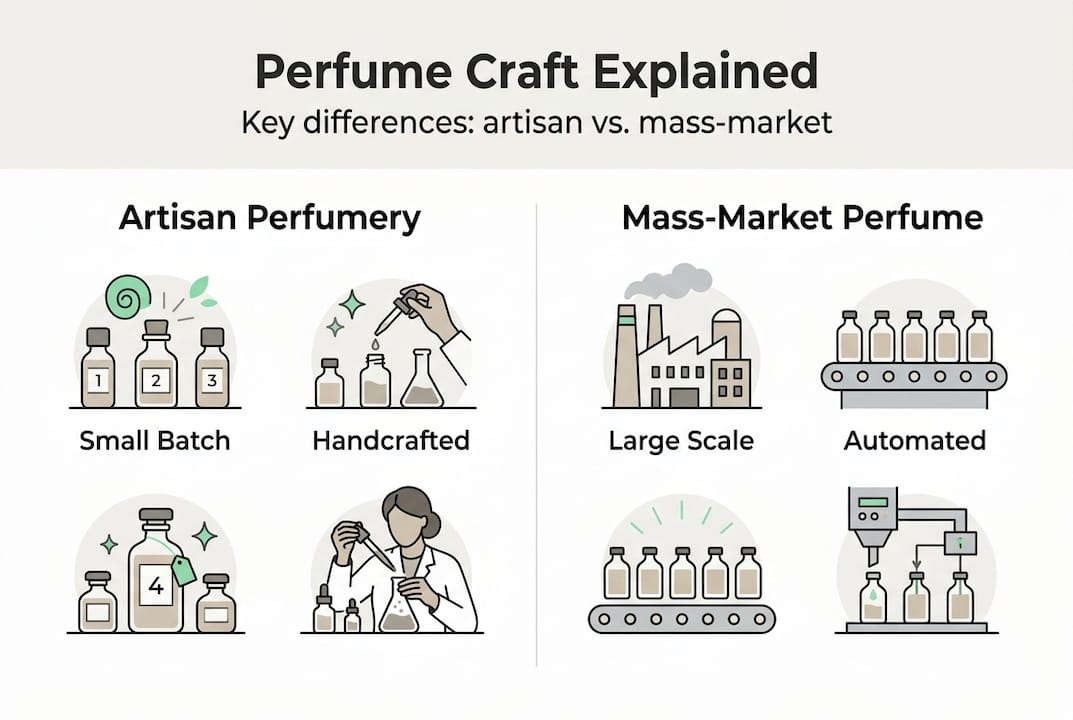
- Comparing artisan and mass-market perfumes
- Personalisation and rarity: The collector’s appeal
- Ethics and sustainability in artisan fragrance creation
- Why artisan perfumery’s resurgence is more than nostalgia
- Explore artisan fragrances with Alexandria UK
- Frequently asked questions
Key Takeaways
| Point | Details |
|---|---|
| Small-batch artistry | Artisan perfumery relies on handcrafted techniques and unique formulations for exclusive fragrances. |
| Collector appeal | Rare, personalised scents foster thriving communities and encourage self-expression. |
| Ethical commitment | Many artisan perfumers emphasise responsible ingredient sourcing and sustainability. |
| Growing market | Artisan fragrances are seeing significant growth due to consumer demand for individuality. |
| Fresh perspective | Artisan perfumery’s resurgence is driven by modern values far beyond nostalgia. |
What defines artisan perfumery?
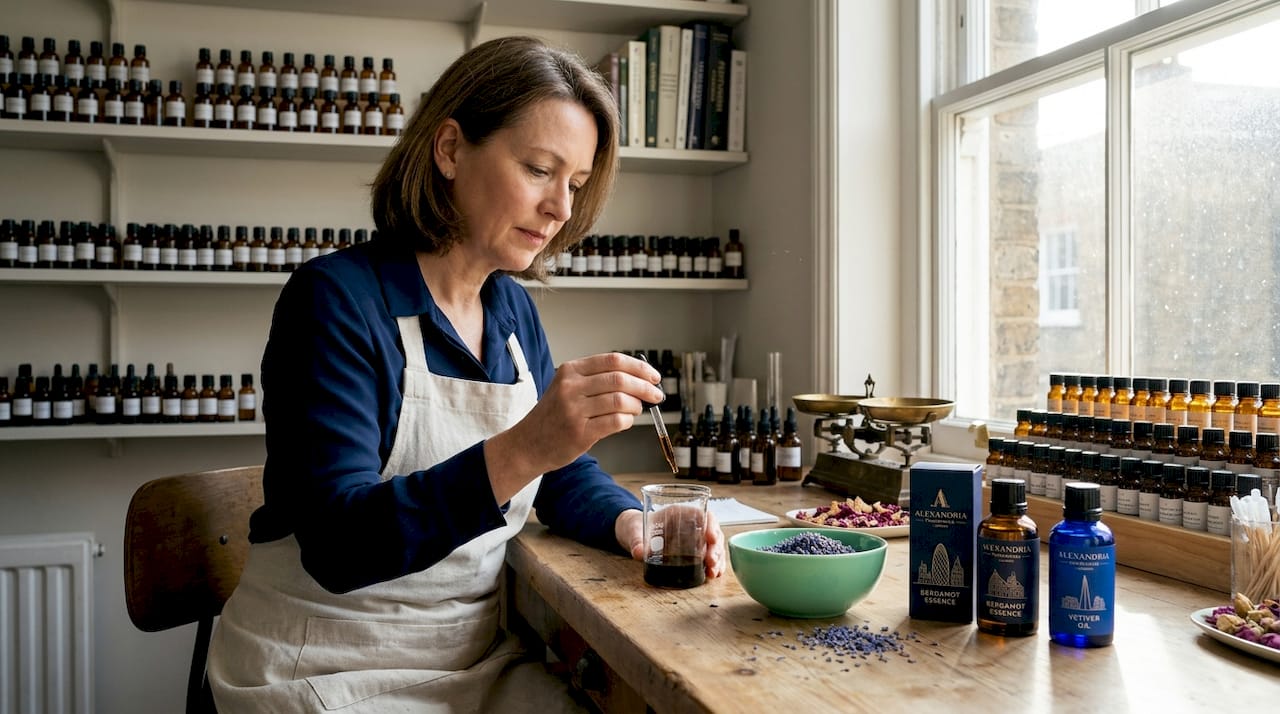
Artisan perfumery is, at its core, a philosophy as much as a practice. It is grounded in the belief that fragrance should be crafted with patience, intention, and an unwavering respect for raw materials. Unlike the industrialised processes behind mainstream launches, artisan perfumers operate at a human scale, often producing limited quantities with hands-on involvement at every stage.
The characteristics that separate artisan perfumery from mass-market production are tangible and meaningful:
- Small-batch production: Volumes are intentionally limited, ensuring greater control over quality and preserving the integrity of each formula.
- Exceptional ingredient selection: Artisan perfumers seek out authentic perfume ingredients, from rare absolutes to sustainably cultivated botanicals, rather than defaulting to cheaper synthetic substitutes.
- Revival of traditional extraction methods: Techniques such as enfleurage, cold maceration, and steam distillation are favoured for their ability to capture the true character of a plant.
- Creative autonomy: Artisan perfumers are not constrained by marketing committees or commercial viability targets. Their work reflects genuine artistic vision.
- Sensory evolution: An artisan fragrance is designed to evolve on skin, rewarding the wearer with shifting accords throughout the day rather than projecting a single, static note.
“Artisan perfumery revives traditional methods like enfleurage for unmatched floral fidelity, appealing to connoisseurs valuing evolution on skin over projection.”
Enfleurage, for example, involves pressing floral material into a layer of odourless fat, which slowly absorbs the bloom’s volatile aromatic compounds over time. This technique, largely abandoned by commercial producers for being too labour-intensive and costly, captures a luminous, living quality in floral notes that no modern solvent extraction can replicate. The resulting absolute is extraordinarily true to nature, a distinction that connoisseurs recognise immediately.
What also defines artisan work is the maker’s willingness to evolve a formula. Many artisan perfumers revisit and refine their blends seasonally, responding to ingredient availability and personal creative growth. This fluidity is entirely alien to mainstream perfumery, where consistency across millions of units is the primary concern. For those making mindful scent choices, artisan perfumery offers a values-driven alternative that simply cannot be replicated at industrial scale.
Comparing artisan and mass-market perfumes
With artisan values clearly defined, it becomes illuminating to place them directly alongside the conventions of mass-market perfumery. The contrast is striking, and it extends far beyond price point.
| Feature | Artisan perfumery | Mass-market perfumery |
|---|---|---|
| Production scale | Small batch, limited edition | Mass production, millions of units |
| Ingredient sourcing | Rare, traceable, seasonal | Standardised synthetics and commodities |
| Creative direction | Independent perfumer vision | Corporate committees and trend forecasting |
| Sensory experience | Evolves on skin, layered complexity | Consistent projection, linear development |
| Exclusivity | High, limited availability | Wide retail distribution |
| Pricing | Premium, reflects true cost | Competitive, often celebrity-driven |
| Environmental consideration | Often sustainable, transparent | Variable, frequently opaque |
The sensory experience on skin is perhaps the most persuasive argument for artisan fragrances. Because natural materials are chemically complex, they interact with individual skin chemistry in ways that synthetics cannot. A rose absolute from Grasse, for instance, carries over 300 naturally occurring aromatic compounds. A synthetic rose accord contains perhaps a handful. The richness of the former is simply incomparable.
This is not to suggest that all synthetic materials are inferior. Skilled artisan perfumers often blend naturals with high-quality synthetics to achieve specific effects, extend longevity, or stabilise a fragile accord. The key distinction lies in intentionality: every component is chosen for a reason, not selected from a lowest-cost approved list. You can explore a detailed fragrance comparison to understand how these values translate in practice.
Market growth tells its own story. The indie perfume segment is projected to grow from $2.96 billion in 2024 to $6.95 billion by 2033, while the niche market moves from $4.2 billion to $8.3 billion across the same period. Consumers are actively choosing depth over ubiquity. This shift also reflects a broader cultural appetite for provenance, for knowing the origin and intention behind what one wears.
Consider, too, the question of exclusivity versus accessibility. A mass-market fragrance might be worn by hundreds of thousands of people simultaneously, its identity diluted by sheer volume. An artisan perfume, produced in runs of a few hundred bottles, becomes something genuinely personal. For those who regard fragrance as a form of self-expression, this distinction carries real weight. A quality and value comparison reveals how artisan-inspired approaches can deliver that depth without always requiring the highest price point.
Personalisation and rarity: The collector’s appeal
Having compared artisan and mainstream perfumery, the next layer to explore is the unique culture of personalisation and rarity that has grown around small-batch fragrance. This world has its own communities, rituals, and languages, and its appeal is only intensifying.
The artisan and indie perfume market shows a clear shift towards personalisation, with small-batch rarity actively fostering collector communities. Limited scalability, far from being a weakness, has become a defining feature that amplifies desire and deepens engagement.

Collector communities gather online and at fragrance events, sharing samples, reviewing limited releases, and celebrating the independent creators behind some of the most original work in contemporary perfumery. These communities are knowledgeable, passionate, and discerning. They know the difference between a singular, raw-material-driven composition and a formula built around market-tested appeal. Discover more about this movement through artisan perfume trends in the UK, where independent perfumery is experiencing a particularly vibrant resurgence.
For collectors, rarity is a genuine value driver. Limited-edition releases from respected artisan houses can command significant prices on secondary markets, not because of branding or celebrity endorsement, but because the quality is undeniable and the supply finite. This is perfumery as object of desire, as wearable art.
How to find your signature artisan scent:
- Begin with samples. Most artisan houses and stockists offer discovery sets or individual sample vials. Never commit to a full bottle without wearing a fragrance for a full day.
- Identify your accord preferences. Learn whether you gravitate towards orientals, florals, chypres, fougères, or gourmands. Understanding your preferences narrows the field dramatically.
- Research the perfumer’s philosophy. The story behind a fragrance often reveals whether it will resonate with your values and aesthetic sensibility.
- Test on skin, not paper. Blotters reveal top notes only. Skin allows a fragrance to breathe, develop, and reveal its true character through all three layers of dry-down.
- Give it time. An artisan fragrance often requires several hours, even multiple wearings, to fully reveal its complexity. Patience is rewarded handsomely.
- Engage with community reviews. Fragrance forums and collector groups offer candid, detailed assessments that no marketing copy can match.
Pro Tip: When exploring artisan fragrances, request samples in unboxed, unlabelled vials and assess them blind. Removing visual and brand cues allows you to respond purely to the scent itself, which is the only honest way to discover whether a fragrance truly speaks to you.
The personal expression benefits of wearing an artisan scent extend beyond aesthetics. Fragrance carries memory, mood, and identity in a way that few other personal choices do. Understanding fragrance as a personal statement helps explain why so many collectors treat their artisan acquisitions with the same reverence they give to fine jewellery or bespoke tailoring.
Ethics and sustainability in artisan fragrance creation
As rarity and personalisation shape the collector’s world, ethical and sustainable practice represents the next vital dimension of artisan perfumery. For fragrance enthusiasts who care about the origins of their ingredients, artisan producers generally offer a far more transparent and conscientious approach than their mainstream counterparts.
Ethical ingredient sourcing within artisan perfumery encompasses several interconnected concerns:
- Biodiversity protection: Many artisan perfumers avoid ingredients derived from endangered species or over-harvested botanicals, such as rosewood, wild agarwood, or certain musks.
- Fair trade and provenance: Direct relationships with growers in regions like Grasse, Madagascar, or Oman ensure fair compensation and sustainable agricultural practices.
- Cruelty-free formulation: Artisan houses are more likely to avoid animal-derived ingredients, offering plant-based and synthetic alternatives that meet ethical standards without compromising quality.
- Minimal waste and responsible packaging: Small-scale production enables more thoughtful choices around packaging, using recycled materials, refillable bottles, and reduced plastics.
- Transparency in formulation: Many artisan perfumers publish full ingredient lists, an openness that corporate brands rarely extend, allowing consumers to make genuinely informed decisions.
The enfleurage revival represents a compelling intersection of sustainability and quality. Because this technique requires no solvents or heat, it produces an extraction of exceptional purity without petrochemical involvement. For connoisseurs who prioritise both sensory excellence and environmental responsibility, enfleurage-derived ingredients carry a particularly meaningful appeal.
However, it would be dishonest to suggest that artisan perfumery is without ethical complexity. Natural ingredient sourcing at any scale carries environmental impact. Certain precious naturals, including sandalwood, iris root, and jasmine sambac, require significant land and water resources to cultivate. The challenge for conscientious perfumers and consumers alike is to support producers who manage these demands responsibly.
Pro Tip: When researching an artisan brand’s ethical credentials, look beyond marketing language. Ask whether they hold certifications from bodies such as the Soil Association or Fairtrade, and whether they can trace their primary materials to named suppliers or growing regions.
Understanding ethical scent duplication is also relevant here. The inspired-by perfumery sector, when conducted with integrity, offers a way to access exceptional quality at accessible prices while remaining transparent about creative inspiration. Explore how Alexandria UK’s ethical perfume revolution approaches this challenge, and read further on the broader perfume dupes dilemma to understand how quality and ethics can coexist.
Why artisan perfumery’s resurgence is more than nostalgia
There is a temptation to frame the revival of artisan perfumery as a romantic retreat from modernity, a longing for simpler times when perfumers worked by candlelight and measured ingredients by hand. That reading is both partial and insufficient.
The real engine behind artisan perfumery’s growth is not nostalgia. It is the distinctly contemporary need for genuine personalisation in an era of algorithmic homogeneity. When streaming services, social feeds, and recommendation engines conspire to deliver everyone a slightly different version of the same content, wearing an artisan fragrance that perhaps only a few hundred people in the world own becomes a meaningful act of individual expression.
Artisan perfumery also satisfies a growing hunger for sensory storytelling. In a world of screens and digital interactions, the desire to engage the olfactory sense fully and deliberately has intensified. A well-crafted artisan scent is a narrative worn on skin. The luminous green spark of its opening, the warm, resinous heart that follows, and the lingering, intimate base are chapters in a story that unfolds over hours. No algorithm can write that.
The collectors, connoisseurs, and creative professionals driving market growth are not simply rejecting mainstream culture. They are actively constructing an alternative value system in which provenance, craftsmanship, and authenticity carry weight. Fragrance, for these individuals, is as much a personal statement as a wardrobe choice or an artistic preference.
What is particularly encouraging is that this movement is raising standards across the industry. Mainstream brands are increasingly launching niche sub-lines, investing in natural materials, and publishing more transparent ingredient disclosures. Artisan perfumery, far from being a niche curiosity, is actively reshaping the expectations of a global market. That is not nostalgia. That is cultural leadership.
Explore artisan fragrances with Alexandria UK
Artisan perfumery rewards those willing to look beyond the obvious, to seek out the extraordinary in a crowded market and invest in scents that truly reflect who they are. If this guide has sparked curiosity or deepened an existing passion, the next step is exploration.
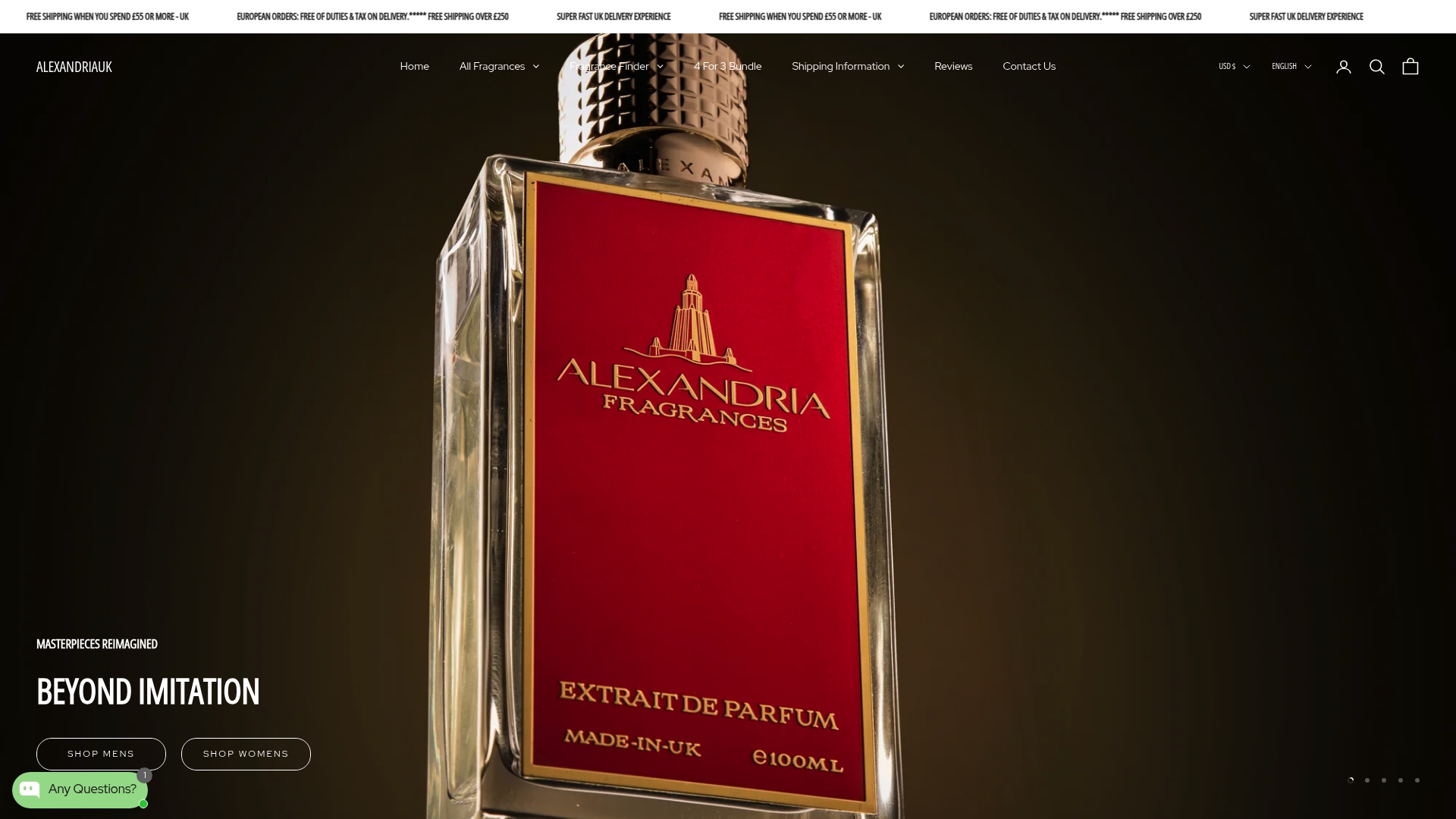
Alexandria UK curates an exceptional collection of inspired-by and artisan-quality fragrances, created with a genuine commitment to quality, transparency, and sensory excellence. Whether you are searching for your first artisan discovery or adding a considered choice to an established collection, Alexandria UK offers a beautifully curated range that balances craftsmanship with accessibility. Explore the full collection at alexandriauk.com and take the first step in your personal scent journey, guided by expertise and a shared passion for extraordinary fragrance.
Frequently asked questions
What makes artisan perfumery different from mainstream brands?
Artisan perfumes are crafted in small batches using carefully selected, often rare ingredients, prioritising individuality, tradition, and genuine craft over mass production. Techniques such as enfleurage produce results that mainstream production cannot replicate.
Why is artisan perfume often more expensive?
Higher costs reflect small-scale production, rare natural ingredients, and time-intensive techniques that cannot be automated. The growing market confirms consumers recognise and accept this premium as an honest reflection of value.
Can artisan perfumes be sustainable and ethical?
Many artisan perfumers prioritise ethical sourcing, sustainable agricultural relationships, and transparent formulation. However, responsible methods vary between producers, so research and certification verification remain essential when choosing a brand.
How do I select an artisan perfume for myself?
Begin with sample discovery sets, test fragrances on skin rather than paper, and allow each scent several hours to fully develop before forming an opinion. Engaging with fragrance communities and understanding your preferred accords will accelerate and refine your search considerably.