Wearable art perfumes: scent, identity, and expression
TL;DR:
- Wearable art perfumes are artistic scents that express identity and emotion beyond mainstream appeal.
- They often operate at an intimate level, responding uniquely to individual skin chemistry.
- Layering and understanding creative intent enhance personal uniqueness and emotional connection.
Wearable art perfumes: scent, identity, and expression
Perfume is rarely just perfume. At its most elevated, it becomes an invisible signature, a personal manifesto worn on the skin rather than displayed on a wall. Yet for many fragrance enthusiasts, the concept of wearable art perfumes remains elusive, caught somewhere between the world of fine art and the beauty counter. This guide cuts through that ambiguity. Here, we explore what truly defines wearable art perfumes, the philosophies that shape them, how they differ from conventional scents, and how collectors can use layering and skin chemistry to craft something genuinely one of a kind.
Table of Contents
- What are wearable art perfumes?
- Artistic philosophies and creative methods
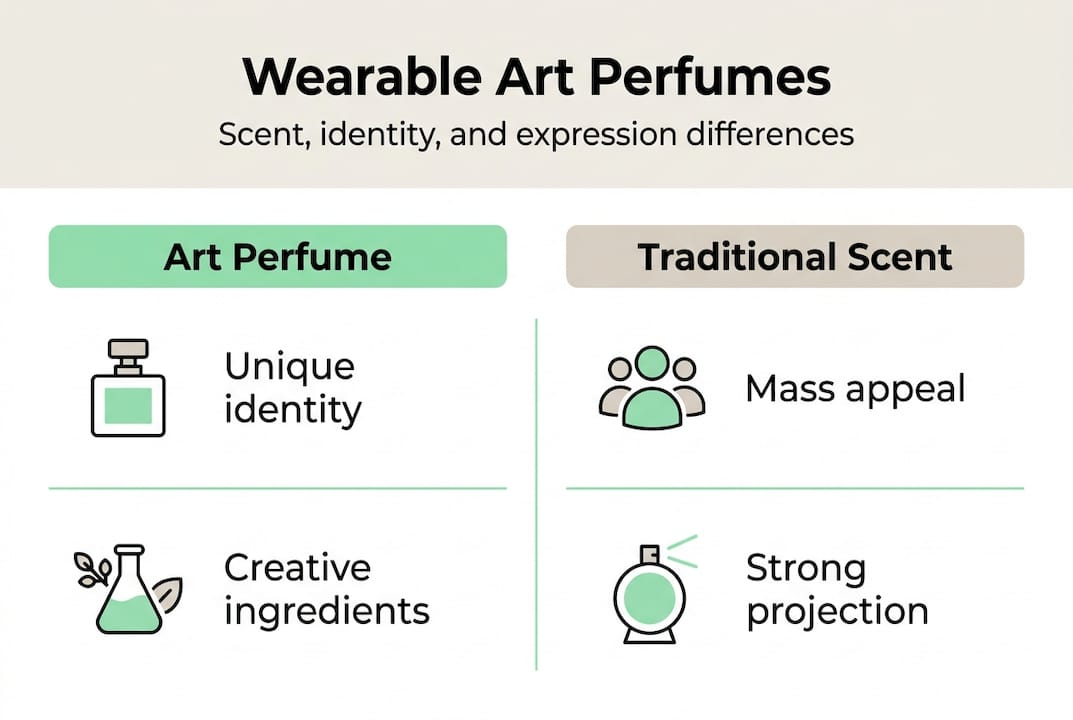
- How wearable art perfumes differ from traditional scents
- Layering, bespoke uniqueness, and the collector’s approach
- The overlooked power of art perfumes: more than meets the nose
- Explore wearable art perfumes and your next masterpiece
- Frequently asked questions
Key Takeaways
| Point | Details |
|---|---|
| Wearable art perfumes defined | Wearable art perfumes are crafted as an artistic extension, transforming scent into an invisible artwork. |
| Creative philosophy matters | Avant-garde perfumers and artist collaborations drive innovation and emotional depth in fragrance. |
| Layering creates uniqueness | Collectors achieve bespoke scents through careful layering and attention to skin chemistry. |
| Balance of art and wearability | A successful wearable art perfume is both conceptually strong and enjoyable for daily use. |
What are wearable art perfumes?
To understand wearable art perfumes, one must first accept a radical premise: scent is a legitimate art form. Not an accessory. Not a finishing touch. An art form, as meaningful and intentional as a canvas soaked in pigment or a sculpture carved from marble. Wearable art perfumes refer to niche and artistic fragrances conceptualised as wearable artworks, where scent serves as an invisible extension of personal expression, emotion, and identity, akin to wearing a painting or sculpture on the skin.
This distinction matters enormously. A mainstream department store fragrance is designed to appeal to the widest possible audience, prioritising commercial palatability over artistic risk. A wearable art perfume, by contrast, is conceived with a specific creative intention. It may reference a painting, an emotion, a memory, or even an abstract philosophical idea. The goal is not mass approval but genuine resonance.
Think of fragrance as self-expression in its most refined form. Just as a painter selects pigments that communicate a specific emotional truth, a niche perfumer selects raw materials, accords, and structural techniques to evoke something deeply personal and precise.
Wearable art perfumes share several defining qualities:
- Intentional artistic narrative: Each fragrance tells a deliberate story or embodies a concept beyond simply smelling pleasant.
- Niche or artisanal origin: These scents typically emerge from independent or niche houses, where creative freedom supersedes commercial pressure.
- Emotional and sensory depth: Complexity is prized; the fragrance reveals itself in layers over time, much like studying a painting in different lights.
- Limited production: Many wearable art perfumes are produced in small batches, enhancing their collectible, exclusive character.
- Identity alignment: They invite the wearer to project a specific facet of their identity, making the scent genuinely personal rather than generic.
“Scent is the only sense with direct access to the limbic system, bypassing rational thought entirely. A wearable art perfume does not ask you to think. It asks you to feel.”
Unlike power perfumes of the 1980s, defined by their thunderous sillage and insistence on being noticed across rooms, wearable art perfumes often operate at a more intimate register. They reward closeness. They are discovered rather than announced. This intimacy is central to their artistic appeal and is what separates them so sharply from mainstream fragrance culture.
Artistic philosophies and creative methods
With the concept defined, let us examine how artistic philosophies shape the creation of wearable art perfumes. The creative process behind these fragrances is as varied and layered as the scents themselves, drawing on everything from conceptual art theory to collaboration with visual artists, sculptors, and gallery curators.
Avant-garde perfumers like Aistis Mickevicius of FUMparFUM turn gallery objects into wearable art via conceptual scents. Some prioritise a “middle register” wearability over extreme projection, contrasting sharply with deliberately non-wearable provocative scents such as Etat Libre d’Orange’s Sécrétions Magnifiques. Understanding this spectrum is essential for any enthusiast navigating the wearable art category.
Several distinct creative philosophies define how artistic fragrance creation works at the highest level:
| Approach | Description | Example |
|---|---|---|
| Gallery-to-skin | Scents inspired directly by artworks or gallery installations | FUMparFUM, Chronotope |
| Artist collaboration | Perfumers partner with visual artists or sculptors | Jillian Switzerland, Guerlain L’Art & La Matière |
| Conceptual narrative | Fragrance built around a philosophical idea or story | Etat Libre d’Orange |
| Material exploration | Focus on rare or unusual raw materials as the artistic medium | Various niche independents |
Guerlain’s L’Art & La Matière collection is a compelling example of the collaboration model. Each fragrance in this line is conceived as a dialogue between a master perfumer and a precious raw material, with the artistic intent communicated through both the scent structure and the visual presentation of the bottle and packaging. The result is a holistic artwork, not merely a liquid in glass.
Jillian Switzerland takes a distinctly feminist art perspective, creating fragrances inspired by female artists such as Ana Mendieta and Hannah Wilke. These scents are not simply named after artists for marketing purposes; the actual structural choices within the fragrance reflect the emotional and political content of the artist’s work. This is conceptual perfumery at its most rigorous.
“The best wearable art perfumes do not explain themselves. Like the finest contemporary art, they create a space for individual interpretation, allowing the wearer to bring their own experience to the encounter.”
The notion of “middle register” wearability is particularly interesting. Some avant-garde perfumers deliberately engineer their fragrances to operate at a level that is intimate and personal, projecting softly so that only those in close proximity experience the full artistic statement. This stands in deliberate contrast to the bombastic projection of 1980s power perfumes, which prioritised being noticed across an entire room.
The creative methods extend to ingredient selection as well. Art perfumers often use unusual or challenging materials, ingredients that might be considered difficult or unexpected in commercial perfumery, precisely because those materials serve the artistic intention. An accord built around petrichor, burning wood, or metallic notes might challenge the wearer’s expectations, but that challenge is itself the artistic act.

How wearable art perfumes differ from traditional scents
Understanding the creative intent leads naturally to a deeper question: what truly sets wearable art perfumes apart from conventional fragrances? The differences are substantial, extending well beyond ingredient lists or price points.
Traditional power perfumery, as established in the 1980s, valued enormous sillage and the ability to announce one’s presence well before entering a room. Modern artistic perfumery often prioritises what some call the “embrace radius”, a scent perceptible only to those in intimate proximity. This is not a lesser ambition but a different one entirely.
Consider personal scent chemistry and how it interacts with projection. A traditional power fragrance is engineered to smell largely the same on every skin, maintaining consistent projection and sillage through heavy synthetic fixatives and musks. A wearable art perfume, by contrast, is often designed with sufficient complexity that it responds to individual skin chemistry, creating a genuinely different experience on different wearers.
Key contrasts at a glance:
- Commercial fragrance prioritises mass appeal, consistent performance, and broad demographic reach.
- Wearable art perfume prioritises artistic integrity, emotional resonance, and individual expression.
- Traditional formulations rely heavily on proven accords and safe ingredient choices.
- Art perfumery embraces unusual, challenging, or even deliberately difficult ingredients as artistic tools.
- Mainstream marketing sells aspiration through celebrity and lifestyle association.
- Niche art perfumery sells concept, story, and intellectual engagement.
The philosophical differences run even deeper. Perfume as a bio-hacking tool, the idea that scent can deliberately alter one’s emotional state, mood, or perceived identity, is a concept embraced wholeheartedly by many wearable art perfumers. Rather than simply making the wearer smell attractive, these fragrances aim to transform how the wearer feels and how others subconsciously perceive them.
Pro Tip: If you are exploring wearable art perfumes for the first time, seek out fragrances that have a stated artistic inspiration or collaboration behind them. Reading about the concept before smelling the fragrance enriches the olfactory experience enormously.
Emotion is the true currency of wearable art perfumes. Where a commercial fragrance might aim to evoke clean freshness or seductive warmth in broadly understood terms, an art perfume might target something far more specific: the particular nostalgia of childhood summers, the unsettling beauty of an abandoned building, or the tender melancholy of a love letter never sent. These precise emotional targets are what make wearable art perfumes genuinely extraordinary to collect and wear.
Layering, bespoke uniqueness, and the collector’s approach
For collectors and enthusiasts, understanding uniqueness and quality is central, so let us explore practical ways to curate wearable art scents for a truly personal wardrobe.
The foundation of any serious collection is sourcing from reputable niche houses. Established niche houses are essential for quality; layering and skin chemistry create bespoke uniqueness, with experts noting direct limbic access for emotional impact that surpasses even visual art in its immediacy. This direct neurological access is what gives great perfumery its extraordinary power over memory and mood.
Building a collector’s approach to wearable art perfumes involves several deliberate steps:
- Research artistic intent first. Before acquiring a new fragrance, read about the creative philosophy behind it. Understanding the intended narrative makes the wearing experience richer and more meaningful.
- Source from respected niche and independent houses. Quality of raw materials is paramount. Art perfumery demands exceptional ingredients to execute its vision properly.
- Experiment with skin chemistry. Test fragrances on your own skin over several hours before committing. A fragrance that opens brilliantly in a spray bottle may evolve in unexpected directions on your specific skin.
- Practise deliberate layering. Applying complementary wearable art fragrances in sequence creates an entirely new olfactory composition unique to you. This is where the magic of true personalisation occurs.
- Keep a fragrance journal. Record your impressions, the emotions each scent evokes, and how different combinations interact. Over time, this journal becomes an invaluable guide to your own sensory preferences.
Layering is perhaps the most exciting dimension of the collector’s practice. To master scent layering effectively, one must understand the concept of fragrance families and how different accords interact. A resinous oriental base can anchor an airy green floral in extraordinary ways, creating depth and longevity that neither fragrance achieves independently.
Exploring the art of layering dupe perfumes adds another dimension entirely. High-quality inspired fragrances, thoughtfully layered with niche art perfumes, can produce results that are both artistically valid and genuinely unique. This approach makes wearable art accessible without compromising on the depth or intentionality that defines the category.
Pro Tip: When layering wearable art perfumes, apply the heavier, more resinous fragrance first as a base, then layer the lighter, more volatile accord on top. This technique ensures the complex top notes of your secondary fragrance shine without being overwhelmed.
Skin chemistry’s role cannot be overstated. The same fragrance can read as warm and animalic on one skin, cool and powdery on another. This variability is not a flaw; it is precisely what makes wearable art perfumery so deeply personal. The skin becomes part of the artistic medium, co-creating the final composition alongside the perfumer’s vision.
The overlooked power of art perfumes: more than meets the nose
Conventional perfume wisdom tends to evaluate fragrance on a narrow set of criteria: projection, longevity, and seasonal suitability. These are useful metrics for commercial fragrances, but they fundamentally miss the point of wearable art perfumes. Applying them to an art fragrance is rather like reviewing a painting purely on the quality of its frame.
Wearable art perfumes reward a different kind of engagement. They ask the wearer to be present, attentive, and emotionally open. The fragrance may shift dramatically over hours, offering a narrative arc from opening to drydown that mirrors the experience of moving through a gallery exhibition. This temporal dimension is unique to perfumery among all art forms; no other medium changes with the viewer’s own body chemistry in real time.
For true connoisseurs, personal fragrance as art represents one of the most intimate forms of self-expression available. Unlike a painting that hangs on a wall for all to see, a wearable art perfume is experienced only by those close enough to enter your world. It is selective, private, and extraordinarily powerful as a result.
The transformative effect on identity is real. Wearing a fragrance with a specific artistic narrative changes how you carry yourself through the day. It is a subtle but genuine shift in psychological orientation, one that collectors and enthusiasts describe repeatedly as deeply meaningful.
Explore wearable art perfumes and your next masterpiece
The world of wearable art perfumes is rich, layered, and endlessly rewarding for those willing to engage with it seriously. Whether you are drawn to gallery-inspired conceptual scents, artist collaboration fragrances, or the intimate artistry of skin-close accords, the journey from curious enthusiast to confident collector is one of the most pleasurable in the fragrance world.
Alexandria UK offers a curated selection of quality fragrances, including inspired alternatives to some of the most celebrated niche and designer scents, giving collectors at every level access to exceptional olfactory artistry. Developing your own signature through our unique fragrance layering guide is an ideal place to begin. Our resources are designed to help you understand, explore, and ultimately wear fragrance as the art form it truly is.
Frequently asked questions
How are wearable art perfumes created?
They are developed by niche perfumers who use artistic inspiration, creative ingredient combinations, and collaborative partnerships with visual artists to design scents as genuine wearable artworks. Brands like FUMparFUM, Chronotope, Guerlain’s L’Art & La Matière, and Jillian Switzerland exemplify this approach, creating fragrances inspired by artists such as Ana Mendieta and Hannah Wilke.
What makes art perfumes ‘wearable’?
Wearable art perfumes strike a careful balance between artistic concept and practical everyday use, ensuring the scent remains both accessible and expressive. Avant-garde perfumers often prioritise a middle register projection that suits daily wear, distinguishing them from deliberately unwearable provocative experiments.
Does skin chemistry affect the scent of wearable art perfumes?
Yes, significantly. The science of personal scent explains how individual skin chemistry shapes the way any fragrance develops, making wearable art perfumes a particularly intimate and personal experience for every collector.
Can wearable art perfumes be layered for bespoke effects?
Absolutely. Layering is one of the most powerful tools in the collector’s repertoire. Bespoke uniqueness through layering and skin chemistry allows enthusiasts to create a genuinely original scent profile, extending the artistry of each individual fragrance into something entirely new.