Artikel: Fragrance scent categories: the connoisseur's guide

Fragrance scent categories: the connoisseur's guide
TL;DR:
- Fragrance categories are fluid and layered, with nuanced subcategories that influence scent development and perception. Understanding the fragrance wheel, pyramid, and specialty types enhances accurate dupe selection and appreciation of perfumes. Recognizing transitions between categories allows for more sophisticated scent exploration and informed purchasing decisions.
Most fragrance enthusiasts can name their favourite perfume without hesitation, yet when asked to describe its fragrance scent categories, they pause. That hesitation is telling. The common assumption is that scent families are simple labels — “floral,” “woody,” done — when in reality, they represent a fluid, layered language that evolves minute by minute on your skin. Misreading these categories is precisely why so many dupe purchases disappoint. This guide cuts through that confusion, walking you through the four core scent families, the fragrance pyramid, and the nuanced specialty categories that truly govern how a perfume behaves, develops, and matches.
Table of Contents
- The four core fragrance scent categories and their character
- The fragrance pyramid: understanding top, heart, and base notes
- Beyond the basics: specialty scent categories and nuances
- Applying scent categories for selecting quality scents and dupes
- Reframing fragrance categories: insights from a connoisseur
- Explore premium fragrance selections and expert resources at Alexandria UK
- Frequently asked questions
The four core fragrance scent categories and their character
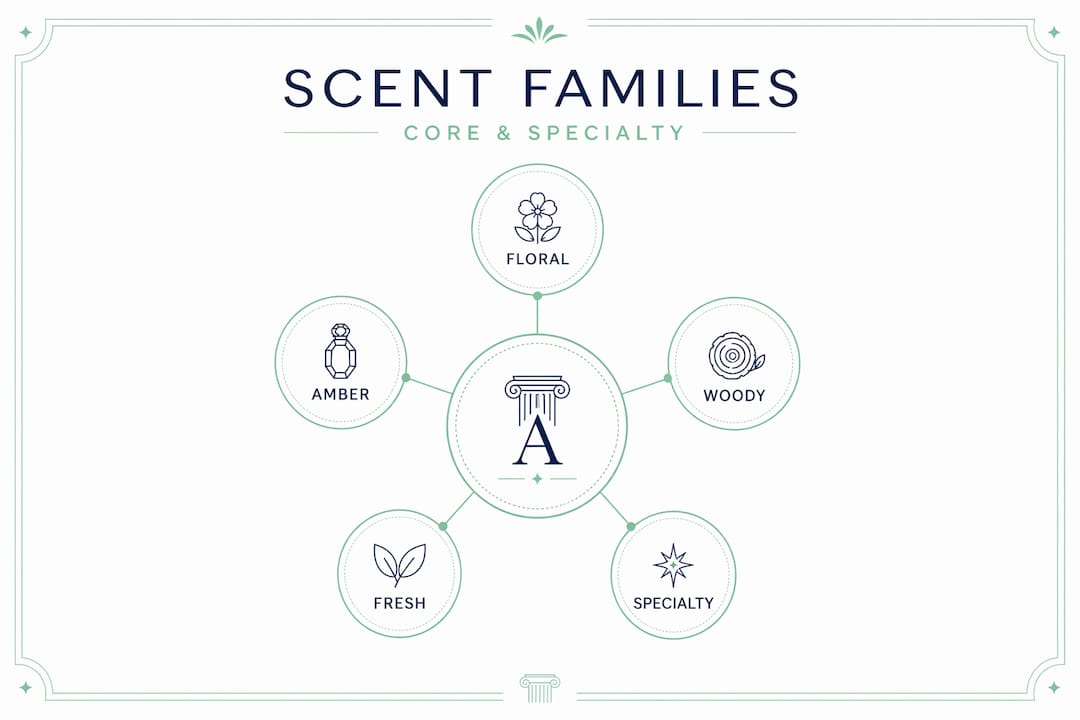
Every serious conversation about perfume begins with the fragrance wheel, a tool that has shaped the industry since perfumer and author Michael Edwards introduced it in the early 1990s. Its circular design is not arbitrary. Michael Edwards’ Fragrance Wheel groups fragrances into four core families: Floral, Fresh, Woody, and Oriental (Amber), arranged so that adjacent families share overlapping characteristics. This circular logic is the first insight most guides miss entirely.
Understanding the different perfume categories means understanding each family not as a fixed label but as a personality with a spectrum of expressions. Here is how the four families truly differ:
| Family | Dominant notes | Typical mood | Common associations |
|---|---|---|---|
| Floral | Rose, jasmine, peony, lily | Romantic, feminine, luminous | Day wear, weddings, spring |
| Fresh | Citrus, green tea, aquatic accords | Light, clean, energising | Sport, warm weather, office |
| Woody | Sandalwood, cedarwood, vetiver, oud | Warm, grounded, sophisticated | Evening, cooler months, unisex |
| Oriental (Amber) | Vanilla, benzoin, amber, spices | Sensual, rich, hedonistic | Evening, cold weather, date nights |
Within each family, the fragrance landscape branches further into distinct subcategories worth recognising:
- Floral: Soft floral (powdery, delicate), floral oriental (blooms warmed by amber), soliflore (a single flower spotlighted), floral woody
- Fresh: Citrus (sharp and luminous), aquatic (cool, ozonic), green (herbal, dewy, cut-grass)
- Woody: Mossy woods (earthy, complex), dry woods (smoky, cedar-forward), woody oriental (the bridge between wood and spice)
- Oriental (Amber): Soft oriental (subtle spice with musk), oriental (full-bodied, resinous), floral oriental (florals embraced by warmth)
Recognising these subcategories transforms how you approach a new scent. A “woody floral,” for instance, may open with roses but settle into cedarwood and vetiver, which explains why two florals from the same brand can feel entirely different on skin.
The fragrance pyramid: understanding top, heart, and base notes
A scent family tells you what a fragrance contains. The fragrance pyramid tells you when you will experience it. This distinction is where most shoppers, and even experienced collectors, stumble. The fragrance pyramid breaks a perfume into three layers: top notes (5 to 30 minutes), heart notes (30 minutes to four hours), and base notes (four to 12 or more hours), each evaporating at a different rate and revealing a different character.
Understanding each layer’s purpose is essential for evaluating any fragrance, particularly a dupe:
-
Top notes are the first impression. Dominated by volatile molecules such as citrus, light herbs, and aldehydes, they evaporate quickly and are designed to attract attention. They are also the most misleading, because what you smell in the first five minutes is rarely what you will wear for the next six hours.
-
Heart notes form the true identity of a perfume. Florals, spices, and softwood accords typically sit here. The heart is where a scent fulfils the promise its category makes, where a floral actually blooms and an oriental begins to smoulder.
-
Base notes are the signature. Rich, slow-evaporating ingredients such as musks, resins, ambers, and oud anchor the whole composition and determine how the fragrance lingers on fabric and skin. The base is where a quality accord reveals itself as genuinely luxurious or merely passable.
Pro Tip: Never assess a fragrance or its dupe on the basis of the opening spray alone. Wear it for at least 45 minutes before forming a judgement. The heart and base notes are where true category alignment is confirmed or exposed.
With a clear understanding of note structure behind you, the perfume landscape becomes significantly richer and more navigable.
Beyond the basics: specialty scent categories and nuances
The four core families are a starting point, not the whole story. Specialty scent categories frequently discussed alongside those four families include Gourmand, Chypre, Fougère, Aromatic, Aquatic, and Green, each adding a layer of complexity that makes perfume classification genuinely fascinating.
These categories often straddle two or more core families, sitting in the transitional zones the wheel’s circular structure naturally creates. A Chypre, for instance, pivots between Floral and Woody, while a Gourmand often lives in the warm amber territory but with an edible twist. Appreciating this fluidity is what separates smart fragrance choices from impulsive ones.
Here is a brief guide to each specialty category:
- Gourmand: Edible, dessert-like scents built on vanilla, caramel, chocolate, or tonka bean. A masterclass in the art of making skin smell genuinely indulgent. Think warm, luscious, and entirely irresistible in cool weather.
- Chypre: Named after the island of Cyprus, this classic category is built on a moss, labdanum, and bergamot accord. Rich, earthy, and bracingly sophisticated, Chypres feel timeless rather than trendy.
- Fougère: French for “fern,” this family is anchored by lavender, coumarin, and oakmoss. Archetypally masculine in tradition yet increasingly reinterpreted for all genders, it is the backbone of countless classic men’s fragrances.
- Aromatic: Herb-forward compositions featuring rosemary, sage, thyme, and basil. Clean without being clinical, aromatic scents feel like a Mediterranean herb garden in midsummer.
- Aquatic: Ozonic and cool, aquatics evoke sea spray, rain-washed air, and crisp open spaces. They sit within the Fresh family but carry a distinctive salty or mineral character.
- Green: Dewy, cut-grass, and leafy accords dominate here. Green fragrances feel alive and photosynthetic, evoking early mornings in a botanical garden.
Many of the most revered contemporary perfumes blend two or three of these categories with surgical precision. Recognising them lets you identify adjacent scents you are likely to love and find dupes that genuinely honour the original’s complexity, not merely its opening impression.
Applying scent categories for selecting quality scents and dupes
Understanding fragrance scent types is one skill. Applying that knowledge to purchase decisions, particularly when hunting quality dupes, is another entirely. The gap between those two skills is where money is wasted and collections stagnate.
Begin by using scent families as a first-pass filter. If you adore a dense oriental amber with heavy base notes, searching within the Fresh family will always disappoint you, regardless of how beautiful those citrus-forward scents are in their own right. Narrowing by family immediately eliminates the majority of poor matches. Then, as a further refinement for dupe hunting, treat categories as a first-pass filter and validate the match over time using the fragrance pyramid to confirm base note alignment.
| Original perfume type | Dupe category match | Pyramid focus | What to verify |
|---|---|---|---|
| Floral oriental | Floral oriental | Heart and base | Rose to amber transition |
| Woody fougère | Woody aromatic | Base notes | Oakmoss and coumarin depth |
| Gourmand amber | Gourmand oriental | Heart notes | Vanilla quality and sweetness balance |
| Fresh citrus aquatic | Fresh aquatic | Top to heart | Ozonic freshness longevity |
Common mistakes that lead to poor dupe choices and how to sidestep them:
- Judging on the first spray: The top notes of a dupe may mirror the original closely, but if the base notes diverge, you will notice within an hour. Always extend your evaluation.
- Ignoring concentration differences: An Eau de Toilette and an Eau de Parfum of the same accord will express their pyramid differently. A quality dupe should match the original’s concentration where possible.
- Overlooking skin chemistry: The same fragrance genuinely smells different on different people. Test on your own skin, not a strip, before committing.
- Fixating on top note similarity: Citrus opens most fragrances brilliantly regardless of their final category. Do not be seduced by a shared opening if the heart and base belong to entirely different families.
- Skipping community knowledge: Understanding fragrance dupes through expert sources and shared experience builds a far more reliable shortlist than label-reading alone.
Pro Tip: Pay close attention to the “centre of gravity” within a fragrance pyramid. Some perfumes are top-heavy (vivid opening that fades quickly), others are base-heavy (slow to reveal themselves but extraordinarily long-lasting). A true dupe matches this timing, not just the note list. This is what separates a genuinely faithful alternative from a passing resemblance. Good fragrance dupes and loyalty are built on this alignment, not marketing.
Reframing fragrance categories: insights from a connoisseur
Here is an uncomfortable truth the fragrance industry rarely advertises: most people use scent categories as a shortcut when they should be using them as a compass. A shortcut gets you somewhere faster. A compass tells you where you actually are.
Treating fragrance families as rigid boxes is genuinely limiting. It leads enthusiasts to dismiss whole quadrants of the wheel based on a single disappointing experience, usually formed in the volatile opening minutes of a spray. The real value of the wheel lies not in its labels but in its transitions. The fragrance wheel’s circular layout reflects how scents naturally transition between related families, which is exactly why finding dupes becomes more successful when you focus on adjacent quadrants rather than demanding an exact categorical match.
Consider a classic Chypre: its architecture sits at the intersection of Floral and Woody, borrowing the luminosity of one and the depth of the other. A dupe labelled purely “woody” might share its base accord without capturing its floral brightness, while a “floral” dupe might nail the opening without the earthy resonance underneath. The answer lies between the categories, in scent layering for dupes rather than chasing a single-family match.
The truly discerning approach treats note timing and layering as the perfume’s DNA. Categories are the species; the pyramid is the genome. When you evaluate a fragrance or its inspired alternative by how its accord shifts across all three layers, you are reading that genetic code with clarity. This is how expert collectors identify exceptional dupes with confidence, not by matching top notes on a blotter but by wearing the composition through its full evolution on skin.
Explore premium fragrance selections and expert resources at Alexandria UK
Every insight in this guide comes to life when you have the right scents in hand to test, compare, and savour. At Alexandria UK, every fragrance in the collection is curated with a deep understanding of scent family classifications and pyramid architecture, ensuring that each inspired alternative genuinely honours the original’s character from first spray to final base note.

Whether you are searching for a luminous floral, a dark and hedonistic oriental, or a masterful gourmand accord that rivals designer originals, Alexandria UK’s collection is organised to help you navigate by category, compare note structures, and discover quality alternatives with confidence. The curation is built on passion for fine fragrance and a genuine respect for olfactory craft, so every selection earns its place on merit. Explore the full range and let expert knowledge guide your next discovery.
Frequently asked questions
What are the four main fragrance scent categories?
The four main fragrance families are Floral, Fresh, Woody, and Amber (Oriental), each defined by characteristic notes and emotional associations that guide both personal preference and expert curation.
How does the fragrance pyramid affect choosing a perfume?
The fragrance pyramid breaks a perfume into top (5 to 30 minutes), heart (30 minutes to four hours), and base notes (four to 12-plus hours), revealing how a scent evolves on skin and helping you choose fragrances that develop in a way that genuinely suits you.
What are specialty fragrance categories and why do they matter?
Specialty categories such as Gourmand, Chypre, and Fougère add nuanced scent profiles that sit between the four core families, enriching the fragrance palette considerably and making personal discovery far more rewarding.
How can I find a good fragrance dupe using scent categories?
Use fragrance families as an initial filter, then validate the match over time by wearing the scent through its full pyramid, paying particular attention to whether the heart and base notes align with the original before committing.
Why do perfumes in the same category sometimes smell different?
Differences in the “centre of gravity” timing within the fragrance pyramid explain this well: two florals may share the same category label yet differ dramatically if one emphasises a bright, volatile top note while the other lingers on a deep, musky base.