Artikel: Ethical fragrance explained: How to choose mindful scents

Ethical fragrance explained: How to choose mindful scents
TL;DR:
- Ethical fragrance involves responsible sourcing, transparency, and environmental stewardship, not just natural ingredients.
- Certifications from bodies like IFRA, Ecocert, and COSMOS reliably verify ethical and sustainable practices.
- Natural ingredients are not inherently more ethical; certified synthetics can offer lower environmental impact and consistent quality.
Most people assume ethical fragrance simply means reaching for a bottle labelled ‘natural’ or ‘clean’. That assumption, however well-intentioned, misses the full picture entirely. True ethical perfumery weaves together responsible sourcing, verified manufacturing standards, transparent ingredient disclosure, and genuine environmental stewardship. It can include brilliantly engineered synthetic molecules that outperform rare botanical extracts on every measure that matters. This guide cuts through the noise, dismantles common misconceptions, and gives fragrance connoisseurs a clear, actionable framework for choosing scents that honour both quality and conscience.
Table of Contents
- What does ‘ethical’ mean in fragrance?
- How the industry defines and measures ethical fragrance
- Biotech, synthetics, and naturals: Which is most ethical?
- How to verify a fragrance’s ethical credentials
- Why ethical fragrance is about progress, not perfection
- Explore ethical fragrance further with Alexandria
- Frequently asked questions
Key Takeaways
| Point | Details |
|---|---|
| Ethical is not just natural | True ethical fragrance balances quality with responsible sourcing, safety, and transparency. |
| Biotech advances matter | Certifiably safe synthetics can outperform natural ingredients in both impact and longevity. |
| Verification is crucial | IFRA, Ecocert, and COSMOS certify brands for real, not just claimed, ethical practices. |
| Support ongoing progress | No brand is perfect but transparency and engagement drive positive industry change. |
What does ‘ethical’ mean in fragrance?
The language around fragrance ethics is notoriously slippery. Walk into any boutique and you will encounter the words ‘ethical’, ‘sustainable’, ‘natural’, and ‘clean’ used almost interchangeably, as though they are synonyms. They are not. Understanding the precise meaning of each term is the first essential step towards making genuinely mindful choices.
Ethical refers to the moral framework governing how a fragrance is produced, sourced, and sold. It encompasses fair wages for growers, safe working conditions, animal welfare considerations, and honest marketing. Sustainable is specifically about environmental impact: whether resources are replenished, carbon footprints are minimised, and ecosystems are protected. Natural simply means the ingredient originates from a plant, animal, or mineral source; it says nothing about whether that extraction was responsible. Clean is perhaps the vaguest term of all, with no universally agreed regulatory definition in the fragrance industry.
Consider what genuinely ethical fragrance production involves:
- Fair-trade or directly audited sourcing of raw materials
- Responsible manufacturing with reduced waste and energy use
- Full ingredient transparency and allergen disclosure
- Animal cruelty-free practices throughout the supply chain
- Honest, substantiated marketing claims
One of the most important realities for connoisseurs to absorb is this:
Ethical does not mean all-natural. Biotech synthetics can enable remarkable quality and longevity without ecological harm, provided they are verified by credible bodies such as IFRA.
Greenwashing, the practise of making exaggerated or unsubstantiated environmental claims, is rife in fragrance retail. A brand labelling a product ‘natural’ whilst sourcing endangered botanicals irresponsibly is far less ethical than a house using certified lab-created aroma molecules. Readers exploring perfume ethics in the UK will find that the conversation has grown considerably more nuanced in recent years, reflecting a maturing consumer base that demands substance over surface.
The fragrance industry does maintain industry sustainability benchmarks through bodies such as IFRA and Ecocert, which offer verified, independently assessed frameworks. Seeking those benchmarks is far more reliable than trusting front-of-pack vocabulary.
How the industry defines and measures ethical fragrance
With a clear understanding of the ethical landscape, we can now look at how the fragrance sector actually defines and regulates these standards.
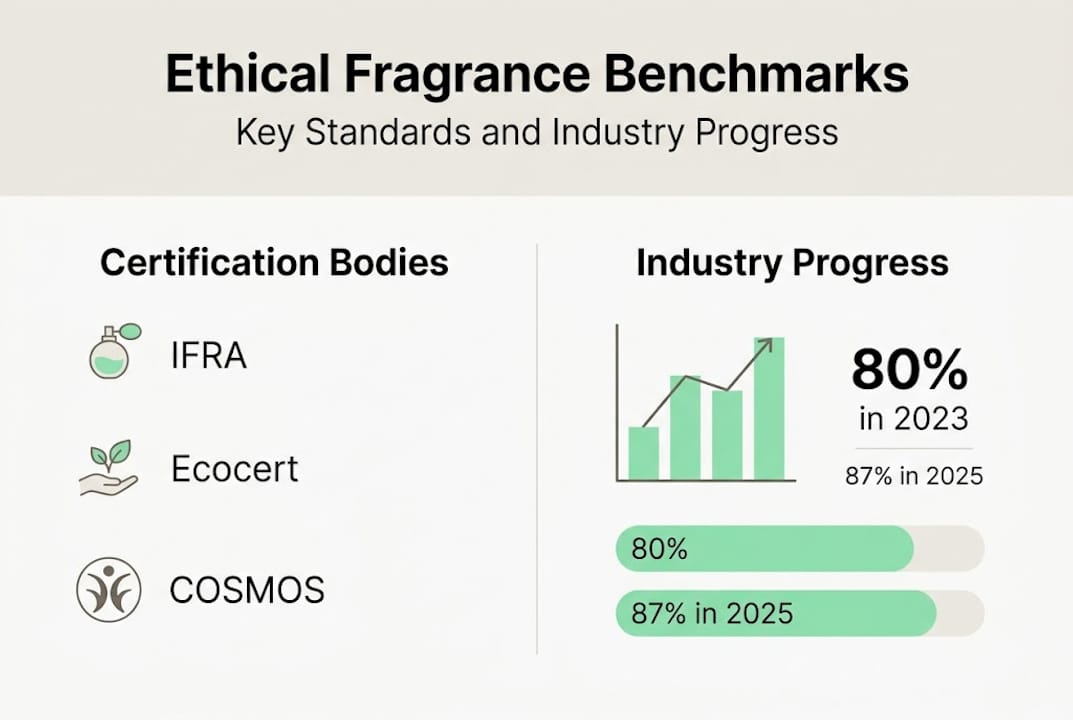
Three organisations sit at the heart of fragrance certification. IFRA (the International Fragrance Association) sets globally recognised standards for ingredient safety and sustainable practice. Ecocert independently certifies organic and ecological cosmetic formulations. COSMOS (the Cosmetic Organic Standard) provides rigorous certification for organic and natural cosmetics, including fine fragrance.
The most compelling data comes from the IFRA-IOFI 2025 sustainability report, which reveals tangible, measurable progress across the sector:
| Metric | 2023 figure | 2025 figure |
|---|---|---|
| Companies with environmental strategies | 80% | 87% |
| Companies with responsible sourcing strategies | Not reported | 60% |
| Companies engaged with product safety | Not reported | 90% |
These figures represent genuine movement. The rise from 80% to 87% on environmental strategies reflects growing corporate accountability, and a 90% engagement rate on product safety is remarkable for a sector of this complexity.
Yet the industry is candid about where it falls short. Traceability of rare natural ingredients, particularly those sourced from biodiverse but politically complex regions, remains an ongoing challenge. Oud, for instance, is notoriously difficult to trace from forest to flacon with full confidence. Ambergris, though now largely replaced by synthetic alternatives, historically presented significant animal welfare concerns.
For connoisseurs investing in fine fragrance, the practical takeaway is straightforward. Brands that voluntarily align with IFRA, pursue Ecocert certification, or publish transparent sustainability reports are demonstrating verifiable commitment, not merely aspiration. Exploring sustainable production in the UK reveals how domestic producers are increasingly meeting and exceeding these international benchmarks.
87% of fragrance companies now operate with formal environmental strategies in place, a figure that would have seemed ambitious just a decade ago.
Biotech, synthetics, and naturals: Which is most ethical?
With a framework for how ethics are measured, the next step is navigating the contentious debate around ingredient sourcing.
Few debates in perfumery are more passionately fought than naturals versus synthetics. The popular assumption, particularly among newer fragrance enthusiasts, is that natural ingredients are inherently purer and more ethical. The evidence, however, presents a more complicated and fascinating picture.
| Factor | Natural ingredients | Biotech synthetics |
|---|---|---|
| Environmental footprint | Often high; land, water, habitat disruption | Generally lower; controlled production |
| Ingredient traceability | Frequently limited | Highly traceable by design |
| Safety and allergen control | Variable; natural aldehydes can cause reactions | Precise; controlled molecular structure |
| Quality consistency | Subject to harvest variation | Consistent batch to batch |
| Ethical sourcing assurance | Dependent on supply chain transparency | Verifiable through production records |
Rose absolute sourced from Bulgarian valleys requires thousands of blooms for a single kilogram of extract. Sandalwood from Mysore has been subject to severe over-harvesting. Vetiver from Haiti, whilst supporting local communities when sourced fairly, carries a significant carbon footprint in transport and extraction. These are not arguments against naturals; they are arguments for scrutiny.

Biotech synthetics, by contrast, are produced in controlled laboratory environments. When certified by independent bodies such as Ecocert, these molecules offer exceptional safety profiles, predictable performance, and a dramatically reduced burden on ecosystems. The best modern musks, woods, and floral accords are engineered to rival or surpass their natural counterparts in quality and longevity.
Pro Tip: When a label simply reads ‘natural’ without a certification mark from Ecocert, COSMOS, or an equivalent body, treat the claim as unverified. Certified nature-inspired sustainable perfumes often combine responsibly harvested botanicals with biotech molecules for the finest results.
Fragrance sustainability challenges documented in the IFRA-IOFI report confirm that the path forward is not a binary choice between naturals and synthetics. It is about certified, transparent, and responsible use of both. Beautifully crafted eco-friendly dupes increasingly demonstrate that outstanding olfactory artistry and ethical integrity are entirely compatible.
How to verify a fragrance’s ethical credentials
Having explored ingredient options, let us focus on how you can check a fragrance’s real ethical standing before buying.
Verifying ethical claims requires a structured approach, particularly given the prevalence of greenwashing. Here is a reliable, step-by-step method:
- Locate certification marks. Look for IFRA compliance, Ecocert certification, or COSMOS approval directly on the packaging or brand website. These are independently assessed, not self-declared.
- Cross-reference certifier databases. Both Ecocert and COSMOS maintain searchable online databases of certified brands and products. If a brand claims certification but does not appear in the database, that is a significant warning sign.
- Examine ingredient disclosure. Ethical brands publish full ingredient lists, including potential allergens. Vague terminology such as ‘fragrance blend’ without further detail warrants scepticism.
- Review the brand’s sustainability reporting. Annual sustainability reports, supply chain audits, and third-party assessments indicate genuine commitment rather than marketing posture.
- Assess unregulated language critically. Terms such as ‘clean’, ‘green’, ‘natural’, and ‘pure’ carry no legal definition in fragrance retail. They are marketing terms unless substantiated by certification.
- Research ingredient origins. For brands using natural ingredients, look for fair-trade sourcing, direct community partnerships, or named supply chains. Ambiguity here often signals a problematic supply chain.
Pro Tip: Search the IFRA website directly to confirm whether a fragrance house is a member and what standards they adhere to. Membership does not guarantee perfection, but it signals meaningful engagement with globally recognised safety and ethics frameworks.
For those making ethical dupe choices, the same verification standards apply. A well-crafted dupe built on certified ingredients can be as ethically sound, and in some cases more so, than the designer original it draws inspiration from.
Why ethical fragrance is about progress, not perfection
After discussing practical verification, it is worth reflecting on what genuine ethical effort truly means within such a layered, global industry.
Perfection in ethical fragrance sourcing is, frankly, unattainable right now. Global supply chains stretch across dozens of countries, involve hundreds of species, and operate within regulatory frameworks that vary widely by region. Expecting any single brand to achieve flawless ethical compliance across every dimension simultaneously sets an unrealistic, and arguably counterproductive, standard.
What truly matters is the direction of travel. A brand that published its first sustainability report, joined IFRA, switched to certified synthetics for endangered botanical replacements, and introduced fair-trade sourcing for its hero ingredients has done something meaningful, even if gaps remain. Dismissing that brand because it has not achieved perfection overlooks real, positive change.
Connoisseurs and eco-conscious buyers wield genuine influence. Rewarding transparency, engaging with brands that show measurable improvement, and supporting houses committed to Alexandria’s ethical perfume revolution creates the market conditions that push the entire industry forward. That is far more powerful than waiting for a flawless standard that does not yet exist.
Explore ethical fragrance further with Alexandria
Ready to put your ethical fragrance knowledge to use? Here is where you can experience mindful scents in practice.
Alexandria has built its reputation on the belief that extraordinary fragrance and genuine ethical responsibility are not competing ambitions, they are complementary ones. Every scent in the collection reflects careful attention to ingredient sourcing, certified quality, and transparent craftsmanship. Whether you are drawn to nature-inspired accords, modern biotech marvels, or inspired alternatives to iconic designers, Alexandria offers a curated range where integrity underpins every flacon. Explore Alexandria’s fragrance collection and discover how mindful choices and remarkable scent experiences can coexist beautifully.
Frequently asked questions
Are synthetic perfume ingredients less ethical than natural ones?
No. Certified synthetic ingredients often carry a lower environmental impact and deliver superior safety and traceability compared to many natural materials. Biotech synthetics enable high quality and longevity without the ecological harm associated with rare botanical extraction.
What certifications should I look for when buying ethical fragrance?
Prioritise independent certifications from IFRA, Ecocert, or COSMOS, each of which rigorously assesses safety, responsible sourcing, and environmental impact. A brand displaying verified Ecocert certification has met independently assessed standards, not simply made unsubstantiated marketing claims.
How can I check if a brand’s ethical claims are genuine?
Cross-reference any certification claims against the certifier’s own searchable database, and treat vague ‘natural’ or ‘clean’ branding as unverified until backed by a credible third-party mark. Confirmed certifier database listings are the most reliable indicator of authentic ethical credentials.
Do ethical perfumes compromise on scent quality or longevity?
Not at all. Modern biotech molecules and certified synthetics routinely achieve outstanding quality and longevity, often surpassing their natural counterparts. IFRA-verified ingredients combine safety with performance, disproving the notion that ethical choices require any sacrifice in olfactory excellence.