Artikel: Authentic perfume: ingredients, quality & identification

Authentic perfume: ingredients, quality & identification
TL;DR:
- Counterfeit perfumes are increasingly sophisticated, mimicking packaging and markers of authenticity.
- Genuine fragrances follow strict ingredient, formulation, safety standards, and have verifiable batch codes.
- Authenticity is confirmed through chemical profiling, ingredient disclosure, and adherence to industry regulations.
Even the most seasoned fragrance collector can be deceived. Today’s counterfeit perfumes are not the poorly labelled imitations of a decade ago; they are sophisticated replicas that mirror packaging, bottle weight, and even batch codes with alarming precision. Yet authenticity in perfumery runs far deeper than the visual surface, encompassing regulated ingredients, verified formulations, and measurable safety standards. This guide unpacks the science, the standards, and the sensory intelligence that separates a genuine fragrance from a clever forgery, equipping you with the knowledge to build a collection you can trust completely.
Table of Contents
- What defines an authentic perfume?
- Perfume concentrations and their importance
- Inside the ingredients: nature, science, and safety
- The science of authentication: beyond the bottle
- Why perfume authenticity matters more than ever
- Enhance your collection with genuine scents
- Frequently asked questions
Key Takeaways
| Point | Details |
|---|---|
| IFRA sets authenticity | Authentic perfumes comply with IFRA safety and purity standards that genuine brands respect. |
| Concentration reveals quality | A perfume’s oil concentration and longevity are reliable signs of authenticity and superior craftsmanship. |
| Natural and synthetic balance | Both ingredient types are used to deliver safe, consistent, and high-quality authentic fragrances. |
| Advanced testing is key | Modern lab techniques, not just packaging, now confirm perfume authenticity amidst sophisticated counterfeiting. |
What defines an authentic perfume?
With growing confusion around what truly counts as ‘the real thing’, let’s first nail down what authenticity actually means for perfumes. Authenticity is not simply a question of branding or origin country. It is a layered concept that encompasses the integrity of ingredients, the precision of formulation, and strict adherence to internationally recognised safety regulations.
At the heart of this framework sits the International Fragrance Association. Authentic perfumes adhere to IFRA Standards, which regulate fragrance ingredients through prohibitions, restrictions on maximum concentrations by product category, and specifications for purity and origin to ensure consumer safety. These standards are not optional guidelines; they represent the industry’s collective commitment to responsible perfumery. Any fragrance that bypasses them is, by definition, operating outside the boundaries of authentic production.
So what does a regulated, authentic perfume actually look like in practice? Consider these common markers:
- Batch code and manufacturing date printed clearly on the bottle and outer packaging, traceable through official brand databases
- Full ingredient disclosure on the outer box, listing allergens as required by EU cosmetic regulations
- Consistent fill level with no air gaps or spillage residue around the nozzle
- Precise atomiser function that delivers a fine, even mist rather than a sputtering or uneven spray
- Correct weight and glass quality, since authentic bottles use heavier, optically clear glass with smooth seams
Visual and packaging checks remain a sensible first step for any collector. However, their reliability is diminishing rapidly. Counterfeiters now invest in high-quality printing, accurate font replication, and even genuine-feeling cardboard textures. Learning to spot authentic perfume with confidence requires moving beyond the surface and understanding the deeper markers of quality.
“Authenticity in perfumery is not merely about provenance; it is about the promise that every ingredient, every accord, every drop has been crafted and verified to meet the highest standards of safety and artistry.”
This distinction matters profoundly for collectors who invest emotionally and financially in their fragrances. A counterfeit does not just cheat you financially; it may expose you to unregulated chemical compounds with unknown skin safety profiles.
Perfume concentrations and their importance
Now that you know what authentic means, let’s see how perfume concentration lends clues to authenticity and quality. Concentration refers to the percentage of aromatic compounds dissolved in alcohol and water, and it directly governs how a fragrance performs on skin.
Understanding the recognised concentration tiers is essential knowledge for any serious enthusiast:
| Type | Aromatic oil concentration | Expected longevity |
|---|---|---|
| Parfum | 20 to 40% | 8 to 12+ hours |
| Eau de Parfum (EDP) | 15 to 20% | 6 to 8 hours |
| Eau de Toilette (EDT) | 5 to 15% | 3 to 5 hours |
| Eau de Cologne (EDC) | 2 to 5% | 1 to 3 hours |
| Eau Fraîche | 1 to 3% | 1 to 2 hours |
Perfume concentrations define types and their expected longevity benchmarks; authentic fragrances consistently match these ranges, while counterfeits frequently fall below 8% concentration regardless of the label they carry, resulting in noticeably poor longevity and weak sillage.
Sillage, the trail a fragrance leaves in the air as you move, is one of the most telling indicators of genuine quality. A well-formulated Eau de Parfum should project confidently for the first two hours before settling into a closer, intimate dry-down. If a bottle labelled EDP fades within an hour, that is a significant red flag.
Here is a practical approach to assessing concentration authenticity:
- Spray on skin and note the initial blast. Authentic parfum and EDP concentrations open with a rich, layered accord that evolves over minutes.
- Check the dry-down at 30 minutes. Genuine fragrances reveal heart notes clearly; fakes often smell flat or chemical at this stage.
- Assess longevity at the four-hour mark. An authentic EDP should still be perceptible on skin; a counterfeit will have largely vanished.
- Evaluate sillage by asking someone nearby. A genuine fragrance projects beyond the wearer; a diluted fake stays skin-close from the outset.
For a thorough breakdown of how concentration shapes your wearing experience, exploring perfume longevity explained and the full guide to perfume concentration types will sharpen your understanding considerably.
Inside the ingredients: nature, science, and safety
With concentration providing one clue, the actual ingredients form the core of perfume authenticity. Here is how the composition of a genuine fragrance reflects both artistry and rigorous science.
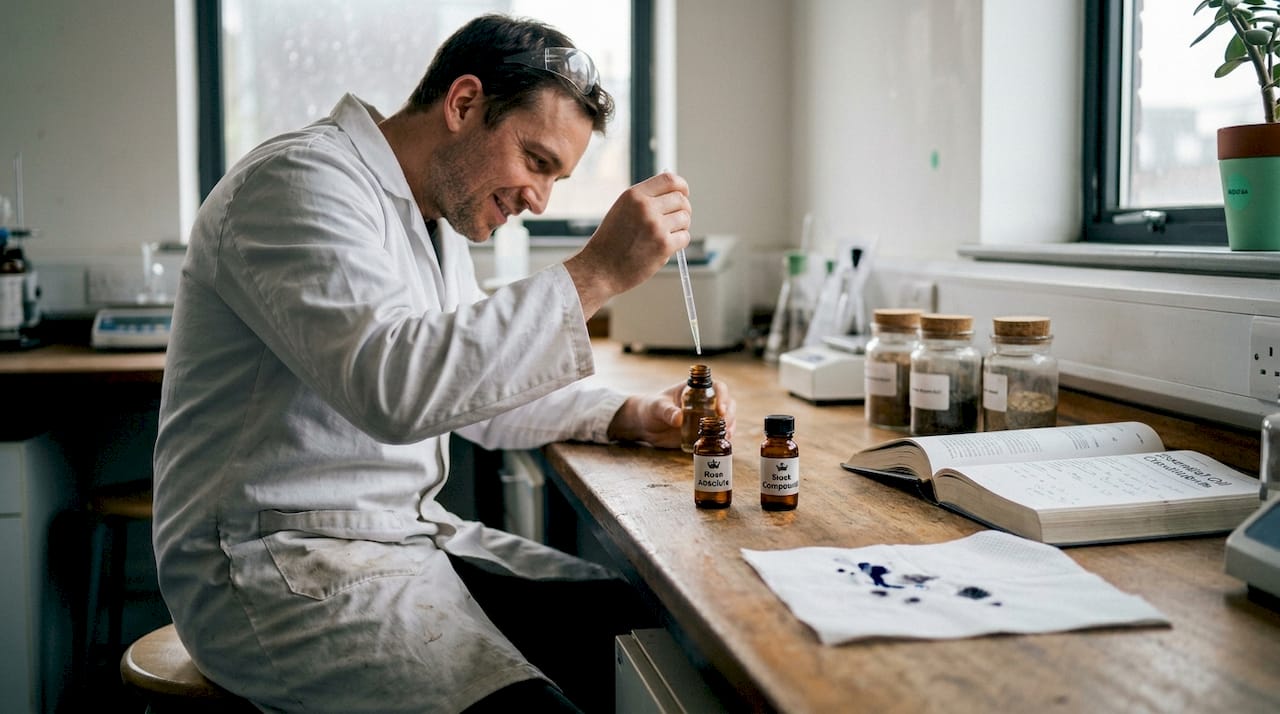
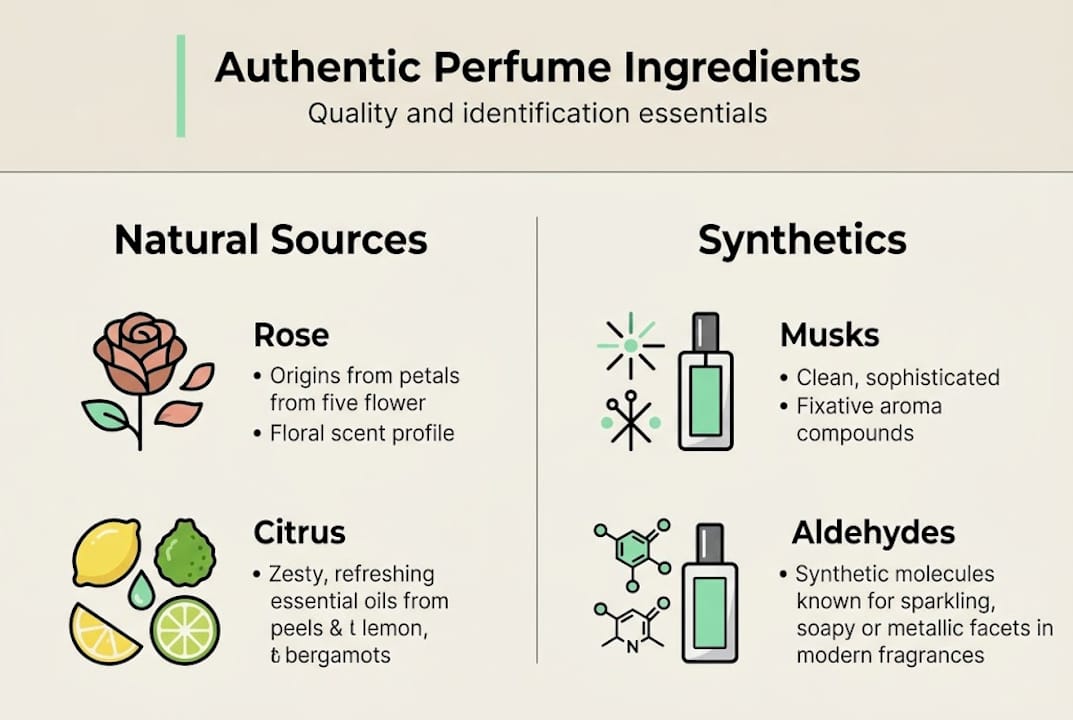
Authentic perfumes draw on a sophisticated palette of both natural and synthetic materials. Natural ingredients such as rose absolute, sandalwood, and vetiver bring organic complexity and emotional resonance. Synthetic molecules like iso E super or hedione provide consistency, longevity, and the ability to replicate rare or endangered botanicals without environmental cost.
| Ingredient | Type | Function | Allergen risk |
|---|---|---|---|
| Rose absolute | Natural | Floral heart note | Moderate (geraniol, citronellol) |
| Sandalwood | Natural | Creamy base note | Low |
| Iso E super | Synthetic | Woody, cedar-like texture | Very low |
| Hedione | Synthetic | Diffusive jasmine effect | Very low |
| Bergamot | Natural | Citrus top note | High (bergapten, photosensitiser) |
| Ambroxan | Synthetic | Warm, skin-like base | Very low |
Natural ingredients can contain allergens; synthetics enable compliance and safety, and both are used in authentic perfumes. This is a vital distinction that surprises many enthusiasts. The presence of synthetic molecules is not a marker of inferior quality; it is frequently a marker of responsible, safety-conscious formulation.
Authentic perfumes list their 26 EU-regulated allergens on outer packaging, a legal requirement that counterfeit products routinely ignore or falsify. This disclosure protects sensitive skin and signals that the brand operates within the regulated framework.
Pro Tip: When assessing a new fragrance, check the outer box for a clearly printed ingredient list. If allergens are absent or the list is suspiciously short, treat this as a warning signal worth investigating further before applying the fragrance to skin.
For a richer understanding of how different raw materials shape a fragrance’s character, the guide to perfume ingredient types offers an illuminating exploration of the perfumer’s toolkit.
The science of authentication: beyond the bottle
Knowing ingredients is critical, but even the best eyes and noses can be fooled, so let’s unpack the cutting-edge science of verification. For collectors acquiring high-value or rare fragrances, visual and olfactory checks are simply no longer sufficient.
The gold standard for perfume authentication is chemical profiling. Gas chromatography combined with mass spectrometry, known as GC-MS, separates a fragrance into its individual molecular components and identifies each one with extraordinary precision. Visual and physical checks are insufficient as counterfeits improve; chemical profiling using GC-MS and GCxGC-TOFMS is definitive for confirming composition and authenticity. Two-dimensional chromatography (GCxGC-TOFMS) takes this further, resolving complex fragrance matrices that standard GC-MS might partially overlap.
For most enthusiasts, commissioning a full laboratory analysis is not practical for everyday purchases. However, understanding what these techniques reveal is valuable:
- Molecular fingerprinting confirms the presence and ratio of key aromatic compounds specific to a genuine formulation
- Detection of prohibited substances identifies compounds banned under IFRA standards, which frequently appear in unregulated counterfeits
- Concentration verification confirms whether the aromatic oil content matches the labelled type
- Solvent and carrier analysis reveals whether cheap alcohol substitutes have been used in place of pharmaceutical-grade ethanol
“The fragrance industry’s most sophisticated authentication tools are the same ones used in forensic science. When the stakes are high, chemistry does not lie.”
For collectors who invest significantly in their fragrance wardrobe, these techniques represent the ultimate assurance. Even without laboratory access, understanding the science sharpens your instincts when assessing a new acquisition.
Pro Tip: If you are purchasing a high-value fragrance from a secondary market, request batch code verification directly from the brand’s customer service before completing the transaction. Many houses now offer this service, and a genuine seller will have no hesitation in providing documentation.
For practical, everyday guidance, the resources on detecting fakes and fake perfume warning signs provide an accessible starting point before scientific verification becomes necessary.
Why perfume authenticity matters more than ever
Here is a perspective that often gets lost in the technical discussion: authenticity in perfumery is not merely a consumer protection issue. It is an act of cultural stewardship.
When you choose a genuine fragrance, you are supporting the master perfumers, the ingredient farmers, the laboratory scientists, and the artisans whose collective expertise makes a truly great scent possible. Counterfeits do not just steal revenue; they erode the incentive to innovate, to source responsibly, and to push the boundaries of olfactory artistry.
For passionate collectors, the bottle on your shelf represents a moment in perfumery’s living history. The secrets behind scent longevity are inseparable from the integrity of the ingredients and the care invested in formulation. Caring deeply about what is in your bottle is not pedantry; it is the very foundation of genuine fragrance appreciation. The most discerning collectors understand that authenticity and artistry are two sides of the same exquisite coin.
Enhance your collection with genuine scents
Ready to put your new expertise to use? Building a collection grounded in authenticity means choosing sources that prioritise quality, transparency, and genuine fragrance knowledge above all else.
At Alexandria UK, every fragrance in the catalogue is selected with exactly this standard in mind, whether you are drawn to iconic designer inspirations or seeking quality-led alternatives that honour the artistry of the originals. The team’s deep expertise means you receive honest guidance, not just a transaction. Explore authentic fragrances with the confidence that comes from understanding what true quality looks and smells like, and discover a collection built for enthusiasts who refuse to compromise.
Frequently asked questions
What is the IFRA and why does it matter for authentic perfumes?
The International Fragrance Association (IFRA) sets global safety standards that authentic perfumes must follow, ensuring consumer safety and consistent product quality across the industry.
How can I tell if a perfume is fake or authentic?
While visual checks provide a useful starting point, chemical profiling is definitive as counterfeiters replicate packaging with increasing sophistication, making laboratory analysis the only truly reliable confirmation method.
Are authentic perfumes made with only natural ingredients?
No. Natural ingredients can contain allergens while synthetics enable safety compliance, and authentic perfumes use both material types to achieve quality, consistency, and regulatory adherence.
Why do authentic perfumes last longer than fakes?
Authentic fragrances match recognised concentration and longevity benchmarks, whereas most counterfeits fall below the required aromatic oil percentages, resulting in noticeably shorter wear time and weaker projection.