
What Is Extrait Perfume? Luxury and Longevity Decoded
Choosing the perfect fragrance should feel like a pleasure, not a puzzle, yet many British fragrance lovers still find extrait perfume surrounded by myths and misunderstandings. This matters because knowing the difference between extrait and other perfume types can change both your scent experience and the true value you receive. Here you will discover what actually sets extrait perfume apart through its exceptional concentration and longevity as well as how to spot luxury worth paying for versus when a dupe might serve you just as well.
Table of Contents
- Extrait Perfume Defined And Misconceptions
- Fragrance Oil Concentration And Longevity
- Extrait Versus Other Perfume Types
- Choosing, Applying, And Caring For Extraits
- Luxury Versus Price: Value And Dupes
Key Takeaways
| Point | Details |
|---|---|
| Definition of Extrait Perfume | Extrait perfume contains 30-40% fragrance oils, offering higher potency and longevity compared to other fragrance types. |
| Misconceptions Clarified | Common myths include that extrait is just a stronger version of eau de parfum; in fact, they represent entirely different fragrance categories. |
| Longevity and Value | Despite the higher initial price, extrait perfumes offer better value over time due to fewer applications needed for longer-lasting wear. |
| Application and Care | Apply extrait sparingly to pulse points and store in a cool, dark place to maintain quality and extend longevity. |
Extrait Perfume Defined and Misconceptions
Extrait perfume represents the pinnacle of fragrance concentration and luxury. Unlike lighter fragrances, extrait contains the highest percentage of aromatic compounds, delivering an uncompromising scent experience that evolves beautifully on your skin.
At its core, extrait perfume is defined by its composition. Extrait contains 30% or higher perfume oils, making it significantly more potent than eau de parfum or eau de toilette. This exceptional concentration means every drop delivers maximum impact and longevity.
The perfumer’s vision shines through with remarkable clarity in extrait formulations. Aromatic compounds making up 20-40% of the formula means minimal dilution allows each note to express itself fully. You’re experiencing the fragrance exactly as the perfumer intended.
Extrait perfume offers an immersive scent experience with exceptional longevity—often lasting 8-12 hours or longer on the skin.
Common Misconceptions About Extrait
Misunderstandings around extrait perfume are surprisingly common, even amongst fragrance enthusiasts. Let’s clear up the confusion.
Misconception 1: It’s just stronger eau de parfum
This is incorrect. Extrait operates in an entirely different concentration bracket. The difference between eau de parfum (typically 15-20% fragrance oils) and extrait (30-40%) is substantial—it’s not simply “more” of the same formula.
Misconception 2: You need less, so it’s better value
Whilst extrait does last considerably longer, the initial cost is higher. However, when calculated per wear, the value proposition becomes clearer. A 50ml bottle of extrait delivers significantly more wears than a standard fragrance.
Misconception 3: All extraits smell identical
Quite the opposite. Because extrait formulations contain higher concentrations of oils, individual fragrance characteristics become more pronounced. Two extraits can feel entirely different on the skin.
Misconception 4: It’s overpowering and unsuitable for daily wear
This depends entirely on the fragrance itself and application method. Many luxury extraits are wearable throughout the day when applied judiciously. A small spray delivers all-day sillage without overwhelming those around you.
Misconception 5: Extrait is only for special occasions
Whilst extraits certainly shine at evening events, many aficionados wear them daily. The rich, layered evolution means you discover new facets throughout the day.
Pro tip: Apply extrait to pulse points sparingly—your neck, inner wrists, and behind ears—as a single application often provides sufficient projection and longevity for the entire day.
Fragrance Oil Concentration and Longevity
The relationship between fragrance oil concentration and how long a scent lasts on your skin is straightforward: higher concentration equals longer wear time. This fundamental principle shapes everything about extrait perfume and why it commands premium prices.

Fragrance oil concentration refers to the percentage of aromatic compounds dissolved in alcohol and water. The higher this percentage, the more potent and durable your fragrance becomes on the skin. Extrait perfume sits at the top of this concentration hierarchy.
Different fragrance types contain vastly different concentrations. Here’s how they stack up:
- Eau de Cologne: 2-5% fragrance oils (lasts 1-2 hours)
- Eau de Toilette: 5-10% fragrance oils (lasts 3-5 hours)
- Eau de Parfum: 15-20% fragrance oils (lasts 5-8 hours)
- Extrait de Parfum: 30-40% fragrance oils (lasts 8-12+ hours)
Why does concentration matter so dramatically? More aromatic molecules mean your skin absorbs a greater quantity of scent compounds. These molecules evaporate more slowly, releasing fragrance gradually throughout the day.
Understanding perfume longevity reveals how concentration interacts with skin chemistry, climate, and fragrance composition. Extrait’s superior longevity stems directly from this higher oil content.
Higher fragrance oil concentration doesn’t just mean longer wear—it fundamentally changes how a fragrance develops on your skin, revealing subtle notes that lighter concentrations mask.
How Concentration Affects Scent Evolution
Extrait perfume evolves differently than lighter fragrances because of its oil density. The top notes last considerably longer, allowing mid-notes to emerge more gradually.
With eau de toilette, top notes vanish within 15-30 minutes. With extrait, they can linger for an hour or more. This extended timeline means you experience the fragrance’s full journey.
The base notes also perform differently. In lighter concentrations, they disappear quickly. In extrait, they build and intensify, creating a rich, layered experience that strengthens rather than fades.
The Economics of Concentration
Higher concentration requires more aromatic materials, increasing production costs significantly. A 50ml bottle of extrait contains far more fragrance oils than a 100ml bottle of eau de parfum.
This investment pays dividends over time. Fewer applications are required, so a small bottle lasts months rather than weeks. Many users find the cost-per-wear substantially lower despite the higher initial price.
Pro tip: Store your extrait in a cool, dark place away from direct sunlight, as the concentrated oils degrade faster when exposed to heat and UV light, reducing longevity over time.
Extrait Versus Other Perfume Types
Extrait de parfum stands apart from every other fragrance category in terms of concentration, longevity, and overall experience. Understanding how it compares to lighter alternatives helps you make informed choices about which type suits your needs.
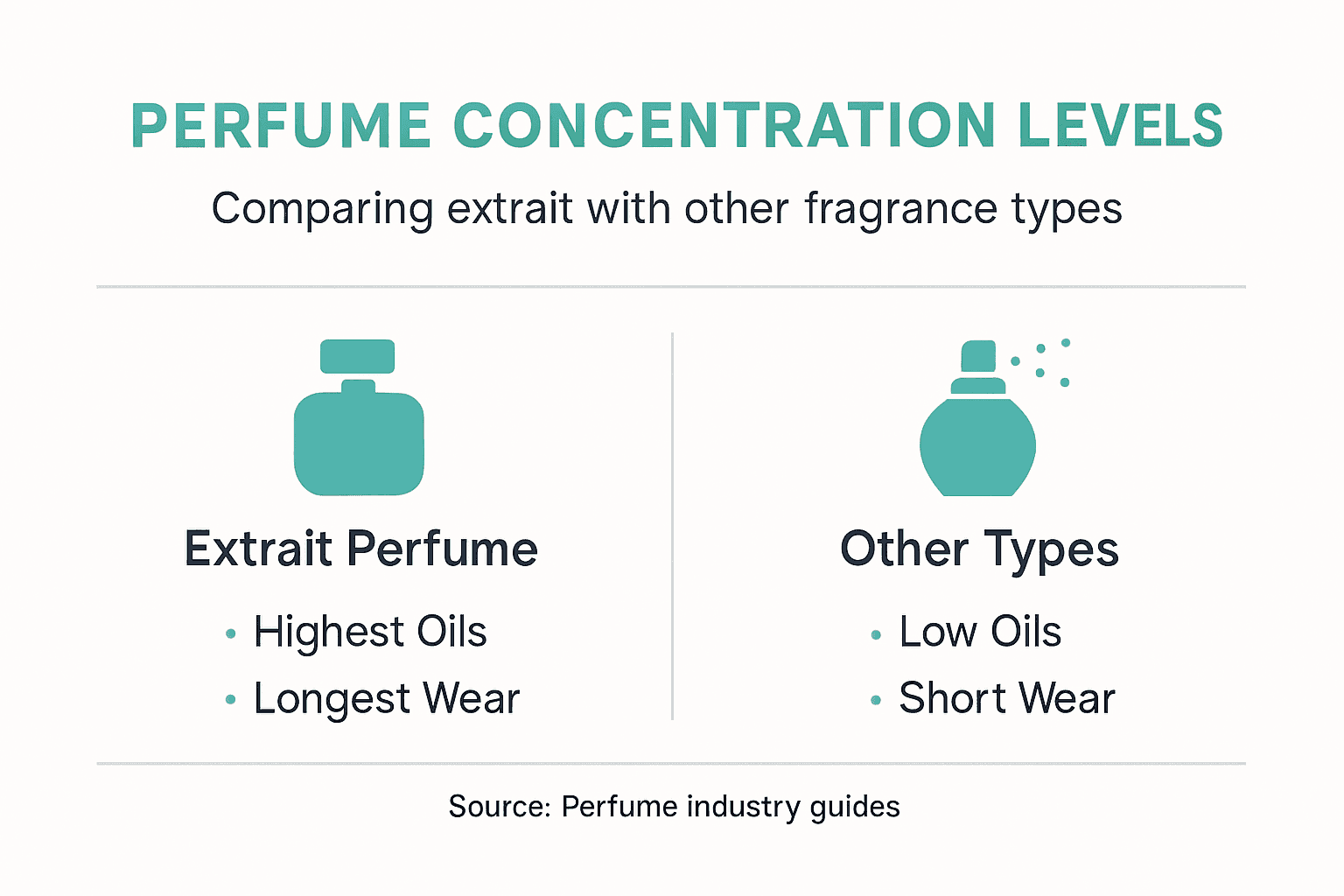
The fragrance hierarchy is defined by aromatic compound concentration. Each category delivers a distinctly different scent experience and wear time. Extrait occupies the premium tier of this classification.
Concentration Comparison
Extrait contains 20-40% fragrance concentration compared to lighter fragrances. This dramatic difference directly impacts how long your scent lingers and how powerfully it projects.
Here’s how the major types compare:
- Eau de Cologne: 2-5% oils (lasts 2-4 hours)
- Eau de Toilette: 5-10% oils (lasts 3-5 hours)
- Eau de Parfum: 15-20% oils (lasts 5-8 hours)
- Extrait de Parfum: 20-40% oils (lasts 12-24 hours)
The gap between eau de parfum and extrait is substantial. You’re not simply getting a slightly stronger version—you’re investing in an entirely different product category.
Extrait perfume delivers 12-24 hours of fragrance, compared to eau de cologne which lasts merely 2-4 hours, making extrait a fundamentally superior investment for serious fragrance lovers.
Longevity and Projection Differences
Extrait requires far fewer applications than lighter fragrances. One or two spritzes in the morning sustains you through the entire day and into the evening. Eau de toilette typically demands reapplication by afternoon.
Projection also differs dramatically. Extrait announces your presence from several metres away, whilst eau de toilette fades within an arm’s length. This makes extrait ideal for special occasions or when you want maximum impact.
The scent also evolves more gradually. Lighter fragrances compress their entire journey into a few hours. Extrait unfolds over the entire day, revealing new facets as time passes.
Price-Per-Wear Analysis
Whilst extrait costs significantly more upfront, the economics favour it over time. A 50ml bottle of extrait outlasts a 100ml bottle of eau de parfum because you use so little per application.
Calculate your actual spending per wear, not the initial price tag. Many users find extrait represents exceptional value despite the premium cost.
When to Choose Each Type
Eau de Cologne suits casual summer wear and travel. Eau de Toilette works for office environments requiring subtle fragrance. Eau de Parfum offers versatility for daily wear. Extrait serves those demanding luxury, longevity, and sophisticated scent development.
Pro tip: Layer your extrait with unscented moisturiser on pulse points to improve longevity further; the oils cling better to hydrated skin, extending wear time by several hours.
Here’s a practical comparison of fragrance categories and their ideal uses:
| Fragrance Type | Typical Use | Concentration Level | Longevity Range |
|---|---|---|---|
| Eau de Cologne | Summer, travel | Very low (2-5%) | Short (1-4 hours) |
| Eau de Toilette | Office, daytime wear | Low (5-10%) | Moderate (3-5 hours) |
| Eau de Parfum | Daily, versatile | Medium (15-20%) | Long (5-8 hours) |
| Extrait de Parfum | Luxury, special use | Highest (20-40%) | Very long (12-24 hours) |
Choosing, Applying, and Caring for Extraits
Mastering extrait perfume requires more than simply purchasing a bottle. Proper selection, application technique, and storage practices ensure you get maximum enjoyment and longevity from your investment.
Choosing the right extrait perfume starts with understanding your preferences. Consider whether you prefer fresh, aromatic scents or warm, sensual fragrances. Extrait formulations intensify these characteristics considerably, so test before committing.
Extrait concentrations mean you need far less product per application. This allows you to explore premium fragrances without excessive spending. Many enthusiasts rotate several extraits rather than wearing one daily.
Application Techniques
Experts recommend applying extrait perfume lightly to pulse points to maximise longevity whilst avoiding overpowering the senses. Pulse points—your neck, inner wrists, behind your ears, and inner elbows—generate warmth that amplifies fragrance projection.
Here’s the correct approach:
- Apply one or two spritzes to pulse points only
- Avoid rubbing your wrists together (this breaks down fragrance molecules)
- Allow the scent to settle for a few minutes before moving
- Never apply to clothing directly; always spray on skin
The beauty of extrait lies in its restraint. You need minimal product to create maximum impact. One application typically lasts your entire day.
Apply extrait sparingly to pulse points—wrists, neck, and behind ears—allowing the concentrated oils to develop naturally on warm skin for optimal longevity and projection.
Storage and Care
Extrait perfume demands careful storage to preserve its integrity. These concentrated formulations degrade faster than lighter fragrances when exposed to environmental stress.
Proper storage involves:
- Keeping away from heat: Store in a cool location, ideally between 15-18°C
- Avoiding direct sunlight: UV light degrades fragrance compounds rapidly
- Using sealed bottles: Exposure to air oxidises oils, reducing scent quality
- Selecting dark glass: Opaque bottles protect against light penetration
Many fragrance enthusiasts store extraits in their original packaging within a cupboard or drawer. Never leave bottles on windowsills or in bathrooms where humidity and temperature fluctuate constantly.
Layering and Personalisation
Extrait perfumes can be layered with lighter fragrances to create personalised scent profiles. Apply your lighter fragrance first, then add a touch of extrait to create complexity.
This technique extends your fragrance wardrobe considerably. One extrait can work with multiple lighter fragrances, giving you countless combinations. Experimentation reveals unexpected harmonies.
Pro tip: Store your extrait bottles in a cool, dark drawer within their original packaging, and keep them sealed between uses to prevent oxidation and maintain the concentrated oils’ quality for years.
Luxury Versus Price: Value and Dupes
The relationship between price and quality in extrait perfumes is complex. Understanding what you’re actually paying for helps you make decisions aligned with your budget and fragrance goals.
Luxury perfumes command premium prices for legitimate reasons. Quality and rarity of raw materials, artisan craftsmanship, and meticulous maceration processes all contribute to higher costs. These aren’t arbitrary markups—they reflect genuine ingredient quality and expertise.
Extrait formulations particularly benefit from superior materials. The high concentration means every aromatic compound matters. Lower-grade ingredients become immediately obvious in such potent concentrations, which is why luxury houses invest heavily in sourcing.
However, price doesn’t always guarantee personal satisfaction. A £200 extrait might not appeal to your nose, whilst a £80 alternative could become your signature scent. Preference is deeply personal.
What You’re Actually Paying For
Luxury extrait pricing breaks down into several components:
- Raw materials: Rare absolutes and natural extracts cost significantly more than synthetic alternatives
- Craftsmanship: Master perfumers command high fees for their expertise and creative vision
- Maceration time: Extended ageing in oak or glass improves complexity but requires months of storage
- Bottle and packaging: Luxury presentation adds tangible costs
- Brand heritage: Established houses leverage decades of reputation
The first four factors directly affect scent quality. The last one is debatable—brand name adds prestige but not fragrance performance.
Luxury extrait perfumes offer complex scent profiles and exceptional longevity, justified by superior ingredients and meticulous craftsmanship rather than marketing alone.
The Dupe Question
Understanding fragrance dupes reveals a nuanced landscape. Quality dupes capture the essence of luxury fragrances at fraction of the cost, though they rarely match original complexity exactly.
Dupes work best when:
- You’re testing a fragrance before committing to the luxury version
- You want a similar scent for everyday wear, reserving the original for special occasions
- Budget constraints prevent purchasing expensive extraits
- You prefer the dupe’s longevity or projection profile
However, dupes typically contain lower fragrance concentrations. An eau de parfum dupe won’t deliver the 12-hour longevity of a true extrait. Managing expectations prevents disappointment.
Finding True Value
Value isn’t about lowest price—it’s about cost-per-wear and personal satisfaction. A £150 extrait lasting 12 hours costs £5 per wear over six months. An £40 eau de parfum lasting 5 hours costs £3 per wear, but requires frequent reapplication.
Calculate what matters to you: longevity, sillage, scent complexity, or brand prestige. Align purchases accordingly rather than chasing brand names.
Pro tip: Test fragrance dupes at department store testers before purchasing, comparing their longevity and development against the luxury originals to determine whether the price difference justifies the quality gap for your personal preferences.
To assist your purchasing decisions, here’s how extrait perfume prices relate to their value:
| Bottle Size | Average Price | Estimated Wears | Cost Per Wear |
|---|---|---|---|
| 50ml Extrait | £150-£200 | 100+ | £1.50-£2.00 |
| 100ml Eau de Parfum | £80-£120 | 80-100 | £0.80-£1.20 |
| 50ml Eau de Cologne | £40-£50 | 40-50 | £1.00-£1.25 |
| 50ml Dupe | £20-£40 | 50-70 | £0.40-£0.80 |
Discover the True Essence of Extrait Perfume with Alexandria UK
Unlock the luxurious world of extrait perfumes where high fragrance concentration meets exceptional longevity. If you have been searching for fragrances that not only evolve beautifully on your skin but also offer lasting projection throughout your day, your journey starts here. At Alexandria UK, we understand the art of extrait – from its potent 30-40% aromatic compounds to its ability to transform your scent experience.
Explore our carefully curated selection inspired by luxury fragrances and quality dupes designed to deliver sophisticated scent profiles without compromise. Whether you want to experience authentic extrait along with its magnificent scent evolution or seek refined dupes that offer great value, we provide trusted collections tailored for every preference and budget. Do not wait to elevate your fragrance game—visit our homepage and experience how true extrait perfume luxury feels today.
Frequently Asked Questions
What is extrait perfume?
Extrait perfume is a highly concentrated fragrance type that contains 30-40% pure perfume oils, making it more potent and longer-lasting than other perfume categories, such as eau de parfum or eau de toilette.
How long does extrait perfume last compared to other fragrance types?
Extrait perfume typically lasts 8-12 hours or longer on the skin, significantly outlasting eau de parfum (5-8 hours) and eau de toilette (3-5 hours) due to its higher concentration of aromatic compounds.
Can extrait perfume be worn daily, or is it only for special occasions?
Extrait perfume can certainly be worn daily. While it shines at special events, many enthusiasts appreciate its rich scent profile for everyday use when applied sparingly.
How should I apply extrait perfume for the best results?
Apply extrait perfume lightly on pulse points such as the neck, inner wrists, and behind the ears. Use one or two spritzes, allowing the fragrance to settle without rubbing, to maximise projection and longevity.


