Why abstract perfumes intrigue: emotion, artistry & scent
TL;DR:
- Abstract perfumes evoke emotions and concepts rather than recognizable notes.
- They challenge perception, engaging the mind and personal imagination uniquely.
- Synthetic molecules expand creative possibilities, enabling bold, unconventional scents.
Even the most seasoned perfumer will pause when asked to describe an abstract fragrance. These are scents that resist easy explanation, that refuse to be pinned down to a single flower, fruit, or familiar accord. Abstract perfumes defy categorisation and familiar notes, creating novel olfactory experiences that challenge perception and evoke unique emotions, memories, and imagination. They are not trying to smell like a rose garden or a freshly cut citrus grove. Instead, they reach for something far more elusive: a feeling, a concept, a mood. This guide explores how and why these extraordinary fragrances stand apart, and why they captivate fragrance lovers and aspiring perfumers alike.
Table of Contents
- What makes a perfume ‘abstract’?
- How abstraction in scent challenges perception
- The role of synthetic molecules and artistic boldness
- Why abstract perfumes resonate uniquely with wearers
- Why embracing abstraction transforms the perfume experience
- Explore artistry and innovation in modern perfumery
- Frequently asked questions
Key Takeaways
| Point | Details |
|---|---|
| Defying scent conventions | Abstract perfumes break away from familiar notes and traditional structures to offer something truly different. |
| Personal emotional resonance | Each wearer interprets abstract scents in a unique way, shaped by personal experiences and culture. |
| Innovation through synthetics | Synthetic molecules and creative techniques expand what’s possible in modern perfumery. |
| Risk unlocks discovery | Embracing abstract fragrances leads to a richer, more inventive olfactory journey. |
What makes a perfume ‘abstract’?
To understand why abstract perfumes intrigue, let’s clarify what truly makes a perfume ‘abstract’. In traditional perfumery, a scent is built around recognisable notes. You smell jasmine and you know it is jasmine. You detect sandalwood and your brain immediately files it away under something warm, woody, and familiar. Abstract perfumes operate on an entirely different level.
An abstract fragrance deliberately avoids clear, identifiable note structures. Rather than mimicking a natural object or place, it constructs an olfactory impression that exists nowhere in nature. The result is a scent that triggers emotional and imaginative responses rather than straightforward recognition. Scent storytelling becomes less about narrating a walk through a flower market and more about evoking the feeling of standing at the edge of something vast and unknown.
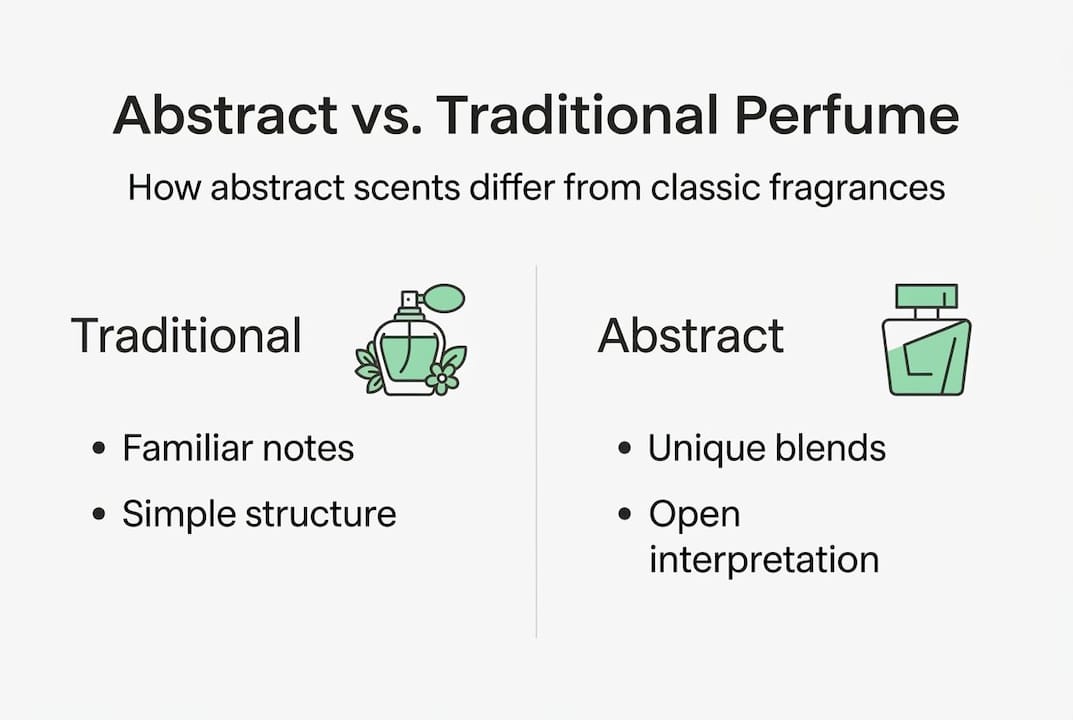
Brands such as Comme des Garçons and LOEWE have built entire reputations on this philosophy. Comme des Garçons has released fragrances featuring notes of tar, concrete, and ink. LOEWE has explored tomato, liquorice, and even the scent of a heated stone. These are not accidental choices. They are deliberate artistic provocations designed to disorient and delight.
| Feature | Abstract perfume | Representational perfume |
|---|---|---|
| Note clarity | Intentionally ambiguous | Clear and recognisable |
| Emotional effect | Imaginative, personal | Familiar, comforting |
| Inspiration | Concepts, moods, ideas | Nature, objects, places |
| Wearer experience | Unique interpretation | Shared recognition |
Exploring the full range of distinct fragrance types reveals just how broad the olfactory spectrum truly is. Key characteristics of abstract perfumes include:
- Conceptual inspiration: drawn from ideas, emotions, or imagined spaces rather than tangible sources
- Unusual ingredients: unexpected materials that challenge the nose’s assumptions
- Non-linear development: the fragrance evolves in surprising, often contradictory directions
- Personal interpretation: no two wearers experience the scent in quite the same way
“Abstract perfumes intrigue because they defy categorisation and familiar notes, creating novel olfactory experiences that challenge perception.”
How abstraction in scent challenges perception
Now that we know what makes a perfume abstract, it is key to see how such abstraction changes our experience of scent. The psychology behind this is genuinely fascinating, and it reaches well beyond the nose.
Scent is deeply linked to memory and emotion through the limbic system, but abstract fragrances engage an additional layer of cognitive processing. When a scent does not match any stored olfactory memory, the brain works harder to interpret it. This heightened engagement is precisely what makes abstract perfumes so memorable. Crossmodal correspondences between scent and music, for example, highlight abstract emotional mappings that challenge traditional note-matching, demonstrating how fragrance can function more like a piece of music than a photograph.
Three ways abstract perfumes impact perception:
- Imaginative association: Without a clear reference point, the mind invents its own narrative. One wearer might find a metallic abstract accord reminiscent of a winter morning; another might associate it with the interior of a vintage car.
- Emotional evocation: Abstract scents bypass rational analysis and speak directly to feeling. They can provoke melancholy, exhilaration, or a sense of mystery without any identifiable cause.
- Breaking olfactory habits: Regular exposure to abstract fragrances trains the nose to become more discerning, expanding the wearer’s capacity to detect and appreciate subtle nuance.
The emotional storytelling of scents is amplified when the story is open-ended. A representational fragrance tells you exactly where you are. An abstract fragrance invites you to decide for yourself.
| Perception type | Representational scent | Abstract scent |
|---|---|---|
| Cognitive load | Low (familiar pattern) | High (novel processing) |
| Memory encoding | Standard | Heightened |
| Personal meaning | Shared | Deeply individual |
This is why abstract perfumes often become the most treasured in a collector’s wardrobe. They grow with the wearer, revealing new dimensions over time.
The role of synthetic molecules and artistic boldness
But what gives perfumers the power to create such unconventional and emotive scents? The answer lies partly in technology and partly in the willingness to take creative risks that would have been unthinkable a generation ago.

Synthetic molecules enable abstraction by offering creative freedom, stability, exceptional sillage, and access to scent effects that nature simply cannot provide. Lily of the valley, for instance, cannot be extracted from the flower itself. Its iconic scent exists in perfumery almost entirely through synthetic recreation. This is not a compromise. It is an opportunity.
With synthetics, a perfumer can construct accords that smell of electricity, of silence, of the colour grey. They can engineer a fragrance that evolves dramatically from first spray to dry-down, telling a story that no single natural ingredient could carry alone. Modern perfumery favours risk-taking with bold accords and high natural concentrations, contrasting sharply with the linear, mass-market approach that dominated the late twentieth century.
Key artistic strategies in abstract perfumery:
- Accord layering: building complex scent structures from multiple synthetic and natural materials that interact unexpectedly
- Ingredient subversion: using familiar materials in unfamiliar concentrations to disorient and intrigue
- Conceptual briefs: perfumers working from abstract ideas, artworks, or philosophical concepts rather than traditional scent briefs
- Intentional dissonance: pairing materials that clash, then resolving them into something surprisingly beautiful
Pro Tip: Do not dismiss a fragrance simply because it contains synthetic molecules. Some of the most celebrated and emotionally resonant abstract perfumes owe their character entirely to laboratory-created materials. Synthetics are not a shortcut. They are a creative tool.
Exploring modern perfumery trends and understanding how perfumers create scents reveals just how deliberate and sophisticated this artistic process truly is.
Why abstract perfumes resonate uniquely with wearers
Having explored the creation of abstract scents, let’s see why they provoke such deeply personal responses. The answer is rooted in something beautifully human: we do not all smell the same things in the same way.
Individual variability in perception, shaped by genetics, cultural background, and personal memory, adds profound nuance to the fragrance experience. Abstract scents amplify this personal resonance because there is no ‘correct’ interpretation to override your own. A traditional rose soliflore invites you to compare your experience against the known quantity of a rose. An abstract fragrance simply invites you to feel.
This is why abstract perfumes are particularly beloved by those who explore artisan perfumeries and seek out the intrigue of dark scents. These are wearers who have moved beyond the desire for approval and into the territory of genuine self-expression.
How abstract scents encourage exploration and creativity:
- They reward patience, revealing new facets over hours and across different skin chemistries
- They spark conversation, prompting wearers to articulate feelings and associations they rarely put into words
- They build olfactory confidence, encouraging the nose to trust its own instincts rather than external validation
- They create a sense of ownership, as the wearer’s personal interpretation becomes inseparable from the fragrance itself
“The most powerful abstract fragrances do not tell you what to think. They create the conditions in which something entirely your own can emerge.”
This is the quiet magic of abstraction. It does not perform for an audience. It speaks privately, directly, and without translation.
Why embracing abstraction transforms the perfume experience
Pulling all these threads together, here is why we think abstract perfumes are essential for anyone who truly loves scent. Most fragrance guides encourage you to start safe: choose something universally appealing, something that will earn compliments, something that will not unsettle. That advice, however well-intentioned, quietly limits discovery.
Conventional wisdom treats fragrance as a social accessory, something chosen for how it lands on others. Abstract perfumes invert this entirely. They ask what you feel, what you imagine, what you need from a scent on a particular day. That shift in perspective is genuinely transformative.
We have seen it happen repeatedly: a fragrance lover who begins cautiously, drawn to safe florals and clean musks, encounters one abstract scent that stops them completely. Something unexpected. Something that does not make immediate sense. And from that moment, their relationship with fragrance changes. They begin to seek out the unfamiliar rather than retreat from it.
Keeping an eye on fragrance trends shows that abstraction is not a niche pursuit. It is increasingly central to how the finest houses and most exciting independent perfumers are thinking about scent. Instead of fearing a fragrance that feels strange, treat it as an invitation to develop a more personal, more nuanced, and ultimately more rewarding olfactory palate.
Explore artistry and innovation in modern perfumery
If you are ready to experiment with your own olfactory boundaries, here is where your journey can continue. Abstract perfumery rewards curiosity above all else, and the best way to develop your appreciation is to expose yourself to a wide range of creative, innovative, and unconventional scents.
At Alexandria, you will find a curated selection of quality-focused fragrances inspired by the world’s most celebrated houses, offering an accessible entry point into the full spectrum of modern perfumery. Whether you are beginning to explore or deepening an existing passion, discover unique fragrances that push creative boundaries and reward the discerning nose. The fragrance academy also offers detailed guides for aspiring perfumers, including a thorough look at unusual perfume types that will expand your understanding and sharpen your appreciation of what scent can truly achieve.
Frequently asked questions
What distinguishes an abstract perfume from a traditional one?
Abstract perfumes avoid familiar notes and recognisable structures, aiming for unique, imaginative scent profiles rather than mimicking tangible objects or flowers. Traditional perfumes typically reference nature directly and invite shared recognition.
Why do some people experience abstract perfumes so differently?
Genetics, cultural background, and individual memory shape how abstract scents are perceived, making reactions highly personal and often impossible to predict from one wearer to the next.
Are synthetic ingredients essential for creating abstract perfumes?
Yes, synthetics provide stability, creative range, and allow access to scent effects impossible with naturals alone, making them indispensable tools for the abstract perfumer.
Which brands are famous for abstract fragrances?
Comme des Garçons and LOEWE are renowned for using unusual ingredients such as tar, concrete, and tomato in their abstract scents, consistently challenging what fragrance can be.