

Why perfumes are discontinued: hidden factors explained
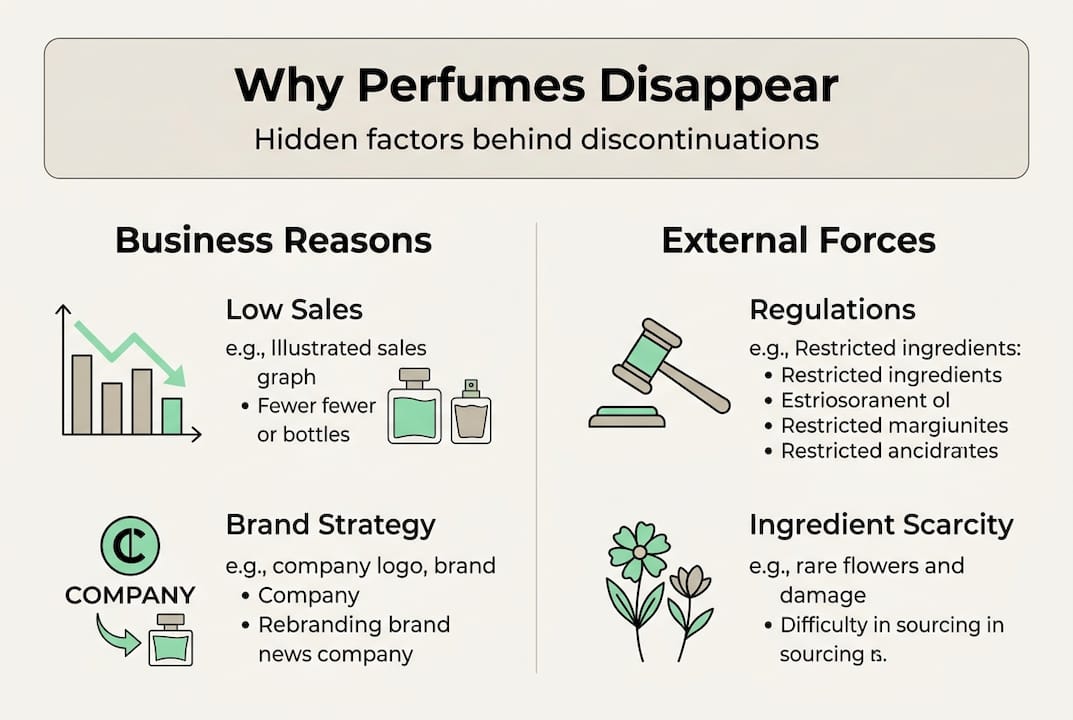
One moment, a fragrance graces the shelves of every luxury boutique, adored by collectors and casual wearers alike. The next, it vanishes without warning, leaving devotees scrambling for the last bottles. This phenomenon affects even former bestsellers and classics, discontinued not from lack of popularity but from business or regulatory pressures. The reasons extend far beyond poor sales, encompassing ingredient scarcity, regulatory shifts, corporate strategy, and evolving market trends. Understanding these hidden factors reveals the fragile lifecycle of even the most iconic scents and the ripple effects across the fragrance industry.
Table of Contents
- Why do brands discontinue perfumes?
- Regulations and reformulations: scent versus safety
- Ingredient shortages and cost pressures
- Corporate strategy and the cycle of trends
- Impact on collectors and the market
- Your next step: discover unique alternatives and learn more
- Frequently asked questions
Key Takeaways
| Point | Details |
|---|---|
| Business drives decisions | Most discontinuations result from low sales or portfolio strategy, not product flaws. |
| Regulations reshape scents | Ingredient bans force reformulations and sometimes cause the loss of iconic perfumes. |
| Scarcity increases value | Collectors prize discontinued scents, making them valuable on the secondary market. |
| Dupes and alternatives exist | Brands and independent houses offer alternatives when favourites disappear. |
Why do brands discontinue perfumes?
The decision to retire a perfume rarely stems from a single cause. Low sales performance remains the primary driver, yet this metric can be deceptive. A fragrance may enjoy a devoted cult following whilst failing to meet corporate profitability thresholds. Brands operate within competitive portfolios where underperformers, regardless of their niche appeal, face elimination to allocate resources towards higher-margin releases.
Portfolio management introduces another layer of complexity. Brands discontinue to refresh portfolios and follow changing trends, retiring even bestsellers to make room for launches aligned with current consumer preferences. This strategic turnover keeps brands relevant but sacrifices continuity for collectors who treasure specific compositions.
Misconceptions abound regarding discontinuation. Many assume poor quality or waning popularity signals a scent’s demise, yet the reality proves more nuanced. A perfume’s technical excellence or loyal fanbase offers no immunity against broader business imperatives. The importance of discontinued scents lies precisely in this tension between artistic merit and commercial viability.
| Factor | Impact on Discontinuation | Frequency |
|---|---|---|
| Low sales performance | Direct trigger for removal | Very High |
| Portfolio rationalisation | Strategic culling of lines | High |
| Regulatory compliance | Forced reformulation or exit | Medium |
| Ingredient scarcity | Supply chain disruption | Medium |
| Corporate restructuring | Licensing or ownership changes | Low |
Key misconceptions to dispel:
- Quality equals longevity: Superior formulation does not guarantee market survival
- Popularity protects perfumes: Even beloved scents face discontinuation during portfolio shifts
- Reformulation saves classics: Regulatory changes may render authentic recreation impossible
- Niche immunity: Small-batch or artisanal fragrances face similar pressures from ingredient costs
“The global fragrance market, valued at over £40 billion, sees approximately 15-20% of new launches discontinued within three years, with legacy scents facing similar attrition rates as brands prioritise trend-driven releases over heritage preservation.”
Regulations and reformulations: scent versus safety
Regulatory frameworks exert profound influence over perfume longevity. The International Fragrance Association (IFRA) and European Union REACH programme establish safety standards that frequently result in ingredient bans, with classic chypre fragrances particularly affected. Oakmoss, a cornerstone of this olfactory family, faced severe restrictions due to allergen concerns, fundamentally altering or eliminating iconic compositions.
High-profile casualties illustrate these pressures. Guerlain’s Mitsouko underwent reformulation to comply with oakmoss restrictions, whilst Dior Homme’s original iteration disappeared entirely. These losses represent more than commercial decisions; they mark the erosion of olfactory heritage as regulatory bodies prioritise consumer safety over artistic preservation.

| Fragrance | Original Launch | Discontinuation/Reformulation | Primary Cause |
|---|---|---|---|
| Guerlain Mitsouko | 1919 | Reformulated 2010s | Oakmoss restrictions |
| Dior Homme Intense | 2007 | Discontinued 2020 | Formula compliance |
| YSL Opium (original) | 1977 | Reformulated 2009 | IFRA standards |
| Chanel No. 5 (vintage) | 1921 | Reformulated 2016 | Allergen regulations |
The debate surrounding these interventions reveals contrasting views: some champion bans as necessary safety measures, whilst others lament the damage to perfumery as an art form. Perfumers face the challenge of recreating beloved accords with compliant materials, often sacrificing the depth and complexity that defined the originals.
Edge cases further complicate the landscape. ‘Repatriation’, where brands reclaim licensing rights, can trigger reformulation to align with new corporate standards. Cost-driven changes, though less publicised, force substitutions that subtly alter a fragrance’s character over time.
Pro Tip: To detect formula changes, compare batch codes and purchase dates. Reformulated versions often exhibit lighter sillage, altered longevity, or shifted note balances. Online fragrance communities maintain databases tracking these modifications, offering invaluable resources for collectors seeking authentic vintage compositions.
Navigating these regulatory waters requires vigilance. Understanding perfume regulations and monitoring recent reformulation trends empowers enthusiasts to make informed purchasing decisions before beloved scents undergo irreversible changes.
Ingredient shortages and cost pressures
Natural raw materials introduce volatility into perfume production. Fragrances dependent on rare botanicals face interruptions when harvests fail, geopolitical tensions disrupt supply chains, or environmental degradation depletes sources. Ingredient scarcity or cost increases, particularly for natural vanilla or Mysore sandalwood, make some reformulations untenable, forcing brands to discontinue rather than compromise quality.
Ingredients at heightened risk include:
- Natural vanilla: Climate change and crop diseases threaten Madagascar’s dominant production
- Mysore sandalwood: Overharvesting and export restrictions limit authentic supplies
- Ambergris: Ethical concerns and rarity drive prices beyond viability for most brands
- Oud: Demand outstrips sustainable agarwood cultivation, inflating costs
- Jasmine absolute: Labour-intensive harvesting and land-use changes reduce availability
- Orris root: Three-year maturation period creates supply lag and price volatility
Synthetic substitutions offer solutions but carry risks. Whilst modern chemistry produces convincing analogues, subtle differences in molecular structure affect how a fragrance evolves on skin. Collectors attuned to a perfume’s nuances detect these shifts, diminishing their satisfaction with reformulated versions.
Pro Tip: Telltale signs of ingredient swaps include altered opening notes, reduced complexity in the heart, and simplified dry-downs. If a once-opulent fragrance feels linear or one-dimensional, synthetic replacements likely replaced natural extracts. Vintage bottles, though pricier, preserve the original vision for those seeking authentic olfactory experiences.
Sustainability pressures compound these challenges. Brands committed to sustainable ingredient sourcing must balance ethical practices with formula integrity. The environmental impact of ingredients increasingly influences discontinuation decisions as companies align with consumer values around ecological responsibility.
Corporate strategy and the cycle of trends
Business manoeuvres shape fragrance portfolios as decisively as creative vision. Corporate events triggering discontinuation include:
- Mergers and acquisitions: New ownership often rationalises inherited brands, eliminating overlapping or underperforming lines
- Licensing terminations: When agreements expire, brands may choose not to renew, discontinuing associated fragrances
- Market repositioning: Strategic pivots towards different demographics or price points render existing scents obsolete
- Distribution consolidation: Streamlining retail partnerships can exclude fragrances incompatible with new channel strategies
- Brand heritage redefinition: Companies reinterpreting their identity may discontinue scents misaligned with the revised narrative
Corporate changes, including acquisitions and licensing shifts, commonly lead to discontinued lines. YSL M7’s fate exemplifies this pattern, as LVMH’s portfolio adjustments sacrificed the fragrance despite its artistic merit and devoted following.
Repatriation, whilst offering brands greater control, frequently precipitates formula changes or outright discontinuation. Licensing fallout leaves fragrances in limbo, with neither the original licensor nor the brand willing to continue production under altered terms.
“Fragrance trends follow approximately five to seven-year cycles, with brands discontinuing scents that no longer align with prevailing olfactory preferences. The shift from heavy orientals in the 2000s to fresh aquatics in the 2010s, and subsequently to gourmand and woody compositions in the 2020s, illustrates this relentless evolution.”
Brands sometimes drop scents to align with new trends, even if a perfume was once a bestseller. This trend-chasing behaviour prioritises immediate relevance over long-term brand equity, frustrating collectors who value consistency and heritage.
The Dior line’s evolution demonstrates these dynamics. As the house pursued younger demographics and contemporary aesthetics, classic masculine fragrances gave way to fresher, more accessible compositions. Understanding fragrance trend shifts and brand repositioning provides context for these seemingly arbitrary decisions.
Impact on collectors and the market
Discontinuation transforms perfumes into coveted artefacts. Demand surges for discontinued fragrances, driving up secondary market prices and feeding collector interest. Scents once available at retail prices command premiums of 200-500% on resale platforms, with rare vintages achieving even higher multiples.
Collector behaviour elevates certain bottles to ‘unicorn’ status. These grails, often from limited releases or early production runs, become focal points for enthusiasts willing to pay extraordinary sums. The psychology mirrors fine wine or art collecting, where scarcity and provenance determine value beyond the liquid’s intrinsic worth.
Tips for sourcing discontinued scents:
- Monitor auction sites: Specialist fragrance auctions and general platforms like eBay yield occasional finds
- Join collector communities: Forums and social media groups facilitate trades and private sales
- Verify authenticity: Request batch codes, examine packaging details, and compare against known genuine examples
- Consider decants: Smaller portions from collectors’ bottles offer affordable access to rare fragrances
- Explore estate sales: Vintage perfumes surface unexpectedly in house clearances and antique shops
- Build relationships: Cultivating connections with boutique owners and fellow collectors creates opportunities
Dupes and replicas fill gaps left by discontinued originals. Quality-focused brands recreate beloved compositions, offering accessible alternatives for those unable or unwilling to pay collector prices. Whilst purists debate their legitimacy, these inspired scents preserve olfactory memories and introduce new audiences to classic accords.
The collector demand for discontinued perfumes sustains a vibrant secondary ecosystem. The dupe perfume market responds to this demand, creating a parallel industry that honours discontinued classics whilst adapting them for contemporary sensibilities.
Your next step: discover unique alternatives and learn more
The disappearance of a cherished fragrance need not mark the end of your olfactory journey. Alexandria UK curates a collection of inspired scents that capture the essence of discontinued classics whilst offering exceptional quality and accessibility. Whether you seek a faithful recreation or a contemporary interpretation, exploring these alternatives reveals new favourites that honour the heritage of lost perfumes.
Our fragrance academy provides deeper insights into the lifecycle and market dynamics of discontinued scents. From understanding reformulation impacts to identifying emerging trends that may signal future discontinuations, these resources empower you to navigate the fragrance landscape with confidence. Visit Alexandria UK’s fragrance collection to discover meticulously crafted alternatives, or explore more on discontinued scents to deepen your appreciation for these olfactory treasures.
Frequently asked questions
What is the most common reason perfumes are discontinued?
Low sales performance and lack of profitability are the top reasons for discontinuation. Even cult favourites face elimination when they fail to meet corporate revenue thresholds.
How can I tell if my favourite scent might be discontinued soon?
Watch for changing formulas, stock scarcity, or brand portfolio shifts as signs of potential discontinuation. Reformulation and ingredient swaps often precede a complete withdrawal from the market.
Why do some reformulated perfumes get discontinued anyway?
If the reformulated scent cannot match the original or meet regulations, brands may discontinue the perfume. Reformulation after ingredient bans does not always succeed; some classics are lost entirely when compliant alternatives prove inadequate.
Are there alternatives for discontinued perfumes?
Yes, dupe brands and niche perfumers often create scents inspired by discontinued favourites. Dupe perfume brands respond to market gaps left by discontinued classics, offering accessible alternatives that preserve beloved olfactory profiles.
Do discontinued perfumes become more valuable?
Discontinued perfumes often see a spike in collector demand, boosting their secondary market value. Scarcity drives up prices of discontinued ‘unicorn’ perfumes, with rare bottles commanding premiums far exceeding their original retail prices.


