Article: 4 Research Backed Reasons Chanel Perfume Is So Expensive
4 Research Backed Reasons Chanel Perfume Is So Expensive
Chanel perfume commands a premium price because of four compounding factors: the sheer cost of rare natural materials at high concentration, the craft and heritage embedded in every formula, the packaging and distribution costs unique to fragrance, and a deliberate strategy of controlled retail and scarcity. None of these alone explains the price tag; together, they justify it.
TL;DR:
- Chanel’s high price is primarily driven by the costly natural ingredients, such as jasmine and May rose, and their labor-intensive extraction methods.
- Maintaining heritage with in-house perfumers and exclusive formulations significantly adds to fixed costs reflected in retail prices.
- Packaging, logistics, and distribution, especially due to fragrance’s restricted transport as an alcohol-based product, further inflate the final cost.
- Chanel controls retail channels and creates scarcity through limited editions, which artificially sustains high prices and perceived exclusivity.
- Buying Chanel from authorized retailers ensures authenticity, but prices can vary up to 25 percent across sellers, with limited editions often priced for scarcity rather than quality.
Table of Contents
- 1. Ingredients, concentrations and olfactory materials
- 2. Craft, in-house perfumers and brand heritage
- 3. Packaging, production scale and distribution costs
- 4. Market positioning, retail control and perceived value
- Expert perspective: the evidence behind Chanel’s pricing
- Limited editions and exclusivity
- Comparison with competitors’ pricing strategies
- Impact of celebrity endorsements and cultural influence
- What the price tag actually buys, and what it does not
- Alexandria UK options: inspired-by fragrances and discovery sets
- Further reading and primary sources
- Sources
- FAQ
1. Ingredients, concentrations and olfactory materials
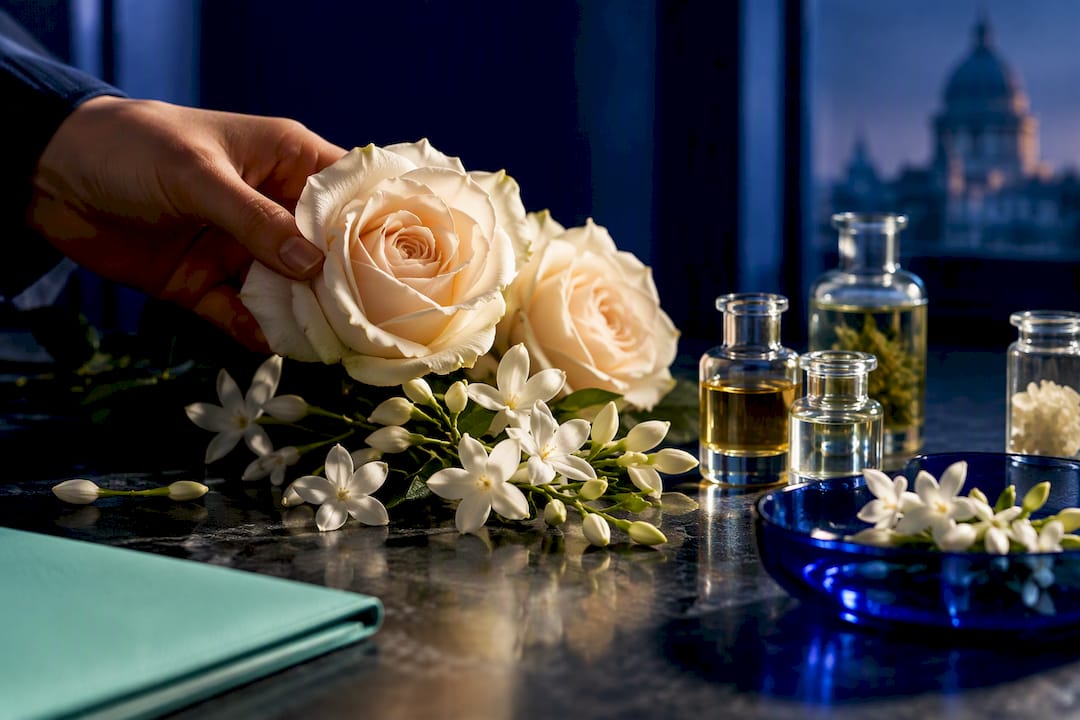
The raw materials inside a bottle of Chanel are extraordinary by volume alone. A 30ml bottle of Chanel No. 5 L’Extrait contains roughly 1,000 jasmine flowers and 12 May rose blooms, harvested and processed before a drop reaches the flacon. Jasmine absolute and May rose oil are among the costliest naturals in perfumery, priced by the gramme rather than the litre, and their yields shift with weather, soil and harvest timing.
Concentration tiers matter just as much as the ingredients themselves. An extrait de parfum can carry 20 to 40% aromatic compounds, an eau de parfum typically 15 to 20%, and an eau de toilette often under 15%. Every percentage point of oil added raises the cost per bottle, because that oil is the most expensive component in the formula, far more so than the alcohol, water or packaging around it.

Extraction methods add another layer of expense. Enfleurage, the traditional technique for capturing delicate florals like jasmine and tuberose, is slow, labour-intensive and low-yield, and luxury and niche houses increasingly lean on high concentrations of rare naturals extracted this way, which pushes prices upward across the category, not just at Chanel. Climate volatility compounds the issue, as poor harvests in Grasse or Bulgaria can tighten supply overnight.
The most costly materials tend to include:
- Jasmine absolute, prized for its rich, indolic sweetness and notoriously labour-intensive to harvest.
- May rose (rosa centifolia), picked by hand for a few weeks each year in southern France.
- Iris (orris) root, aged for years before it yields usable oil.
- Tuberose, another enfleurage candidate with painstaking extraction demands.
Statistic callout: A single 30ml bottle of No. 5 L’Extrait draws on roughly 1,000 jasmine flowers and 12 May rose flowers, a scale of floral sourcing that few mass market fragrances attempt.
Pro Tip: Check whether a fragrance is labelled extrait, eau de parfum or eau de toilette before comparing prices; a lower price on a higher concentration is a genuine bargain, while the reverse is not.
2. Craft, in-house perfumers and brand heritage
Chanel No. 5 was built on a formula that broke convention: Ernest Beaux combined around 80 ingredients, including synthetic aldehydes, to create an abstract floral unlike anything else on the market in 1921. That formulation legacy still underpins how the house prices and presents its fragrances a century later, treating heritage as an asset rather than a footnote.
Maintaining that legacy is not cheap. Houses that keep in-house perfumers, formulation libraries and dedicated studios carry substantial fixed costs, with industry commentary citing annual studio overheads running into the millions, compared with commissioning a formula from an external fragrance house. That overhead has to be recovered somewhere, and it shows up in the retail price.
Storytelling and celebrity association then magnify the perceived value well beyond the raw cost of goods:
- An in-house perfumery signals long-term investment in craft rather than a one-off commission.
- Decades of consistent marketing turn a formula into a cultural reference point.
- Association with instantly recognisable faces reinforces the sense of exclusivity that a lower-priced fragrance simply cannot buy.
3. Packaging, production scale and distribution costs
The juice inside the bottle is only part of the bill. Chanel’s packaging, from weighted glass to bespoke caps and limited-edition finishes, adds meaningful cost per unit, and prestige brands rarely cut corners here because the bottle itself is part of the product experience.
Distribution then adds a layer that many shoppers never see. Fragrance is classified as a restricted good for transport because of its alcohol content, which means specialist logistics, careful handling and allergen labelling are baked into the cost of every shipment. This is not a Chanel-specific burden; it applies across the category, but it disproportionately affects brands shipping globally at scale.
Testers and discovery sets are another recurring cost that prestige houses absorb rather than avoid, because sampling infrastructure is treated as a core commercial cost that must be modelled into price architecture rather than an afterthought.
Non-juice costs typically include:
- Heavy glass bottles and metal caps, chosen for tactile weight and shelf presence.
- Limited-edition finishes, boxes and inserts for seasonal or anniversary releases.
- Testers and discovery sets that retailers rely on to drive full-size purchases.
Statistic callout: Fragrance sits apart from skincare in distribution terms because alcohol content makes it a restricted good for transport, a classification that adds cost and complexity no other beauty category faces at the same scale.
4. Market positioning, retail control and perceived value
Chanel protects its price integrity by controlling where and how its fragrances are sold. Authorised retail channels keep pricing consistent and reinforce the sense that a bottle bought through the right door is worth more than one found elsewhere, whether or not the contents differ.
Scarcity plays the same role. Limited runs, capsule collections and niche-adjacent releases create demand precisely because supply is deliberately restricted, a tactic that separates designer houses chasing volume from those cultivating exclusivity. Chanel’s own product pages for releases such as the No. 5 L’Extrait set show how curated presentation and limited framing are built into the offer itself, not added afterwards.
For shoppers, the practical difference between authorised and discount channels is real. Which? found measurable price variation across UK retailers for the same Chanel bottles, with differences of up to 25% in some cases. Buying from an authorised retailer protects authenticity and warranty; a cheaper parallel import may save money but carries more risk if something goes wrong.
- Authorised retailers guarantee authenticity and after-sales support.
- Limited editions and capsule releases are priced to reflect scarcity, not just materials.
- Price differences between sellers often reflect distribution channel rather than product quality.
Readers weighing niche against designer fragrance more broadly may find it useful to explore niche versus designer perfume positioning before deciding where their money is best spent.
Expert perspective: the evidence behind Chanel’s pricing
This breakdown draws on named industry reporting rather than assumption. Iberchem’s technical profile of the aldehydes behind No. 5 confirms the ingredient volumes cited above, while the Financial Times’ coverage of rising perfume costs situates Chanel within a wider category trend toward expensive naturals and labour-intensive extraction. Logistics detail comes from Luxury Beauty Distribution’s analysis of how alcohol-based products move through the supply chain.
Fragrance pricing rarely comes down to one factor. It is the layering of rare materials, craft overhead, restricted logistics and deliberate scarcity that together explain a price tag most other cosmetics categories never approach.
Alexandria UK’s own fragrance academy content, including its explainer on why perfume is expensive, covers the same territory from a value-conscious angle for readers comparing designer originals against inspired alternatives.
- Iberchem’s ingredient data anchors the jasmine and rose figures cited throughout this piece.
- The Financial Times’ reporting on niche pricing situates Chanel within a broader industry pattern.
- Luxury Beauty Distribution’s logistics guidance explains the restricted-goods cost that applies across the fragrance category.
— dave
Limited editions and exclusivity
Limited editions exist to do one job: make scarcity feel like value. When Chanel releases a capsule set or an anniversary edition, the pricing reflects the promise that supply will run out, not simply the cost of the materials inside.
This is where niche and designer positioning start to blur. A house that releases a tightly limited batch, numbered or otherwise marked as finite, is borrowing a tactic long associated with niche perfumery, where exclusivity is often the primary selling point rather than a marketing layer on top of a mass-market formula. Readers curious about how far this can go should look at examples of genuinely rare, high-value fragrances, where extreme scarcity pushes prices into territory that has little to do with the ingredients themselves.
For the shopper, the practical takeaway is straightforward: a limited edition is rarely a better fragrance than the standard release, but it is almost always priced as though it is. Anyone chasing the scent rather than the scarcity is usually better served by the standard formulation, sold through an authorised channel, without paying a premium purely for a numbered box.
Comparison with competitors’ pricing strategies
Chanel is not alone in commanding premium prices, and it is worth understanding how its approach differs from the wider designer field. Some houses lean heavily on celebrity-fronted campaigns and heavy marketing spend to justify their pricing, treating the fragrance itself as almost secondary to the image built around it.
Chanel’s strategy leans more on heritage and formulation consistency than on marketing spend alone, which is one reason its core releases, No. 5 among them, have held a stable position for decades rather than depending on a rotating cast of campaign faces. Niche houses, by contrast, often price higher still, betting entirely on rare materials and small-batch scarcity rather than brand recognition.
The broader picture, as Financial Times reporting on rising perfume costs makes clear, is a market where prices are climbing across the board, driven by ingredient costs and supply pressures that affect designer and niche houses alike. Chanel sits toward the upper end of designer pricing precisely because it blends the ingredient intensity more common to niche perfumery with the marketing reach of a mainstream luxury house, a combination few competitors manage simultaneously.

Impact of celebrity endorsements and cultural influence
Coco Chanel understood the power of association long before modern marketing had a name for it, and that instinct still shapes how the house prices its fragrances today. Historical accounts of No. 5’s creation and marketing describe how deliberate storytelling and celebrity affiliation transformed a formulation into a cultural artefact almost as famous as the woman who launched it.
That cultural weight persists. A fragrance tied to enduring imagery carries a kind of value that has little to do with jasmine yields or bottle weight, yet it directly supports a higher price because buyers are paying, in part, for the association itself. Few competitors can claim a century of consistent cultural presence, which is precisely why imitation is so difficult to price convincingly against the original.
For readers weighing where their fragrance budget goes, it is worth separating the two things being sold: the scent itself, and the story wrapped around it. Both have value, but only one of them requires rare naturals and skilled formulation to reproduce.
What the price tag actually buys, and what it does not
The honest answer is that a meaningful share of what you pay for a bottle of Chanel goes toward genuine cost: rare naturals, in-house craft, restricted logistics and heavyweight packaging all add up in ways that are easy to verify. Where the conventional wisdom oversells things is in treating brand prestige as if it were interchangeable with formulation quality. It is not. A house can carry real heritage and still price a capsule release primarily on scarcity rather than on what is inside the bottle.
The mistake most buyers make is assuming that paying more automatically buys a better scent experience, rather than a better story. If the goal is simply to enjoy a fragrance profile you love, prioritising concentration and ingredient quality over packaging prestige or limited-edition framing will serve you better than chasing the name alone. Sampling before committing to a full bottle remains the most reliable way to separate what you are actually smelling from what you are being sold.
— dave
Alexandria UK options: inspired-by fragrances and discovery sets
If the ingredient cost and scarcity pricing behind Chanel’s originals have you curious rather than convinced, Alexandria UK’s inspired-by fragrances offer a lower-cost way to explore similar olfactory territory without the designer premium. Our formulations use high oil concentrations for longevity, and every blend is produced to comply with IFRA and cruelty-free standards.

Three options worth starting with:
- Dear Gabby, inspired by Chanel’s Gabrielle, for the luminous, sun-warmed floral profile of the original.
- China Affair, inspired by Chanel’s Coromandel EDP, for fans of its warm, resinous depth.
- Amazing Chypre, inspired by Roja Dove’s Chypre Extraordinaire (UK exclusive), for a mossy, sophisticated chypre profile.
Rather than committing to a full bottle before you know how a scent behaves on your skin, try our Sample Pack 6 x 5ml or our DISCOVERY SET first. It is the same logic that drives testers in prestige retail, applied at a fraction of the cost. Browse the full range across Women’s Fragrances, Men’s Fragrances and Unisex to find your match.
Further reading and primary sources
For readers who want to go directly to the reporting behind this analysis:
- Why has perfume become so expensive? (Financial Times)
- Ingredient profile: aldehydes, the success behind Chanel No. 5 (Iberchem)
- Fragrance distribution in the UK differs from skincare (Luxury Beauty Distribution)
- The cheapest shops to buy perfume (Which?)
- Chanel authentication guide (Insta-Auction)
Sources
- Ingredient profile: aldehydes — the success behind Chanel No. 5 | Iberchem
- Why has perfume become so expensive? — Financial Times
- Fragrance distribution in the UK differs from skincare | Luxury Beauty Distribution
- The cheapest shops to buy perfume | Which?
FAQ
Which is the most expensive perfume brand?
There is no single official ranking of the most expensive perfume brand, since pricing varies by release and rarity rather than by house alone. Ultra-niche and bespoke perfumers with tiny, rare-ingredient batches often exceed designer houses like Chanel on a per-bottle basis.
Which perfume is better, Dior or Chanel?
Neither is objectively better; both are premium designer houses with distinct formulation philosophies and comparable pricing strategies built on heritage, craft and controlled retail. The right choice depends on which olfactory family and brand story resonate with you.
What is the best smelling Chanel perfume?
This comes down to personal preference rather than a fixed answer, though No. 5 remains the house’s most historically significant release thanks to Ernest Beaux’s aldehyde-driven formulation. Readers exploring similar profiles at lower cost can try Dear Gabby, inspired by Chanel’s Gabrielle, for a comparable luminous floral character.
What is the cheapest luxury perfume?
Prices vary widely across authorised and discount retailers, and Which? found up to 25% variation between UK sellers for the same designer bottles. For a lower-cost route into similar scent profiles, Alexandria UK’s Sample Pack 6 x 5ml costs £59.99 and lets you test several inspired-by fragrances before buying a full bottle.