What Is the Best Cologne? Top Picks and Scent Profiles
Choosing a new cologne should feel exciting, yet so many options can quickly leave fragrance lovers in the UK uncertain about what truly sets a scent apart. With concentration levels and ingredient quality both shaping projection and wear time, finding a fragrance that offers real value and a distinct character becomes a rewarding challenge. This guide explores how scent complexity and longevity combine to define excellence, helping you recognise the qualities of premium colognes and discover impressive dupes that reflect your personal style.
Table of Contents
- What Makes A Cologne The Best?
- Different Cologne Types And Notes Explained
- Judging Quality: Ingredients And Longevity
- How Dupes Compare To Original Fragrances
- Common Mistakes When Choosing A Cologne
Key Takeaways
| Point | Details |
|---|---|
| Scent Complexity | The best colognes offer a multi-layered fragrance experience that evolves over time. |
| Cologne Concentration | Understand the different concentration levels to choose a fragrance that fits the occasion and desired longevity. |
| Ingredient Quality | High-quality natural ingredients create a richer and more authentic scent compared to synthetic options. |
| Skin Chemistry Awareness | Test cologne on your skin to see how it interacts with your unique body chemistry for the best results. |
What Makes a Cologne the Best?
Selecting the best cologne requires understanding several critical factors that elevate a fragrance from good to extraordinary. Scent complexity and longevity represent the fundamental characteristics that distinguish superior colognes from average offerings. A truly exceptional cologne combines multiple layers of fragrance notes, creating an intricate olfactory experience that evolves throughout the day.
Key considerations for evaluating cologne quality include:
- Fragrance Composition: A balanced blend of top, middle, and base notes
- Projection and Sillage: How widely the scent spreads and lingers
- Ingredient Quality: Natural versus synthetic fragrance components
- Unique Character: A distinctive scent profile that stands out
Understanding types of cologne categories helps discern which fragrances might suit individual preferences. Professional perfumers meticulously craft exceptional colognes by selecting high-quality essential oils, precisely balancing molecular interactions, and creating harmonious scent progressions that unfold gradually.

The sensory experience of a premium cologne extends beyond mere smell. It represents an intricate art form where molecular science meets creative expression. Professional perfumers consider factors like skin chemistry, temperature interactions, and emotional resonance when designing world-class fragrances.
Pro tip: Test a cologne on your skin for several hours to truly understand its unique characteristics and how it interacts with your personal body chemistry.
Different Cologne Types and Notes Explained
Understanding cologne concentration levels is crucial for selecting the perfect fragrance. Types of cologne varieties range from light and refreshing to deep and intense, each offering unique olfactory experiences that cater to different preferences and occasions.
Cologne concentration levels determine the fragrance’s strength and longevity:
Here’s a succinct comparison of how cologne concentration levels influence various aspects of the fragrance experience:
| Concentration Level | Typical Usage Scenario | Longevity on Skin | Ideal for |
|---|---|---|---|
| Eau de Cologne | Light daytime activities | 1-2 hours | Summer mornings |
| Eau de Toilette | Daily or office wear | 3-4 hours | Work or social events |
| Eau de Parfum | Evening occasions | 5-6 hours | Dinners and functions |
| Parfum/Extrait | Special occasions | 8-10 hours | Formal events |
-
Eau de Cologne: Lightest concentration (2-4% aromatic compounds)
- Perfect for casual, daytime wear
- Subtle and refreshing
- Typically lasts 1-2 hours
-
Eau de Toilette: Moderate concentration (5-15% aromatic compounds)
- Ideal for everyday use
- Balanced projection and longevity
- Lasts approximately 3-4 hours
-
Eau de Parfum: Higher concentration (15-20% aromatic compounds)
- Stronger and more persistent
- Suitable for evening events
- Lasts 5-6 hours
-
Parfum/Extrait: Highest concentration (20-30% aromatic compounds)
- Most intense fragrance experience
- Longest-lasting formulation
- Can persist 8-10 hours
Fragrance notes represent another critical aspect of cologne composition. These notes are strategically layered to create a complex sensory journey. Top notes provide the initial impression, typically featuring light, volatile molecules like citrus or herbal elements. Middle notes emerge after 15-30 minutes, introducing more rounded and balanced scent profiles. Base notes anchor the fragrance, delivering deep, long-lasting impressions with rich ingredients like sandalwood, vanilla, or musk.
Professional perfumers meticulously craft these olfactory symphonies, balancing molecular interactions to create harmonious scent progressions that unfold gradually and engage the wearer’s senses.
Pro tip: Always sample a cologne on your skin and allow it to develop for several hours to truly understand its unique note progression and how it interacts with your personal body chemistry.
Judging Quality: Ingredients and Longevity
Understanding the nuanced science behind fragrance quality requires deep insight into molecular composition and ingredient selection. Perfume longevity factors reveal a complex interplay between natural essential oils, synthetic compounds, and precise formulation techniques that determine a cologne’s ultimate performance.
Key ingredients influencing cologne quality include:
-
Natural Essential Oils: Extracted from botanical sources
- Provide authentic, rich scent profiles
- Higher molecular complexity
- More expensive and sophisticated
-
Synthetic Aroma Compounds: Laboratory-created molecules
- Consistent and predictable scent characteristics
- Enhanced stability
- More affordable production
-
Fixatives: Molecular stabilisers
- Slow fragrance evaporation
- Extend overall wear time
- Include ingredients like resins and musks
The molecular weight of fragrance components plays a critical role in determining longevity. Heavier molecules found in base notes such as sandalwood, amber, and musk evaporate more slowly, creating a persistent olfactory experience. Professional perfumers strategically balance these molecular structures to craft fragrances that unfold dynamically across different wear stages.
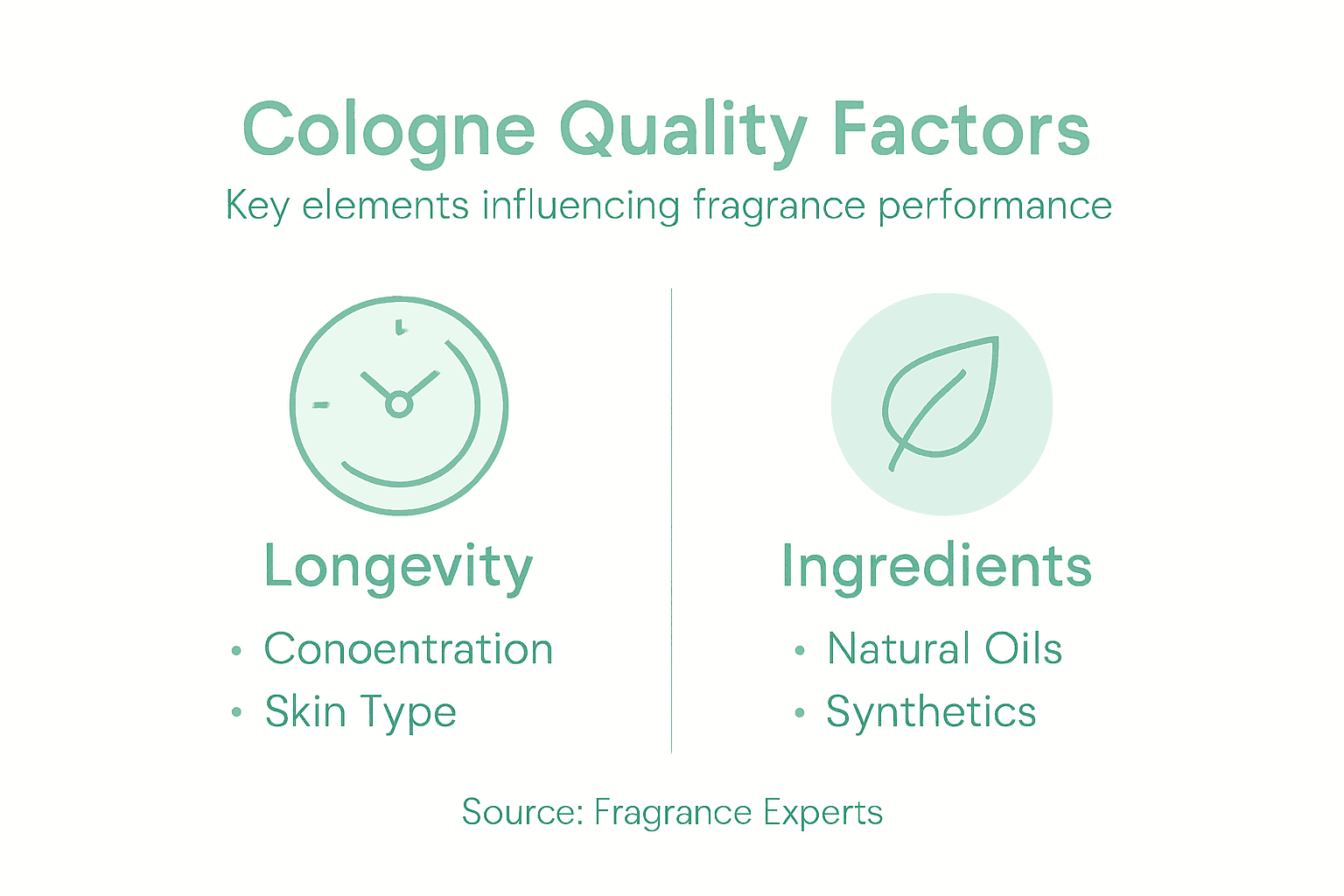
Environmental factors and individual skin chemistry further modulate a cologne’s performance. Temperature, humidity, and personal biochemistry interact uniquely with fragrance molecules, creating a personalised scent experience that transcends standard laboratory measurements.
Below is a summary highlighting core factors that affect how a cologne performs for different people:
| Factor | Impact on Fragrance Performance | Practical Implication |
|---|---|---|
| Skin Chemistry | Changes scent development | Scent may differ per wearer |
| Temperature & Humidity | Alters evaporation rate | Longevity varies seasonally |
| Storage Conditions | Preserves fragrance stability | Cool, dark storage prolongs life |
Pro tip: Store your favourite colognes in cool, dark environments to preserve their molecular integrity and prevent premature degradation of delicate aromatic compounds.
How Dupes Compare to Original Fragrances
In the world of fragrances, dupe perfumes have emerged as a compelling alternative to high-end designer scents. Dupes vs. Originals Quality Comparison reveals a nuanced landscape where affordability meets sophisticated olfactory experiences.
Key differences between original fragrances and dupes include:
-
Ingredient Quality
- Original: Premium, rare natural ingredients
- Dupe: Synthetic equivalents with similar molecular structures
-
Price Point
- Original: Significantly more expensive
- Dupe: 30-70% of original’s retail cost
-
Longevity
- Original: Often more complex, longer-lasting scent profiles
- Dupe: Comparable performance with potential slight variations
-
Packaging and Branding
- Original: Luxury packaging, brand prestige
- Dupe: Functional, cost-effective presentation
Professional perfumers and chemists meticulously analyse molecular compositions to create dupe fragrances that closely mimic high-end scents. These alternatives undergo rigorous development processes, targeting specific aromatic notes and attempting to replicate the intricate layering of original designer fragrances.
The perception of quality extends beyond mere chemical composition. While dupes strive to capture the essence of premium fragrances, subtle nuances in scent progression and depth can distinguish them from their more expensive counterparts. Discerning fragrance enthusiasts often appreciate dupes for their intelligent interpretation of complex scent profiles.
Pro tip: Always test a dupe fragrance on your skin and allow it to develop for several hours to truly appreciate its unique characteristics and how it compares to the original scent.
Common Mistakes When Choosing a Cologne
Selecting the perfect cologne requires more nuance than simply grabbing an attractive bottle off the shelf. Cologne Selection Mistakes reveal a complex landscape of potential pitfalls that can undermine even the most well-intentioned fragrance purchase.
Common mistakes when choosing a cologne include:
-
Impulse Purchasing
- Buying without proper testing
- Selecting based on packaging or brand prestige
- Ignoring personal body chemistry
-
Misunderstanding Fragrance Characteristics
- Judging solely by initial top notes
- Overlooking scent evolution
- Neglecting seasonal appropriateness
-
Application Errors
- Overapplying fragrance
- Applying to incorrect pulse points
- Using same scent year-round
-
Narrow Fragrance Perspective
- Rigidly adhering to gendered marketing
- Avoiding exploration of diverse scent profiles
- Assuming higher price equals superior quality
Professional fragrance experts emphasise the importance of understanding personal body chemistry. Each individual’s skin interacts uniquely with aromatic molecules, meaning a scent that smells remarkable on one person might seem entirely different on another. This biochemical interaction creates a complex olfactory experience that transcends simple product selection.
Context and subtlety play crucial roles in successful cologne selection. A sophisticated fragrance enthusiast considers multiple factors: skin type, lifestyle, professional environment, and personal style. These nuanced considerations transform cologne selection from a mere purchase into a personal statement of identity.
Pro tip: Always test a cologne on your skin and allow it to develop for several hours, observing how the scent transforms and interacts with your unique body chemistry.
Discover Your Perfect Cologne with Confidence
Finding the best cologne can feel overwhelming when faced with so many scent profiles, concentration levels and the mystery of how fragrances interact with your skin chemistry. You want a fragrance that not only smells exceptional but also lasts throughout your day and fits your lifestyle. At Alexandria UK, we understand these challenges and offer a carefully curated selection inspired by premium scents and high-quality dupes that prioritise longevity, authenticity and sophistication.
Explore our collection today and experience the difference personalised fragrance selection can make. From refreshing Eau de Colognes to enduring Parfums, our range empowers you to find your signature scent effortlessly. Start your journey now with Alexandria UK where quality meets affordability, and gain confidence in every spritz. Visit our website to access expert guidance and exceptional fragrances designed just for you.
Frequently Asked Questions
What are the key factors that define the best cologne?
The best cologne is defined by scent complexity, longevity, ingredient quality, projection, sillage, and its unique character. A superior fragrance offers a balanced blend of notes that evolve throughout the day.
How do I choose the right type of cologne concentration?
Choosing the right cologne concentration depends on the occasion. Eau de Cologne is light and refreshing for daytime use, Eau de Toilette is suitable for daily wear, Eau de Parfum is ideal for evening events, and Parfum/Extrait is perfect for special occasions due to its high concentration and long-lasting nature.
What is the difference between natural essential oils and synthetic aroma compounds in colognes?
Natural essential oils are extracted from botanical sources and offer rich, authentic scent profiles. In contrast, synthetic aroma compounds are lab-created, providing consistency and often lower costs, but they may lack the depth found in natural ingredients.
Why is it important to test cologne on my skin before purchasing?
Testing cologne on your skin allows you to experience how it evolves and interacts with your body chemistry, which greatly influences the scent’s final impression. Each individual’s skin can alter the fragrance, making it essential to test it over several hours before deciding.