

How to Test Multiple Perfumes for Lasting Quality
Most British perfume fans find that testing fragrances at home leads to surprisingly varied results. Selecting affordable dupes or luxury scents without a professional setup can make even seasoned fragrance enthusiasts second guess their choices. Creating the right environment and following expert protocols matters more than you might think, especially since over 90 percent of scent judgments depend on precise testing conditions. Get clear, actionable tips to help you confidently compare quality and longevity so every purchase feels rewarding.
Table of Contents
- Step 1: Prepare Your Testing Environment
- Step 2: Select And Organise Your Perfume Samples
- Step 3: Apply Fragrances Using Proper Techniques
- Step 4: Compare Scent Profiles Over Time
- Step 5: Assess Longevity And Quality On Your Skin
Quick Summary
| Key Insight | Explanation |
|---|---|
| 1. Create a neutral testing environment | Use a scent-free space with stable temperature and proper lighting to ensure accurate fragrance evaluation. |
| 2. Organise perfume samples strategically | Gather a diverse collection of scents, and label them to facilitate thorough and systematic testing. |
| 3. Apply fragrances with care | Use blotters for initial tests and apply to pulse points gently to avoid altering scent characteristics. |
| 4. Document scent progression systematically | Track changes in fragrance notes at consistent intervals to understand the evolution of each scent. |
| 5. Assess longevity on your skin | Test how fragrances perform over hours on your skin to gauge quality and personal response accurately. |
Step 1: Prepare your testing environment
Creating a proper environment for perfume testing is critical to obtaining accurate and reliable sensory results. Controlled testing conditions are fundamental to understanding fragrance characteristics with precision and consistency.
To establish an ideal fragrance testing setup, select a neutral space free from competing odours and external distractions. Your testing area should have consistent temperature approximately 20 to 22 degrees Celsius, good ventilation, and minimal airflow that might disrupt scent perception. Professional fragrance assessment protocols recommend using neutral rooms with rigorous environmental controls to eliminate potential contamination and sensory interference.
Choose a well-lit room with natural daylight if possible, avoiding harsh fluorescent lighting that could impact your olfactory experience. Ensure you have a clean surface like a white ceramic tile or plain white paper where you can apply and observe fragrance samples. Have cotton wool buds, blotting paper, and a glass of water nearby to refresh your olfactory senses between testing different perfumes.
Expert Advice: Keep a small fan nearby to help quickly clear lingering scent molecules between perfume tests, ensuring each fragrance receives an unbiased assessment.
Here is a summary of key environmental factors for effective perfume testing:
| Factor | Ideal Condition | Potential Impact if Uncontrolled |
|---|---|---|
| Room Odour | Neutral, scent-free | Unwanted smells interfere with perception |
| Temperature | 20–22 °C, stable | Alters scent volatility and molecule release |
| Lighting | Natural daylight, gentle | Harsh light affects olfactory accuracy |
| Airflow | Minimal, well ventilated | Disrupts scent observation and persistence |
| Surface for Testing | White, clean, non-porous | Contamination or colour bias may occur |
Step 2: Select and organise your perfume samples
Sampling multiple perfumes requires strategic selection and thoughtful organisation to ensure a comprehensive and accurate testing experience. Your goal is to create a systematic approach that allows for fair and nuanced fragrance evaluation.
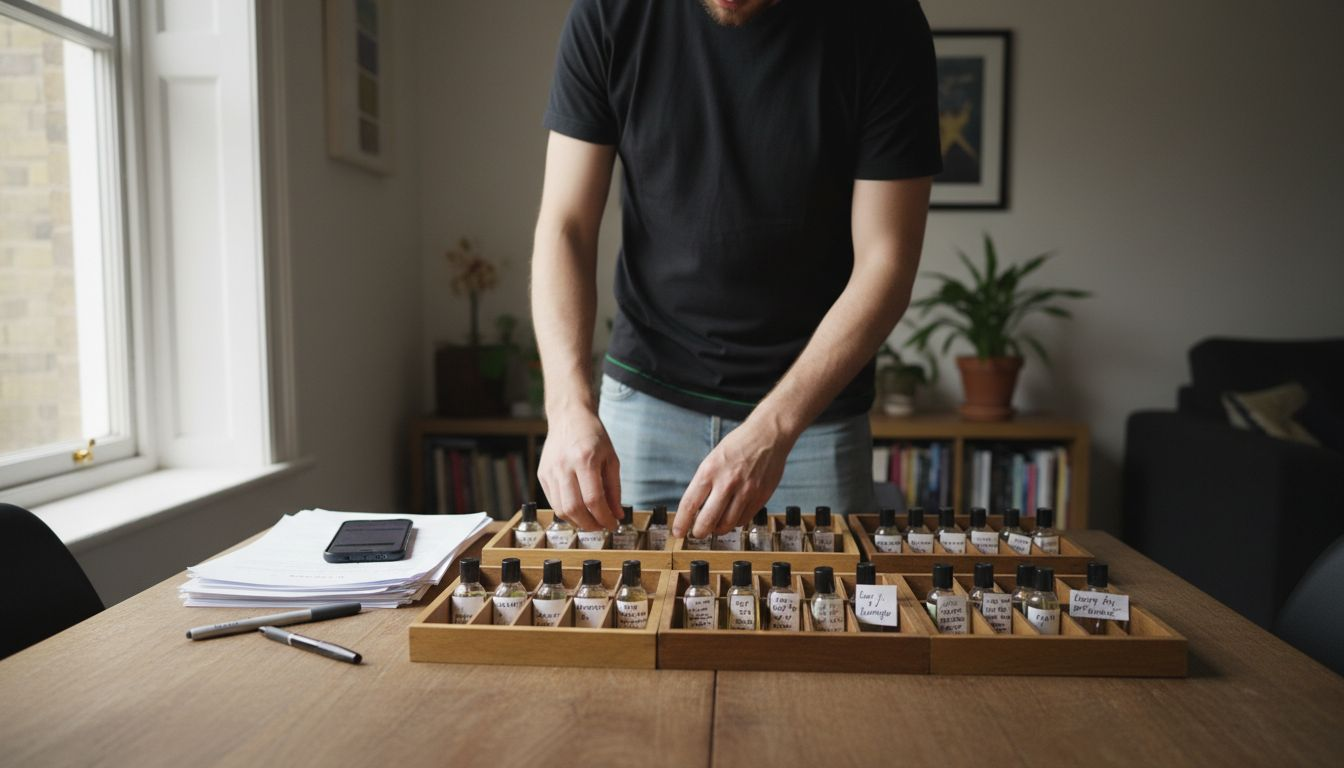
Start by gathering samples that represent diverse scent profiles across different fragrance families such as woody, floral, oriental, and fresh categories. Aim for a balanced collection that includes variations in concentration (eau de toilette, eau de parfum) and notes. Professional fragrance storage requires careful organisation to maintain sample integrity, so invest in a dedicated storage solution like an acrylic organiser or compartmentalised box that protects samples from light, heat, and humidity.
Label each sample with key information including fragrance name, house, concentration, and date of acquisition. Group your samples logically perhaps by scent family, season, or intensity. This systematic approach will help you track your testing progress and make meaningful comparisons. Keep your samples in a cool, dark place away from direct sunlight and temperature fluctuations to preserve their original character.
For our fragrance discovery guide on finding quality scents, consider including both familiar and unfamiliar fragrances to broaden your olfactory understanding.
Expert Advice: Create a simple spreadsheet or testing journal to document your impressions, noting initial reactions, development over time, and personal ratings for each perfume sample.
Step 3: Apply fragrances using proper techniques
Applying perfumes requires precision and understanding to fully capture their complex sensory profile. Professional perfume evaluation techniques emphasise systematic application methods that reveal the true character of each fragrance.
Begin by testing initial impressions using fragrance blotters, which allow you to experience the top notes without skin chemistry interference. When transitioning to skin application, focus on pulse points such as wrists, neck, and behind the ears where body heat naturally diffuses the scent. Apply a small amount using gentle dabbing motions rather than rubbing, which can crush and alter the molecular structure of the perfume.
For comprehensive self-care and fragrance longevity techniques, ensure your skin is clean and lightly moisturised before application. This helps the fragrance adhere better and develop more consistently. Space out your testing intervals to prevent olfactory fatigue and document your impressions at different stages of the fragrance development.
Expert Advice: Wait at least 15 minutes between testing different fragrances and cleanse your olfactory palate with coffee beans or plain bread to reset your sensory perception.
Step 4: Compare scent profiles over time
Comparing fragrance profiles requires a systematic and patient approach that allows you to understand the complex evolution of different perfumes through their various stages of development. Your goal is to capture the nuanced transformations that occur from initial application to final dry down.
Start by documenting the fragrance progression at consistent intervals typically 15 minutes, 1 hour, and 4 hours after initial application. Note how the top notes (initial burst of scent), heart notes (core fragrance), and base notes (lasting undertones) interact and change over time. Understanding scent profiles from floral to woody categories will help you recognise the characteristic developments of different fragrance families.
A comparison of fragrance note development intervals:
| Stage | Time from Application | Typical Scent Characteristics |
|---|---|---|
| Top Notes | First 0–15 minutes | Fresh, bright, first impression scents |
| Heart Notes | 15–60 minutes | Core, defining, harmonious components |
| Base Notes | 1–4 hours or longer | Deep, lasting, underlying foundations |
Create a structured comparison matrix that tracks key characteristics such as projection strength, longevity, complexity, and personal emotional response. Pay attention to how different fragrances perform on your skin chemistry, as this can dramatically alter their perceived character. Some perfumes might bloom beautifully after an hour, while others might fade quickly or develop unexpected nuances.
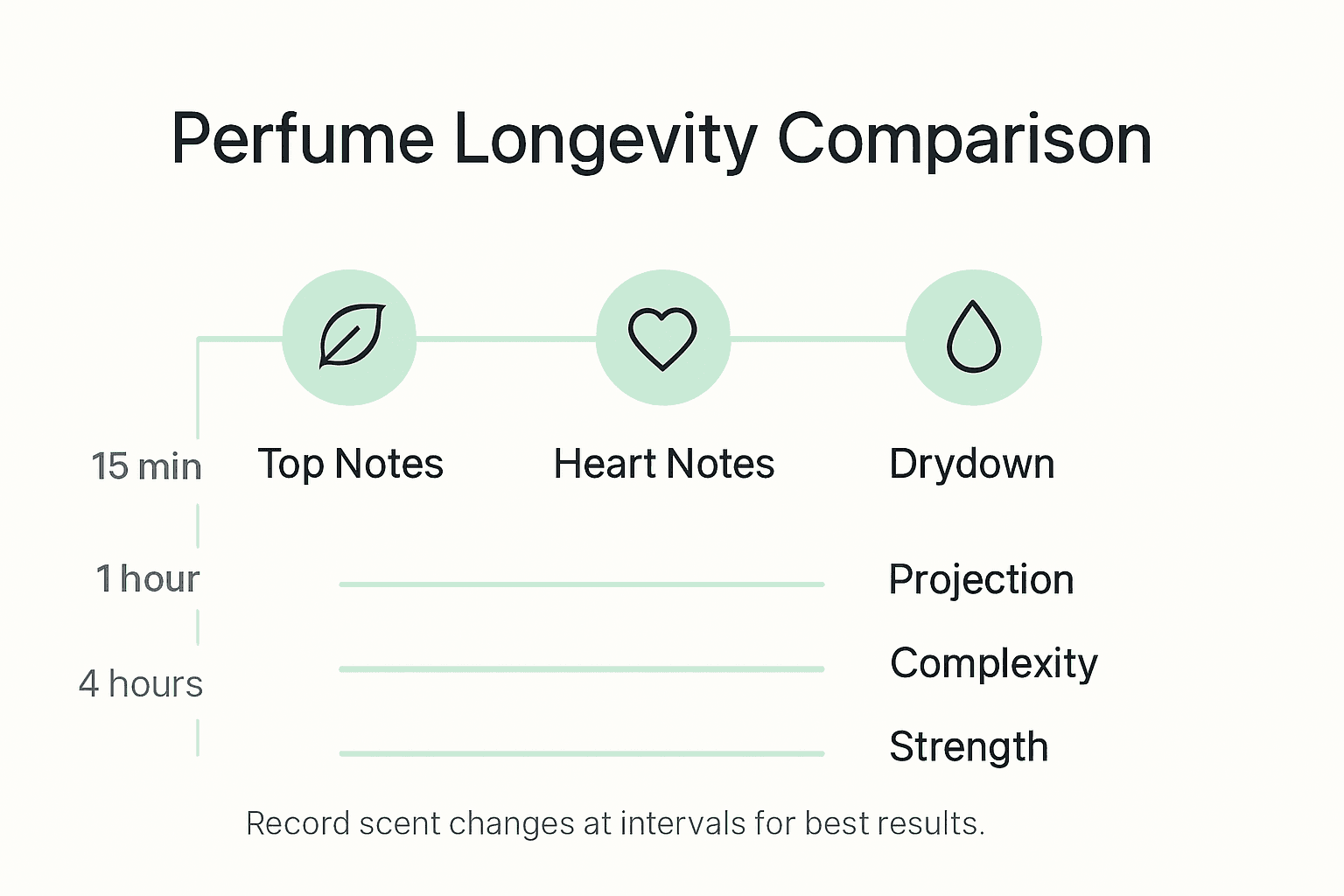
Expert Advice: Use a dedicated notebook or digital tracking app to record precise observations about each fragrance, including environmental conditions and your personal state during testing to ensure consistent and meaningful comparisons.
Step 5: Assess longevity and quality on your skin
Assessing a perfume’s true quality requires more than initial impressions. You need a systematic approach that reveals how fragrances perform uniquely on your individual skin chemistry over extended periods.
Professional longevity testing combines standardised sensory analysis with precise interval measurements, allowing you to understand how different perfumes evolve. Apply fragrances to clean, lightly moisturised skin areas such as inner wrists, neck, and behind ears. Document the scent progression meticulously noting intensity, character shifts, and molecular persistence at consistent intervals 15 minutes, 1 hour, and 4 hours after application.
Consider multiple variables that impact fragrance performance including skin hydration, environmental temperature, personal body chemistry, and perfume concentration. Some fragrances might develop magnificently on certain skin types while appearing muted or transformed on others. Why Fragrance Lasts explores the science behind quality and performance, providing deeper insights into these complex interactions.
Expert Advice: Maintain consistent testing conditions by wearing similar clothing, testing at similar times of day, and avoiding strong competing scents to ensure accurate and comparable fragrance assessments.
Discover Quality Perfumes That Stand the Test of Time
Testing multiple perfumes for lasting quality can be challenging when faced with varying scent longevity and changing olfactory experiences. If you often struggle to find fragrances that truly perform well on your skin, retain their character, and provide a rich scent journey from top notes to base notes, you are not alone. The key pain points include inconsistent longevity, difficulty in assessing true scent development, and skin chemistry affecting fragrance appearance. This is where thoughtful selection and high-quality choices make all the difference.
Explore our exclusive collection at Alexandria UK where quality is our focus. We offer premium perfumes and inspired dupes crafted to deliver lasting wear and refined scent profiles. Begin your experience with confidence by choosing from carefully curated fragrances that excel in projection, complexity, and longevity. Dive deeper into the art of scent evaluation by reading our Fragrance Discovery Tips and master your perfume journey with expert guidance at Alexandria UK. Start exploring now to enjoy fragrances that truly reflect your unique style and stand strong throughout your day.
Frequently Asked Questions
How can I prepare my environment for testing multiple perfumes?
Creating a neutral, scent-free environment is essential for accurate perfume testing. Choose a space with a stable temperature between 20 to 22 degrees Celsius and good ventilation. Ensure the area is well-lit with natural light, and use a clean surface to apply fragrance samples.
What is the best way to organise my perfume samples for testing?
Strategically select and label your perfume samples to allow for effective comparisons. Group them by scent family, intensity, or concentration, and invest in a storage solution that protects them from light and humidity. This organisation will help streamline your testing process and track your evaluations.
What techniques should I use when applying perfumes for testing?
Use fragrance blotters first to capture top notes without skin interference, and then apply small amounts to pulse points using gentle dabbing motions. Avoid rubbing the fragrance into your skin, as this can distort the scent’s molecular structure. Spacing out applications will also prevent olfactory fatigue.
How can I effectively compare different perfume scent profiles?
Document the fragrance profiles at consistent intervals, such as 15 minutes, 1 hour, and 4 hours after application. Note how the top, heart, and base notes evolve over time, and look for differences in projection strength and longevity. Use a comparison matrix to track key characteristics and personal impressions.
What factors should I consider when assessing a perfume’s longevity on my skin?
Skin chemistry, hydration, and environmental conditions significantly influence a perfume’s longevity. To assess how a fragrance develops, apply it to clean, moisturised skin and document the scent’s intensity at intervals. This approach helps you understand how well a perfume performs under consistent testing conditions.
How can I reset my olfactory senses between testing perfumes?
To refresh your olfactory palate, consider sniffing coffee beans or chewing plain bread between tests. Doing so helps eliminate lingering scent molecules, allowing you to experience new fragrances more accurately. Wait at least 15 minutes before testing a new perfume for the best results.


