
How to Choose a Perfume for a Woman: An Expert Guide
The surest way to choose a perfume for a woman is to start from what she already loves: the notes, the fragrance family and the mood of a scent she reaches for again and again. Match those, check the concentration, then test a short list on skin before you commit. A small sample set lets you do all of that for far less than the price of a full bottle, which is exactly how bargain hunters and fragrance enthusiasts find a signature scent without an expensive misstep.
This guide walks through the method a perfumer would use at the counter, translated into steps you can follow at home, whether you are buying for yourself, a partner, a mother or a friend.
TL;DR
- Begin with a scent she already wears or admires, then identify two or three notes that define it.
- Learn the five broad families (fresh, floral, woody, amber and chypre) and shop within the one she gravitates towards.
- Check the concentration: eau de parfum and above generally last longer, but compare versions rather than assuming.
- Test no more than three scents at a time, on skin, and live with them for hours before deciding.
- A sample pack or discovery set lets you test several candidates before committing to a full bottle.
Table of Contents
- Start with the scents she already loves
- Understand the scent families
- Turn one favourite into a shortlist
- Match the perfume to season, occasion and wear
- Read the concentration, not just the name
- Test properly, on skin
- If she has sensitive skin or reacts to scent
- Our perspective
- Try before you commit
- A simple checklist before you buy
- FAQ
- Sources
Start with the scents she already loves
Forget the idea that a perfume should be “feminine” in some fixed sense. The most useful starting point is personal history. Ask which fragrance she has worn longest, which candle she lights, which hand cream she finishes first. Business Insider’s guide to finding your fragrance, drawing on professional advice, recommends noticing the categories and specific notes you naturally enjoy, then keeping a list of everything you try so that patterns emerge.
The list works in both directions. Scento’s guide to sampling perfume online suggests comparing favourites with scents you dislike: notes that repeat across favourites become notes to seek out, while those linked to anything harsh, cloying or irritating become your avoid list. Five minutes with a pen produces a brief more reliable than any “personality quiz”.
If you are buying a gift and cannot interrogate the recipient, look at what is already on her dressing table. A nearly empty bottle is the best clue you will ever get.
Understand the scent families
Fragrance families are an industry classification based on a perfume’s dominant character. The Perfume Society describes them as a way of identifying preferences rather than strict boundaries, and suggests exploring near relations of a family you already enjoy to find new favourites. Our own guide to popular perfume families and choosing your signature scent goes deeper into each one.
Here is a working map, with typical notes drawn from The Perfume Society’s family guide and Fragscent’s notes guide:
| If she loves… | Look in this family | Typical notes |
|---|---|---|
| Clean laundry, citrus peel, morning air | Fresh | Bergamot, lemon, orange, musk |
| Bouquets, garden roses, wedding flowers | Floral | Rose, jasmine, peony, gardenia, iris |
| Dry timber, libraries, cashmere | Woody | Cedar, vetiver, sandalwood, oudh |
| Dessert, cosy evenings, warmth | Amber or gourmand | Vanilla, tonka, amber |
| Polished elegance, a classic feel | Chypre | Bergamot, oakmoss, patchouli, labdanum |
| Warm, rich, slightly daring | Amber or woody with spice | Saffron, cardamom, pink pepper |
A second route is to start from a mental picture. Fragrantica’s practical guide maps impressions to families: a love of flowers points to floral or soliflore (single-flower) scents, the beach to coconut, vanilla and aquatic notes, clean laundry to musk and soft florals, and a sweet tooth to gourmand perfumes.
A quick note on chypre
Chypre (pronounced “sheep-ruh”) is the family newcomers find hardest to picture. It is dry, warm and slightly mossy, built around bergamot, oakmoss, patchouli and labdanum, often with floral or fruity touches. If she adores vintage-style elegance, this is the family to explore.
Turn one favourite into a shortlist
This is the technique that makes shopping efficient, and the one most guides skip. Fragscent recommends identifying two or three defining notes in a favourite, often in the heart or base, then looking for perfumes that share those notes and sit in the same broad family.
- Name the favourite. Say it is a rose-and-musk scent she has worn for years.
- Pull out the defining notes. Rose and white musk, perhaps with a trace of vanilla.
- Search for neighbours. Look for other perfumes in the floral family that share rose and musk but differ in the supporting cast: a peppery twist, a woody base, a fruitier top.
- Sample the neighbours. The same notes can be blended in different proportions and with different materials, so two rose perfumes can smell nothing alike.
This is also where inspired-by fragrances earn their reputation among bargain hunters. If the favourite is a prestige bottle, an inspired-by alternative lets you explore that style at a friendlier price, and the shortlist method above tells you which ones deserve a sniff.
Match the perfume to season, occasion and wear
Style is personal, but context shapes enjoyment. The Perfume Society’s FAQ notes that fragrance can seem stronger and more overpowering in hot weather, while many people prefer fuller, comforting scents in winter, and it stresses that seasonal choices remain a matter of taste.
A practical way to apply this:
- Warm months and daily wear: lighter fresh, citrus and soft floral scents sit comfortably close to the skin.
- Cold months and evenings: amber, gourmand, woody and spicy compositions feel richer and wrap around a winter coat.
- Shared offices: Harper’s Bazaar’s 2026 workplace guide quotes a beauty expert who says the amount you apply can matter more than whether the juice is luxury-priced, and who favours a scent that complements rather than dominates.
If she wants a perfume for every occasion, do not look for one miracle bottle. Two is the sweet spot: one bright, easy scent for daytime and one deeper, more sensual scent for evenings.
Read the concentration, not just the name
Concentration is the proportion of aromatic materials in the carrier. The Perfume Society’s scent strength guide gives rule-of-thumb ranges:
| Type | Typical aromatic concentration |
|---|---|
| Cologne | 2 to 4% |
| Eau de toilette | 4 to 8% |
| Eau de parfum | 8 to 15% |
| Perfume | 15 to 25% |
| Extrait | 20 to 30% |
A higher proportion generally lasts longer and costs more, though brands vary. Different concentrations of the same name can also carry different notes, so compare versions rather than assuming one is merely a louder copy of another. For a bargain hunter, this is the number to watch: a generously concentrated eau de parfum at a modest price is where the real value sits. Our claim at Alexandria is that our inspired-by perfumes use high oil concentrations for long-lasting performance, which is why we think of value in terms of wear time per pound rather than the price on the label.
Test properly, on skin
A fragrance smells different in the first minute from how it smells at hour four, and the later stage is the one you live with. The method below combines advice from The Perfume Society and Business Insider’s expert interviews.
- Screen on paper. Use blotters to rule options in or out. A blotter alone is not enough to decide, so treat it as a filter.
- Limit the line-up. No more than three fragrances on the body, or three or four in a session, so your nose does not tire.
- Space your sniffs. Leave about ten minutes between them and allow the alcohol and top notes to settle.
- Wear the finalist. Spray it on skin and watch how it changes through the heart and base over the day.
- Mind your nose. The Guardian’s 2024 expert advice points out that you can stop smelling a familiar scent after a few hours through olfactory adaptation, even though others still notice it. Ask someone else before you decide a perfume has vanished.
We cover the details in our guides to the best ways to test perfume, testing multiple perfumes and testing perfume in store.
Choosing online without smelling first
Buying blind is far less risky than it sounds if you shop by notes and family and begin with samples. Our connoisseur’s guide to choosing a perfume online explains how to read a description and translate it into what you will actually smell.

If she has sensitive skin or reacts to scent
For anyone who reacts to fragrance, comfort comes first. The British Society for Cutaneous Allergy advises checking ingredient lists and avoiding the specific fragrance chemical responsible for a contact allergy, and says that if reactions involve two or more fragrances or continue, it is usually best to avoid all fragrances. A history of reactions is a reason to speak to a GP or dermatologist before you buy a gift, and to patch test any new scent on a small area of skin first.

For people who are simply sensitive to strong scents, a women’s perfume guide approach of favouring lighter, cleaner, less complex compositions, typically fresh or green, tends to feel easier to wear. Apply a single spray and build from there.
Our perspective
Choosing a perfume is an act of listening. The woman you are buying for has already told you what she loves, in the candles she burns and the bottle she keeps refilling. Our job, as we see it, is to help you hear it.
We build Alexandria around inspired-by fragrances because we believe the pleasure of a beautiful accord should not depend on a designer price tag. We formulate with high oil concentrations so that the scent you fall in love with in the first hour is still with you at the end of the day, and we make our perfumes in an ethical, cruelty-free, IFRA-compliant way.
That is also why we offer sample packs and discovery sets: the best decision is the one made on your own skin, over a whole day. Start small, find the family that makes her pause mid-sentence, and then choose the full bottle with confidence.
dave
Try before you commit
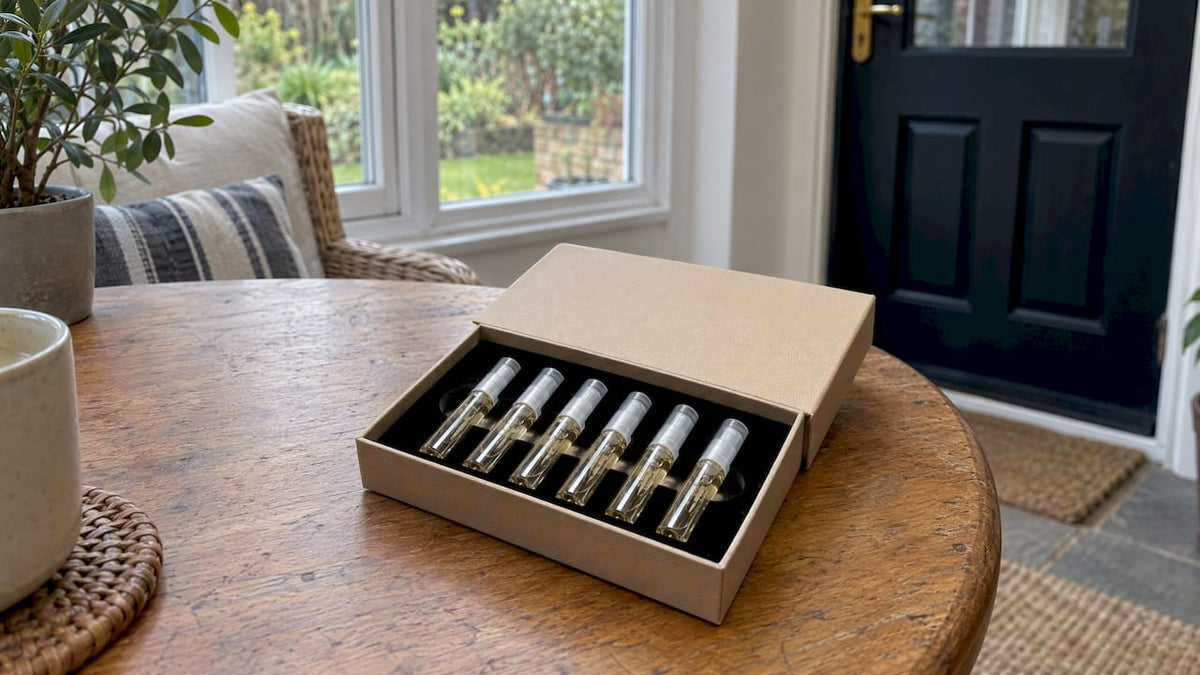
The cheapest mistake is the one you never make. Our Sample Pack of 6 x 5ml is £59.99, which lets you test a spread of scents across families on skin, and our Discovery Set is US$83. If you already know her style, browse the women’s fragrances, or explore unisex scents for woody and amber lovers who dislike anything overly sweet.

For something truly one of a kind, our bespoke personal blend service creates a scent around her own preferences, and our Original Creations collection offers signature compositions that are our own.
Want the full method laid out step by step? Our guide on how to find the best perfume for you is the pillar resource for everything in this article, and our companion article on how to choose a perfume for a woman offers a second expert angle. To get more from the bottle once you have chosen it, read how to make perfume last naturally.
A simple checklist before you buy
- Can you name two or three notes she already loves?
- Have you identified the family that fits those notes?
- Is the concentration an eau de parfum or higher if you want longer wear?
- Does the season and the occasion suit the scent’s weight?
- Have you tested it on skin and lived with it for several hours?
- If she is sensitive, have you checked the ingredient list and patch tested?
If you can answer yes to most of these, you are far more likely to land on a scent she wears daily rather than one that sits in a drawer.
FAQ
How do I choose a perfume if I don’t know her taste?
Look at what she already wears or the products she uses, then choose a crowd-pleasing family such as soft florals, fresh citrus or a gentle vanilla musk. Better still, give her a sample set so that she picks the winner herself.
Is a more expensive perfume always better?
Not necessarily. Price reflects brand, packaging and concentration, and Harper’s Bazaar’s workplace guide quotes an expert who says the amount applied can matter more than whether the juice is luxury-priced. Look at concentration and how the scent develops on skin rather than the label.
How long should I wait before deciding?
Give a perfume several hours on skin so that the heart and base notes appear. The Perfume Society recommends living with a sample before deciding, and testing no more than three fragrances on the body at once.
Which concentration lasts longest?
Generally, the higher the proportion of aromatic materials, the longer a scent lasts, so extrait and perfume tend to outlast eau de toilette. Brands vary, so compare the specific versions rather than relying on the category alone.
Sources
- How to Figure Out Which Fragrance Is Best for You, Business Insider
- How to Sample Perfume Online Without Smelling It First, Scento
- Fragrance Families, The Perfume Society
- Fragrance families: what are they?, The Perfume Society
- How to Find a Perfume by Notes and Match a Scent, Fragscent
- How Do We Decide Which Perfume is Right for Us?, Fragrantica
- FAQs, The Perfume Society
- An Expert Guide to Wearing Perfumes at the Office, Harper’s Bazaar
- Cologne to Parfum: scent strength guide, The Perfume Society
- How do I know if a perfume is going to suit me?, The Guardian
- Fragrance mix I and II, British Society for Cutaneous Allergy