

Scent profiles explained: 4 fragrance families decoded
TL;DR:
- Understanding scent profiles helps collectors make intentional fragrance choices and build a personal wardrobe.
- Fragrances are classified into four main families: Fresh, Floral, Woody, and Amber, each with distinct notes and moods.
- Personal perception of scents varies, so trusting your nose is essential for discovering fragrances that truly resonate.
Most fragrance enthusiasts assume they know their preferences. They reach for something ‘floral’ or ‘woody’ and call it done. Yet the aromatic world is far richer than those broad strokes suggest, with four main families and 14 distinct subfamilies shaping every bottle on the shelf. Understanding scent profiles transforms the way you select, collect, and layer perfumes. It shifts you from guessing to knowing, from impulse buying to intentional curation. This article walks you through the science, the classification systems, and the practical tools that serious collectors use to build a fragrance wardrobe that truly reflects who they are.
Table of Contents
- What is a scent profile? Defining the basics
- The four main scent profile families and their subfamilies
- Methods of classifying scent profiles: Experts versus everyday wearers
- How to use scent profiles in perfume selection
- A collector’s perspective: Why your nose should lead, not labels
- Explore curated scent profiles at Alexandria UK
- Frequently asked questions
Key Takeaways
| Point | Details |
|---|---|
| Profiles add depth | Learning the main scent families and profiles reveals more nuance than basic fragrance labels. |
| Personal preference rules | Your favourite scent will depend on molecular structure and personal background as well as family classifications. |
| Guided exploration matters | Using structured frameworks like the Fragrance Wheel helps refine your collection and amplify enjoyment. |
| Experimentation pays off | Combining and layering scents across families can create truly unique and memorable experiences. |
What is a scent profile? Defining the basics
A scent profile is the complete aromatic fingerprint of a fragrance. It describes not just the dominant notes you smell on first spray, but the full arc of a perfume’s journey: the bright top notes that greet you, the heart notes that define its character, and the base notes that linger on your skin for hours. Think of it as a fragrance’s biography, written in chemistry and sensation.
Understanding scent profiles matters enormously for collectors and enthusiasts. Without this framework, you are essentially shopping blind. Two perfumes might both be labelled ‘floral’, yet one could be a luminous, dewy white floral anchored by musk, while the other is a dark, heady rose draped in oud. The label tells you almost nothing. The profile tells you everything.
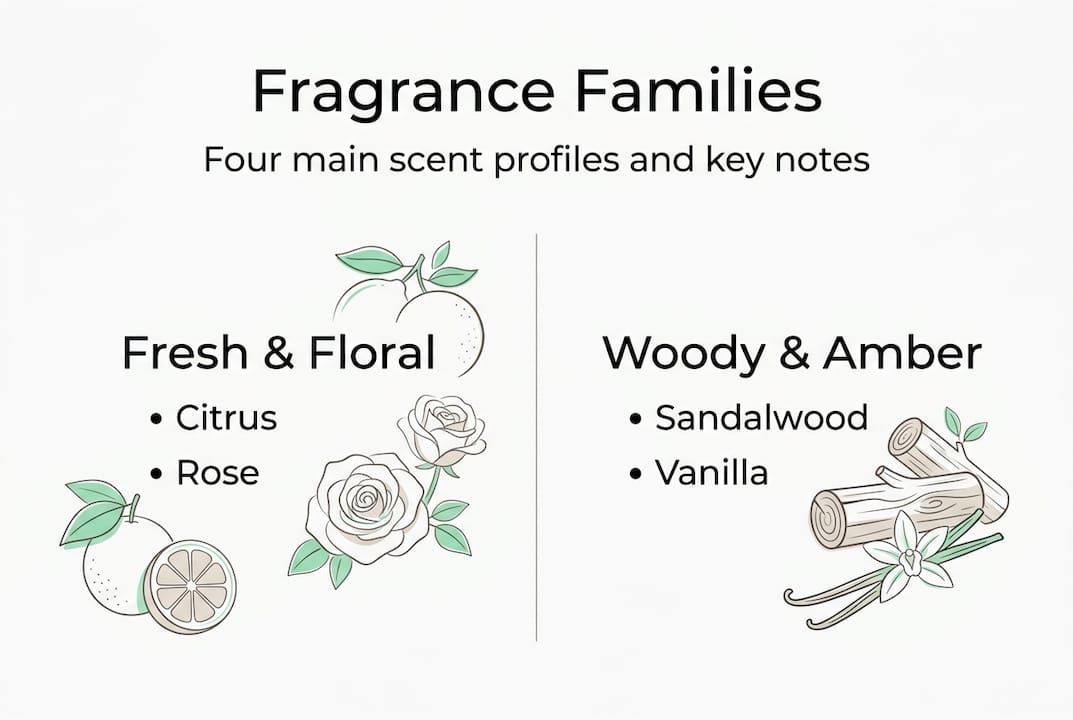
The industry has developed structured approaches to classification over decades. The most respected is Michael Edwards’ Fragrance Wheel, which defines four main fragrance families and 14 subfamilies. Edwards created this system in 1983 to give perfumers, retailers, and consumers a shared language, and it remains the gold standard today. Our own guide to scent profiles expands on how these families translate into real-world fragrance choices.
Several misconceptions cloud the topic for newcomers:
- ‘Floral means feminine’: Florals appear across genders and encompass everything from powdery iris to sharp green stems.
- ‘Woody means heavy’: Many woody fragrances are crisp and airy, built on cedarwood and vetiver rather than dense resins.
- ‘Amber is old-fashioned’: Modern amber accords are sophisticated, layered, and increasingly popular in niche perfumery.
- ‘You can identify a profile by smelling the cap’: True evaluation requires skin contact and time, as the full profile only reveals itself through dry-down.
‘A fragrance is not a single note played in isolation. It is a symphony, and the scent profile is the score.’
Grasping these basics repositions you as a more discerning collector, one who reads the score before attending the concert.
The four main scent profile families and their subfamilies
Industry experts classify fragrances into four main families: Fresh, Floral, Woody, and Amber (formerly Oriental). Each family carries its own emotional register, seasonal associations, and typical note combinations. Knowing them fluently is the foundation of confident fragrance selection.
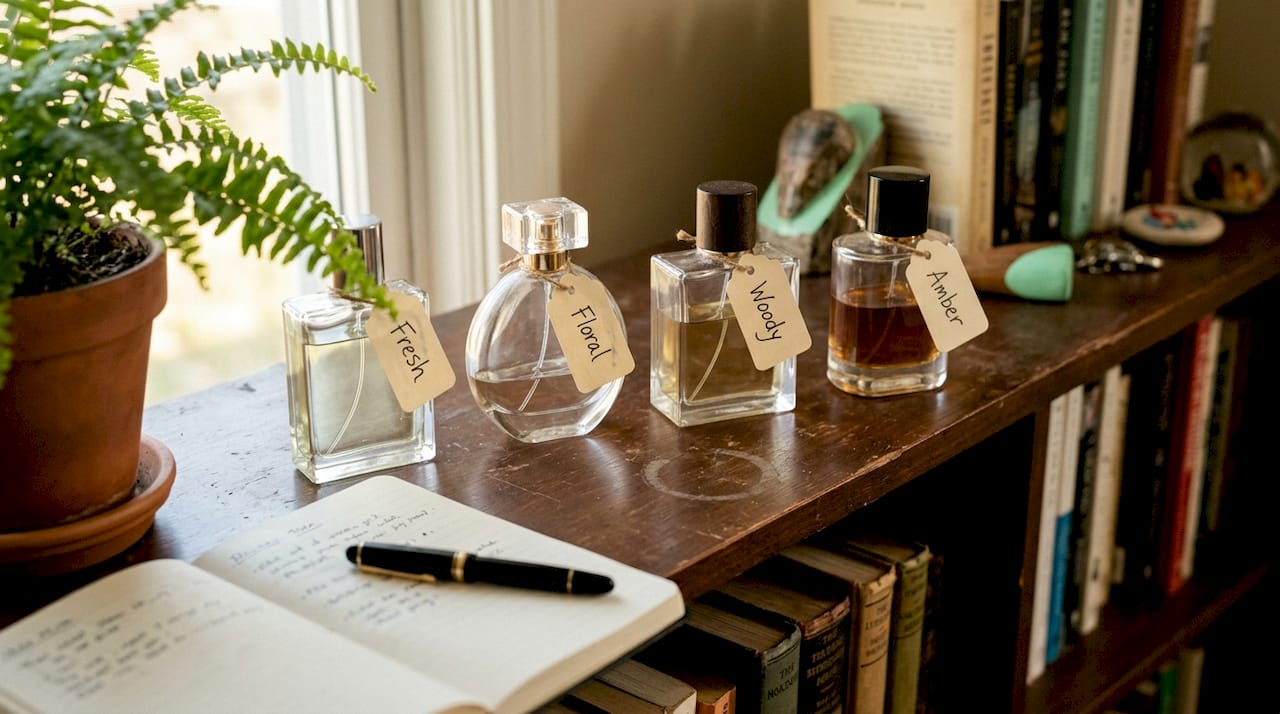
Fresh fragrances are defined by their clean, invigorating character. Subfamilies include Aromatic, Citrus, Water, and Green. Typical notes span bergamot, grapefruit, sea salt, and freshly cut grass. These are the quintessential daytime and warm-weather scents, effortlessly wearable and universally appealing.
Floral is the largest family, encompassing Floral, Soft Floral, and Floral Oriental subfamilies. Rose, jasmine, peony, and ylang-ylang anchor most compositions here. Florals range from the luminous and airy to the lush and opulent, making this family one of the most versatile in perfumery.
Woody fragrances are grounded and complex. Subfamilies include Woody, Mossy Woods, Dry Woods, and Aromatic. Sandalwood, cedarwood, vetiver, and patchouli define the palette. These scents carry a sense of depth and sophistication, often associated with cooler seasons and evening wear.
Amber fragrances are warm, sensual, and enveloping. Subfamilies span Soft Amber, Amber, and Woody Amber. Vanilla, benzoin, labdanum, and spices create that characteristic richness. These are the masterclass in gourmand and hedonistic perfumery, fragrances that linger and seduce.
| Family | Key notes | Mood | Best season |
|---|---|---|---|
| Fresh | Citrus, marine, green | Energising | Spring/Summer |
| Floral | Rose, jasmine, peony | Romantic | Year-round |
| Woody | Sandalwood, vetiver, cedar | Grounded | Autumn/Winter |
| Amber | Vanilla, spice, resin | Sensual | Autumn/Winter |
For a broader look at how these translate into wearable choices, explore our perfume categories guide and our breakdown of popular perfume families across the UK market.
Pro Tip: Layering a Fresh citrus fragrance over a Woody base is one of the most rewarding experiments in personal perfumery. The citrus lifts the wood, and the wood gives the citrus longevity it would never achieve alone.
Methods of classifying scent profiles: Experts versus everyday wearers
Not everyone perceives fragrance the same way, and this is where classification becomes genuinely fascinating. Expert perfumers rely on structured frameworks, trained vocabularies, and years of olfactory conditioning. Everyday wearers bring something equally valuable: unfiltered, emotionally honest reactions that no panel of experts can replicate.
The contrast between these two approaches reveals much about the nature of scent itself. Expert models, such as Edwards’ Fragrance Wheel, prioritise molecular structure and note relationships. They create a consistent, reproducible language for the industry. But they can also flatten the deeply personal dimension of scent experience.
Empirical research adds another layer of complexity. A laymen perception dataset of 74 mono-molecular odours highlights significant variance in scent perception by demographics and personality traits. In other words, the same molecule smells genuinely different to different people, shaped by age, gender, cultural background, and even introversion or extroversion.
| Classification method | Strengths | Limitations |
|---|---|---|
| Expert panel models | Consistent, reproducible | May miss personal perception |
| Empirical laymen data | Reflects real-world diversity | Harder to standardise |
| IFRA standards | Safety and quality benchmarks | Not designed for profile definition |
This matters practically. When you read that a fragrance is ‘woody amber’, that classification reflects expert consensus. Your personal experience of it may be entirely different, and that is not a flaw in your perception. It is the nature of olfaction. Our resources on fragrance family types and our beginner’s fragrance families guide both acknowledge this human variability.
‘Scent is the most democratic of the senses. No certificate or training is required to know what moves you.’
The molecular structure of a fragrance ingredient influences its pleasantness, but perception is never purely chemical. It is filtered through memory, emotion, and identity. The most sophisticated collectors understand that expert frameworks are maps, not destinations.
How to use scent profiles in perfume selection
Scent profiles help individuals discover their preferences and build bespoke fragrance collections. But theory only becomes useful when it shapes real decisions. Here is a structured approach to putting your profile knowledge to work.
-
Identify your instinctive family. Think about the scents that have always drawn you in: fresh laundry, warm vanilla, rain on earth, a garden in bloom. These instincts map loosely onto the four main families and give you a starting point.
-
Sample systematically. Rather than spraying everything at once, test one family per session. Give each fragrance at least 30 minutes on skin before forming an opinion. The dry-down often contradicts the opening spray entirely.
-
Take notes. Keep a fragrance journal, even a simple one. Record the name, family, key notes, and your emotional response. Patterns emerge quickly and reveal your true preferences with surprising clarity.
-
Explore subfamilies. If you know you love Woody fragrances, go deeper. Do you prefer Dry Woods with their smoky, charred quality, or Mossy Woods with their earthy, damp richness? Subfamilies are where genuine discovery lives.
-
Revisit and refine. Your preferences will shift with seasons, moods, and life stages. Revisit fragrances you dismissed and approach them with fresh context. A scent that felt overwhelming in summer may feel perfectly calibrated in winter.
Our fragrance profile selection guide and our exploration of unique fragrance types offer further depth for collectors ready to move beyond the basics.
Pro Tip: Build your fragrance wardrobe the way a stylist builds a wardrobe of clothes. Aim for range across families rather than multiples of the same profile. A Fresh citrus for mornings, a Floral for daytime, a Woody Amber for evenings. Variety makes every fragrance feel intentional.
A collector’s perspective: Why your nose should lead, not labels
Here is an uncomfortable truth that most fragrance guides will not tell you: the categories are a starting point, not a destination. We have seen collectors so committed to their ‘Woody Amber’ identity that they dismiss an extraordinary Floral simply because it does not fit their self-defined profile. That is a loss.
The most memorable fragrance discoveries happen at the edges of categories, where a Fresh accord bleeds into something unexpectedly resinous, or where a Floral heart is ignited by seductive osmanthus and becomes something altogether more complex. Modern perfumery trends increasingly blur traditional family lines, with niche houses deliberately subverting classification to create genuinely original compositions.
Trust the framework to orient you. Then trust your nose to lead you somewhere the framework never anticipated. The finest collections are built not on rigid adherence to profile theory, but on the courage to follow what moves you, wherever it leads.
Explore curated scent profiles at Alexandria UK
Translating scent profile knowledge into real fragrance discoveries is exactly what Alexandria UK is built for. Our collections span all four major families and their subfamilies, offering quality-focused, inspired alternatives that make luxury accessible without compromise.

Whether you are refining a signature scent or building a considered fragrance wardrobe, browsing the Alexandria UK fragrance collections gives you the range to experiment with confidence. From luminous Fresh citrus to dark, hedonistic Amber accords, every profile is represented. Our perfume types guide is also an excellent companion for anyone ready to move from theory to discovery.
Frequently asked questions
What is the difference between a scent family and a scent profile?
A scent family groups perfumes by their dominant notes, such as Floral or Woody, while a scent profile refers to an individual fragrance’s unique combination of notes, structure, and characteristics. The Fragrance Wheel’s families provide the broader category; the profile provides the specific identity within it.
How can I identify my favourite scent profile?
Test fragrances from each major family on your skin, take notes on your emotional responses, and compare your findings to the industry subfamilies for greater precision. Scent perception varies by personality and demographic, so personal testing always outperforms reading descriptions alone.
Do scent preferences change over time?
Yes, factors such as age, season, hormonal changes, and life experiences can meaningfully shift your fragrance preferences, sometimes towards entirely different families than those you once favoured.
Is there a scientific way to classify scents?
Yes, experts use structured frameworks like Edwards’ Fragrance Wheel alongside empirical perception data to classify scents based on both molecular structure and human sensory response, creating a system that balances scientific rigour with real-world experience.


