

Types of Fragrance Families: Choosing Your Signature Scent
Searching for a new signature scent can feel confusing when the perfume aisle offers endless choices and unfamiliar names. For British fragrance lovers keen to find high-quality dupes without overspending, the secret lies in understanding the essential structure of fragrance families. These categories—defined by The Fragrance Foundation UK—organise scents by their main characteristics, letting you choose with confidence and avoid costly mistakes. Learning about fragrance families empowers you to spot hidden gems, match your taste, and make smarter fragrance decisions.
Table of Contents
- Fragrance Families Defined And Their Importance
- Main Fragrance Families And Distinctive Notes
- Modern Subfamilies And Emerging Trends
- Choosing Perfume Dupes By Scent Profile
- Common Mistakes When Selecting Fragrance Types
Key Takeaways
| Point | Details |
|---|---|
| Understanding Fragrance Families | Fragrance families categorise scents, making it easier to identify preferences and find suitable duplicates, enhancing the overall fragrance journey. |
| Importance for Safety and Quality | Recognising fragrance families aids in evaluating potential allergens and ensures safer product use, fostering informed consumer choices. |
| Modern Trends and Personalisation | Emerging subfamilies reflect evolving consumer preferences for unique, gender-neutral, and personal fragrances, offering more options for individual expression. |
| Avoid Common Shopping Mistakes | Understanding fragrance concentration and testing scents properly in your environment can prevent unsuitable purchases and enhance satisfaction. |
Fragrance Families Defined And Their Importance
Fragrance families are broad scent categories that serve as a practical framework for understanding and selecting perfumes. Rather than exploring hundreds of individual fragrances in isolation, these families group similar scents together, making it far easier to identify what appeals to you and why. The Fragrance Foundation UK defines these families as essential tools that help consumers navigate the perfume world with confidence, organising scents into recognisable groups based on their dominant characteristics and aromatic profiles.
Why does this matter for your fragrance journey? Consider this: without fragrance families, choosing a perfume would be like searching for a specific book in a library without any organisational system. Each family shares common traits, whether that’s the warm sweetness of gourmand scents, the fresh crispness of citrus notes, or the sophisticated complexity of orientals. Understanding these categorisations helps you predict what you might enjoy before you ever spray your wrist. If you adored one floral fragrance, learning about complex fragrance families means you can confidently explore others within that same family and discover new favourites with similar characteristics. This is particularly valuable when hunting for affordable dupes or alternatives, as fragrances from the same family often share the same emotional resonance even if their specific notes differ.
Beyond personal preference, fragrance families hold genuine importance for product safety and quality assessment. Fragrances are complex mixtures that play a crucial role in cosmetic products, and each family contains compounds with unique chemical properties and potential allergic reactions. Understanding which family a fragrance belongs to helps manufacturers, safety experts, and consumers evaluate potential sensitivities. This classification system ensures that regulatory standards are properly applied and that consumers can make informed decisions about what they’re applying to their skin.
The importance of fragrance families extends to your wallet as well. When you understand these categories, you gain the ability to find quality alternatives that deliver comparable scent experiences at different price points. A fragrance family tells you what you’re actually paying for, the olfactory promise being made, and whether a product genuinely delivers on that promise or falls short. For the UK fragrance enthusiast seeking high-quality dupes that don’t compromise on scent character, this knowledge transforms shopping from guesswork into informed decision-making.
Pro tip: Identify two fragrances you genuinely love, research their fragrance families, then explore other scents within those same families to build your signature scent profile without spending a fortune on trial and error.
Main Fragrance Families And Distinctive Notes
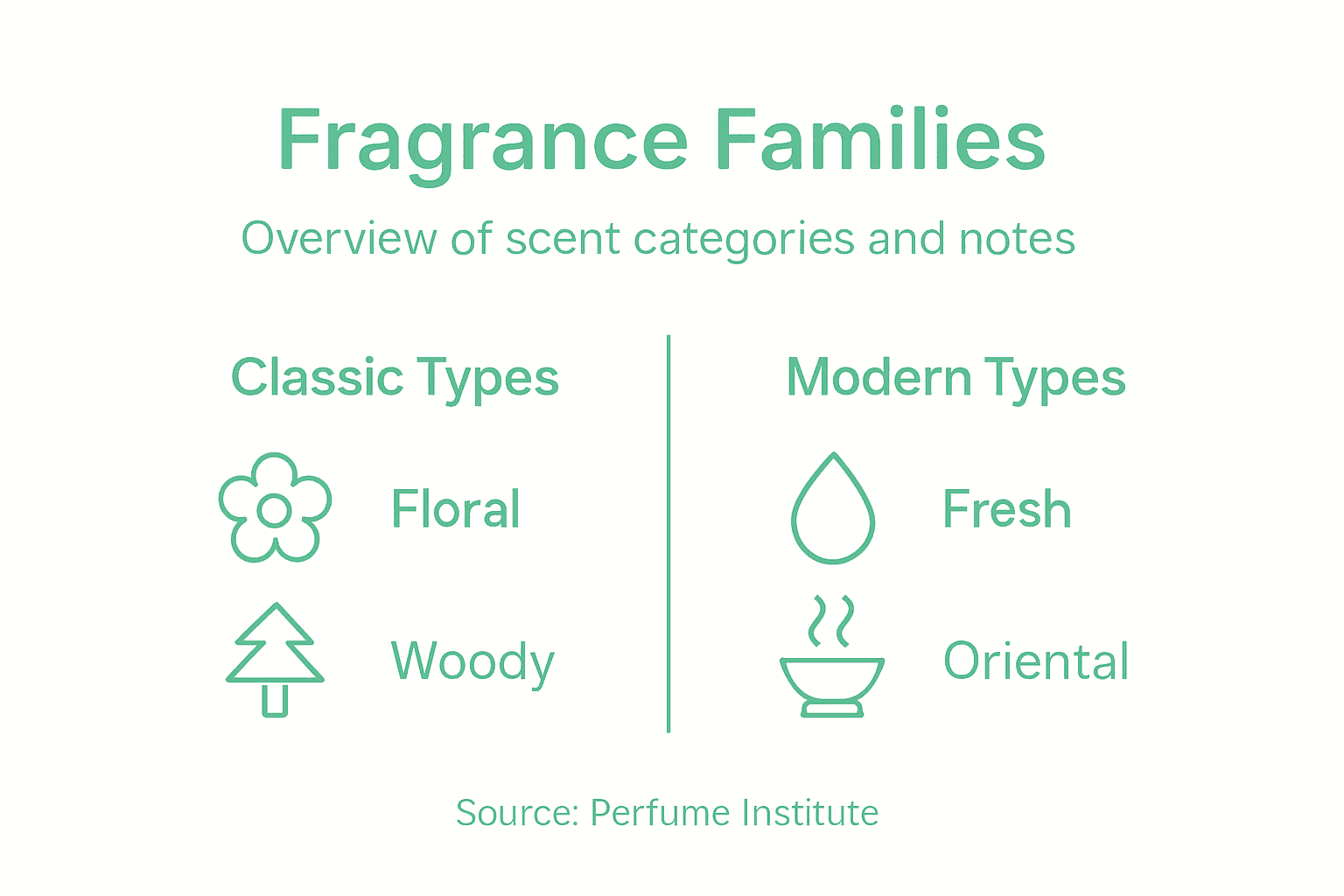
The world of fragrance is built on four principal families, each with its own aromatic personality and character. Understanding these families and their signature notes is the foundation of building your fragrance wardrobe with intention and confidence. The Fragrance Foundation UK’s training programme covers floral, oriental, woody, and fresh families, detailing how each one creates a distinct olfactory experience through specific note combinations. Floral fragrances are built around aromatic flowers such as jasmine, rose, and peony, delivering femininity and elegance. Oriental fragrances rely heavily on warm, sensual notes like vanilla, amber, and musk, creating rich, intoxicating scents that linger on the skin. Woody fragrances emphasise earthy, sophisticated notes derived from cedarwood, sandalwood, and vetiver, offering depth and longevity. Fresh fragrances spotlight bright, crisp notes from citrus fruits, herbs, and aquatic accords, providing uplifting and energising qualities. Each family tells a different aromatic story, and once you recognise these patterns, selecting fragrances becomes far more strategic.
Within each family, distinctive aromatic profiles emerge from the interaction of top, middle, and base notes. Top notes are the immediate impression—typically citrus or herbs—that evaporate quickly over the first five to fifteen minutes. Middle notes, also called heart notes, develop after the top notes fade and can last several hours; these often include florals and spices that define the fragrance’s character. Base notes are the foundation, appearing after thirty minutes and lasting for hours; these rich, heavy molecules such as musk, amber, and woods provide staying power and depth. A floral fragrance might open with bright bergamot (top note), bloom into jasmine (middle note), and settle into warm vanilla (base note). An oriental, by contrast, might start with spicy cardamom, evolve into creamy vanilla, and finish with deep amber and sandalwood. Fresh fragrances typically lead with zesty lemon or grapefruit, move through herbal or aquatic middle notes, and close with light woody or musk base notes. This structure explains why two fragrances from the same family can smell completely different when you first spray them but converge in character after the initial spray settles.

The botanical origins of fragrance notes reveal why certain families resonate with us emotionally and physically. Floral and woody notes come directly from fragrant plants, with their aromatic compounds extracted through distillation or synthetic reproduction. Citrus notes capture the fresh energy of fruit peels, often used in fresh fragrances to create immediate brightness. Woody notes derive from tree resins and heartwood, offering grounding and masculine appeal. Oriental families frequently incorporate spice notes from sources like vanilla orchids and cinnamon bark, creating warmth and sensuality. Understanding these natural origins helps you appreciate why certain fragrances perform better in specific seasons or moments; a woody fragrance feels right in autumn because cedarwood and vetiver mirror the earthy quality of that season, whilst fresh citrus fragrances feel most appealing during spring and summer when brightness matches the season’s energy. For UK fragrance enthusiasts hunting for quality dupes and alternatives, this knowledge is invaluable. When you know that two fragrances share the same family and similar base notes, you can confidently expect a comparable experience even if the top notes differ slightly. A dupe of an expensive floral might swap out rare jasmine for synthetic florals, but if the heart and base remain similar, the overall emotional impact stays true.
Pro tip: Test fragrances from different families on separate days and notice which base notes resonate with you personally, as base notes are the true signature of how a fragrance performs on your skin and the lasting impression it leaves.
Here’s a quick summary of the four main fragrance families and their signature characteristics:
| Family | Key Notes | Typical Mood | Seasonal Suitability |
|---|---|---|---|
| Floral | Jasmine, rose, peony | Elegant, romantic | Spring and summer |
| Oriental | Vanilla, amber, musk | Warm, sensual | Autumn and winter |
| Woody | Cedarwood, sandalwood, vetiver | Earthy, sophisticated | All seasons, especially autumn |
| Fresh | Citrus fruits, herbs, aquatic | Uplifting, energising | Spring and summer |
Modern Subfamilies And Emerging Trends
The fragrance world has evolved dramatically beyond the four classic families. Today’s perfumery landscape includes sophisticated subfamilies that reflect shifting consumer preferences, technological innovation, and a growing desire for personalisation. Fruity fragrances have emerged as a distinct subfamily, blending fruit notes like peach, berries, and apple with floral or gourmand bases to create youthful, playful scents. Gourmand fragrances represent another modern movement, featuring edible-smelling notes such as caramel, chocolate, and praline that deliver comfort and indulgence. Aquatic fragrances appeared in the 1990s and continue to thrive, featuring oceanic or ozonic notes that evoke freshness without traditional citrus. Chypre fragrances occupy a sophisticated niche, combining floral, fruity, and mossy elements in a complex balance that appeals to those seeking depth and elegance. Amber fragrances sit between orientals and woody families, offering warm, resinous qualities with slightly less sweetness than traditional orientals. Each subfamily opens new territory for exploring scents that might better match your personal taste and lifestyle.
What’s driving these new subfamilies and refined classifications? Modern fragrance innovation responds to sustainability and consumer preferences that fundamentally reshape how perfumes are created and marketed. Consumers increasingly demand natural ingredients over synthetic ones, pushing brands to develop fragrances built on botanically sourced or naturally derived components. Synthetic biology and advanced extraction techniques now allow perfumers to recreate rare, endangered, or expensive natural notes in sustainable ways, opening doors to innovative subfamilies that were previously impossible to produce affordably. Personalisation has become a major driver as well, with consumers seeking fragrances tailored to their individual preferences rather than broad categorical boxes. This shift has spawned niche subfamilies catering to specific moods, seasons, or lifestyles. Regulatory oversight, including investigations into fragrance ingredient supply, continues to reshape ingredient sourcing and formulation strategies. For UK fragrance enthusiasts seeking affordable dupes and quality alternatives, this dynamic market actually works in your favour. As larger houses innovate and experiment with new subfamilies, smaller perfume creators and dupe manufacturers follow quickly behind with comparable interpretations at significantly lower price points.
The most exciting contemporary trend is the rise of gender-neutral and unisex fragrances, which deliberately blur traditional family distinctions. Rather than marketing a woody fragrance as masculine or a floral as feminine, modern perfumers create complex compositions that appeal across all preferences. Brands increasingly describe fragrances by mood or experience instead of family category: a scent might be described as “energising morning wear” or “intimate evening experience” rather than strictly “fresh” or “oriental.” This reflects genuine consumer demand for authenticity and self-expression over marketing convention. Transparent or clean fragrances represent another emerging trend, emphasising clarity of individual notes rather than blended complexity, allowing you to appreciate each aromatic layer distinctly. Niche and indie fragrances have exploded in popularity, with small-batch creators experimenting fearlessly with unconventional note combinations that challenge traditional family hierarchies. For someone hunting for signature scents on a budget, this proliferation of subfamilies and emerging trends means more options exist at every price point. A niche indie fragrance might cost considerably less than luxury alternatives whilst offering equally distinctive character and better ingredient quality. Understanding these modern movements helps you recognise that fragrance selection today is about matching your values, mood, and personal identity rather than adhering to outdated categorical rules.
Pro tip: Explore niche and indie fragrance brands that experiment with emerging subfamilies, as they typically offer superior value and innovative scent profiles that large houses have yet to replicate or dupe.
Choosing Perfume Dupes By Scent Profile
Selecting the right dupe perfume starts with understanding the scent profile of the original fragrance you love. A scent profile is the complete aromatic fingerprint of a perfume, encompassing its top, middle, and base notes along with the fragrance family it belongs to. Rather than chasing a specific brand name, focusing on scent profile allows you to find affordable alternatives that deliver the same olfactory experience. The key is learning to deconstruct what you actually smell when you wear a fragrance, moving beyond vague descriptions like “floral” or “fresh” to identify the specific notes that create the overall character. When you understand scent profiles deeply, you can confidently evaluate whether a dupe genuinely replicates the fragrance you adore or falls short in critical ways. Understanding scent profiles and olfactory memory helps you identify which notes matter most to you personally, allowing you to prioritise these elements when comparing alternatives. A fragrance dupe doesn’t need to match every single note; it needs to capture the dominant characteristics that make the original special to you.
Start by identifying the three primary layers of the fragrance you want to replicate. First, note the immediate impression when you first spray the perfume—this is the top note accord that lasts roughly five to fifteen minutes. Is it bright citrus, spicy, herbal, or fruity? Next, observe what emerges after ten to twenty minutes as the fragrance develops on your skin—these middle or heart notes are the true character of the perfume and typically last several hours. Pay attention to floral elements, gourmand sweetness, spice warmth, or aquatic freshness. Finally, identify the lasting base notes that appear after the first hour and persist for hours or even days. These are often woody, musky, amber, or vanilla elements that provide the fragrance’s foundation and longevity. Write down these observations immediately after testing, as scent memory can be unreliable over time. When you have this profile documented, you’re equipped to search for dupes systematically. Look for fragrances in the same family first, as they’re more likely to share the aromatic DNA you’re seeking. A floral dupe of a high-end perfume should feature similar floral notes; an oriental dupe should share the same warm base character. Cross-reference reviews and fragrance databases to confirm that potential dupes actually deliver these notes rather than merely claiming to.
Your sense of smell can be trained and refined to recognise fragrance nuances more accurately, which directly improves your ability to assess dupe quality. Olfactory training improves recognition of scent profiles and helps you distinguish subtle differences between fragrances, enabling better-informed decisions when selecting dupes that genuinely match your original favourite. Practise smelling fragrances deliberately rather than passively. Spend a few minutes with each scent, closing your eyes and focusing on individual note layers rather than forming quick judgements. Return to fragrances you know well—your signature scents or fragrances you’ve worn for years—and try to identify specific notes you’ve previously overlooked. Compare two fragrances side by side, noticing how one smells different from another even within the same family. This active attention trains your olfactory system to recognise subtle variations. Over time, you’ll develop greater sensitivity to fragrance nuances, making it easier to spot when a dupe genuinely replicates the scent profile versus when it cuts corners on base notes or uses cheaper substitutes for key middle notes. When testing potential dupes, apply them to separate wrists or test strips and revisit them at the fifteen-minute mark, one-hour mark, and several-hour mark, noting how the scent profile evolves. A truly effective dupe should follow a similar progression and maintain comparable longevity. Many budget dupes fail not because their top notes are poor, but because their base notes collapse or diverge significantly from the original after the initial spray settles. By tracking scent profile across time, you’ll identify which dupes deliver genuine value and which ones merely smell similar for the first few minutes. For UK fragrance enthusiasts, this methodical approach transforms dupe shopping from expensive trial and error into confident, strategic selection.
Pro tip: Create a simple scent profile chart for fragrances you love, documenting top, middle, and base notes plus longevity and sillage, then use this as a reference template when evaluating potential dupes for accuracy and value.
Common Mistakes When Selecting Fragrance Types
Most fragrance shoppers make predictable errors that lead to disappointment, wasted money, and poorly chosen scents that don’t suit their lifestyle or preferences. Understanding these pitfalls transforms you from a reactive buyer into a strategic one. The first major mistake is confusing fragrance concentration levels with fragrance families. Many people assume that all perfumes perform similarly in terms of longevity and intensity, but this is fundamentally incorrect. Eau de toilette, eau de parfum, parfum, and cologne are entirely different formulations with vastly different price points, performance characteristics, and value propositions. Eau de toilette typically contains three to eight percent fragrance oils, delivering moderate longevity of two to four hours and a softer scent projection. Eau de parfum contains fifteen to twenty percent fragrance oils, lasting four to eight hours with more pronounced sillage and commanding higher prices. Parfum (also called extrait) exceeds twenty percent fragrance oils, delivering exceptional longevity of six to twenty-four hours and rich, complex scent development. Misunderstanding fragrance concentration and longevity creates unrealistic expectations about performance. You might purchase an eau de toilette expecting it to last an entire workday like an eau de parfum, then assume the fragrance itself is poor quality when it performs exactly as intended. For UK shoppers seeking dupes and affordable alternatives, this distinction becomes critical. A quality eau de toilette dupe might genuinely replicate the scent profile of a luxury eau de parfum at a fraction of the cost, but it won’t deliver the same longevity because it contains significantly less fragrance oil. Recognising this difference helps you make apples to apples comparisons rather than feeling cheated when performance doesn’t match your (incorrect) expectations.
Compare these common fragrance concentrations to understand performance and value:
| Concentration Type | Oil Content (%) | Longevity (hours) | Scent Projection |
|---|---|---|---|
| Eau de Toilette | 3–8 | 2–4 | Light to moderate |
| Eau de Parfum | 15–20 | 4–8 | Moderate to strong |
| Parfum/Extrait | 20+ | 6–24 | Strong, long-lasting |
| Cologne | 2–5 | 1–2 | Very light |
A second widespread mistake is ignoring allergic potential and safety considerations when selecting fragrances. Different fragrance families contain compounds with varying allergenicity profiles, and certain individuals may experience reactions to specific note types. Safety assessment of fragrance compounds matters significantly because some fragrance families carry higher risks of sensitisation than others. Musk compounds, oakmoss, certain essential oils, and synthetic musks are known allergens that appear frequently in fragrances. If you’ve had reactions to fragrances in the past, identifying which compounds triggered the reaction helps you avoid similar notes in future purchases. Many people simply assume that if a fragrance exists on the market, it’s safe for everyone, but individual sensitivities vary enormously. Before purchasing any dupe or alternative fragrance, research whether it contains known allergens or irritants specific to your skin. If you have sensitive skin, asthma, or a history of fragrance reactions, patch test new fragrances on a small area of skin before applying to pulse points. This step prevents uncomfortable or even dangerous reactions.
Another critical error is judging fragrances based on initial top notes alone. Many people spray a fragrance, smell it for thirty seconds, and make a purchasing decision based entirely on that first impression. This approach misses the entire development arc of a fragrance. Top notes are intentionally bright and eye catching, designed to grab attention, but they evaporate rapidly. The true character of a fragrance emerges in the middle notes, which appear after ten to twenty minutes and define the scent’s actual personality. Base notes, which anchor the fragrance for hours, don’t fully materialise until the first thirty minutes have passed. A fragrance that smells overwhelming citrus at first spray might develop into something sophisticated and balanced after an hour. Conversely, a fragrance that smells pleasant initially might reveal an unpleasant or chemical base note after the initial spray settles. Testing fragrances properly requires patience and methodical observation. When shopping for dupes, apply potential alternatives in the same conditions and revisit them at multiple intervals to confirm they evolve similarly to the original. This prevents selecting dupes that capture the top note but fail on the more important middle and base note development.
People also frequently neglect to consider their personal skin chemistry and climate when selecting fragrance types. The same fragrance performs completely differently on different people because skin pH, skin microbiome, and natural body warmth all influence how fragrance compounds interact with your body. A fragrance that smells predominantly floral on one person might smell significantly different on another person due to these biological factors. Additionally, fragrance families perform differently in various climates and seasons. Fresh fragrances excel in warm weather but feel thin and washed out in winter cold. Gourmand and oriental fragrances feel oppressive and cloying in summer heat but shine during autumn and winter. Woody and floral fragrances adapt well across seasons but may need lighter formulations in summer. Selecting a fragrance type based purely on marketing or aesthetic preference without considering how it will actually perform on your body and in your climate often results in a purchase you don’t wear. Invest time in testing fragrances in your actual wearing environment—apply them at home in your climate, wear them for several hours, and notice how they develop throughout the day. This practical approach reveals whether a fragrance type genuinely suits your lifestyle.
Pro tip: Always test a potential dupe fragrance for at least three hours on your skin in your typical climate before committing to a full-size purchase, noting how it evolves and whether it provides the longevity and performance you need for your lifestyle.
Discover Your Signature Scent with Confidence and Quality
Navigating the complex world of fragrance families can feel overwhelming but understanding your personal scent profile is the key to choosing perfume dupes that truly match your style and skin chemistry. Whether you are drawn to the warm sensuality of oriental fragrances or the uplifting energy of fresh notes knowing how to select quality alternatives that maintain longevity and character will save you time and money. At Alexandria UK we focus on delivering premium perfume dupes inspired by popular fragrances allowing you to confidently explore scents within your preferred fragrance family without compromise.

Unlock the secret to affordable luxury and avoid common pitfalls such as confusing concentration levels or ignoring base note development. Start your fragrance journey with us today and enjoy expertly curated dupes that reflect the rich complexity of your favourite originals. Visit Alexandria UK now to find your perfect match and elevate your collection with confidence and clarity.
Frequently Asked Questions
What are fragrance families?
Fragrance families are categories that group similar scents together based on their dominant characteristics and aromatic profiles, making it easier to select perfumes that suit your preferences.
How can understanding fragrance families help me find my signature scent?
By learning about fragrance families, you can predict which scents you might enjoy based on your previous preferences, allowing you to explore new fragrances with similar characteristics more confidently.
What are the main fragrance families?
The four main fragrance families include floral, oriental, woody, and fresh, each with its unique key notes and typical moods, helping you identify fragrances that resonate with your personal style.
How do I choose a fragrance dupe based on the scent profile?
To choose a fragrance dupe, start by analysing the scent profile of the original fragrance, focusing on its top, middle, and base notes, and then look for affordable alternatives within the same family that replicate the overall character you love.


