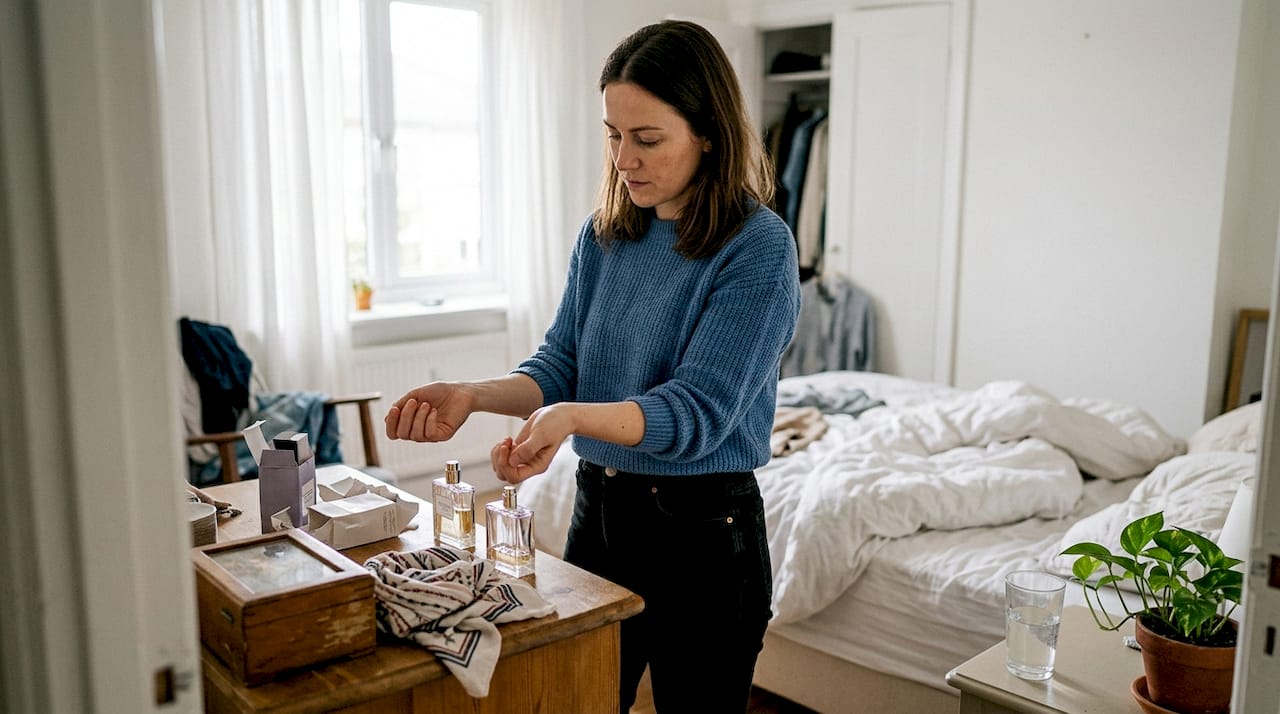
Master fragrance reviews: assess perfumes and dupes expertly
TL;DR:
- Systematic fragrance reviews enhance understanding of scent performance and authenticity.
- Proper setup, tools, and environmental control are crucial for accurate fragrance evaluation.
- Comparing notes, longevity, projection, and sillage with structured criteria ensures credible assessments.
There is little more deflating than investing in a hyped perfume or a promising dupe, only to realise within days that it falls flat on your skin. The sillage fades too quickly, the heart notes smell nothing like the original, or the projection barely carries across the room. Reviewing fragrances systematically transforms this frustration into genuine understanding. A structured approach gives your opinions credibility, helps other enthusiasts make informed choices, and sharpens your own nose over time. This guide walks you through every stage, from setting up your review environment to sharing polished, trustworthy assessments that fellow fragrance lovers will truly value.
Table of Contents
- Gathering tools and setting up for fragrance review
- Step-by-step process for reviewing perfumes and dupes
- Key criteria for quality assessment
- Reporting and sharing your fragrance review
- What most fragrance reviewers get wrong: Our expert insight
- Discover quality fragrances and tools for reviewing
- Frequently asked questions
Key Takeaways
| Point | Details |
|---|---|
| Prepare objectively | Use scent strips and neutral environments for unbiased reviews. |
| Follow a review process | Step-by-step methods help reveal note development and longevity accurately. |
| Assess critical criteria | Projection, sillage, and note accuracy are essential for evaluating perfumes and dupes. |
| Share with structure | Organise your findings clearly to make your review credible and engaging. |
Gathering tools and setting up for fragrance review
Every credible fragrance review begins well before the first spray. Preparation is everything. Without the right tools and environment, even the most experienced nose can be led astray by conflicting stimuli, skin chemistry, or simply poor conditions for scent evaluation.
Your essential toolkit should include:
- Scent strips and blotters for initial top note assessment without skin chemistry interference
- A clean, unscented notebook for immediate impressions and structured notes
- A humidity and temperature gauge, since fragrance performance shifts noticeably with atmospheric changes
- Neutral skin cleanser to ensure your testing surface is free of competing scents
- Fragrance sample vials or decants, especially when sampling quality dupes side by side with originals
The environment itself matters enormously. A neutral smelling environment greatly affects the outcome of fragrance reviews, meaning you should avoid kitchens, florists, or any space heavy with competing aromas. Choose a well-ventilated room with no burning candles, air fresheners, or strongly scented cleaning products nearby. Your own personal scent matters too. Wear an unscented deodorant on review days and avoid perfumed lotions entirely.
Here is a quick comparison of what you need for assessing original perfumes versus dupes:
| Tool | For original perfumes | For dupes |
|---|---|---|
| Scent strips | Essential for top note capture | Essential for side-by-side comparison |
| Skin application | Necessary for longevity assessment | Necessary for chemistry interaction |
| Reference notes list | Compare to brand’s stated notes | Compare to original’s stated notes |
| Humidity log | Useful for projection tracking | Useful for projection tracking |
| Photography | Optional (bottle aesthetics) | Optional (packaging comparison) |
For testing perfume methods to truly yield reliable results, timing is critical. Top notes, those bright opening flourishes of citrus, herbs, or light florals, evaporate within the first five to fifteen minutes. They are fleeting by design, meant to seduce on first contact.
Pro Tip: Record your initial impressions within 30 seconds of application. This is the most accurate window for capturing top note character before your nose begins to adapt.
Step-by-step process for reviewing perfumes and dupes
With your environment prepared and tools at hand, you are ready to move through the review itself. A disciplined, sequential approach ensures you capture every dimension of a fragrance’s performance without missing critical details.
- Apply to a scent strip first. This gives you an unbiased first impression untouched by your skin chemistry. Note the immediate accord, the very first accord you detect upon application.
- Apply to clean skin. Choose the inner wrist or inner elbow. These pulse points carry warmth that encourages fragrance development.
- Document the top notes at five minutes. Write down every accord you identify, no matter how subtle. Refer to the fragrance families explained guide to assist with accurate classification.
- Evaluate heart notes at twenty to forty minutes. The heart is the true soul of the fragrance. This is where florals, spices, or gourmand elements fully reveal themselves.
- Assess base notes at two hours. Woody, musky, and resinous elements anchor the fragrance and define its lasting character.
- Conduct a longevity check at six and twelve hours. This reveals the true tenacity of the scent on your skin.
Tracking this data in a structured format makes comparison between an original and its dupe far more revealing. Comparing fragrance notes and longevity provides meaningful data to differentiate between perfumes and dupes, particularly in the base note stage where cheaper ingredients tend to diverge most noticeably.
| Stage | Time | What to assess | Intensity (1-10) |
|---|---|---|---|
| Top notes | 0-15 mins | Opening accord, brightness | __ |
| Heart notes | 20-40 mins | Core character, complexity | __ |
| Base notes | 2 hours | Depth, warmth, anchoring | __ |
| Longevity check | 6-12 hours | Persistence, fade quality | __ |
For testing perfume longevity across multiple fragrances in a single session, organisation is essential.
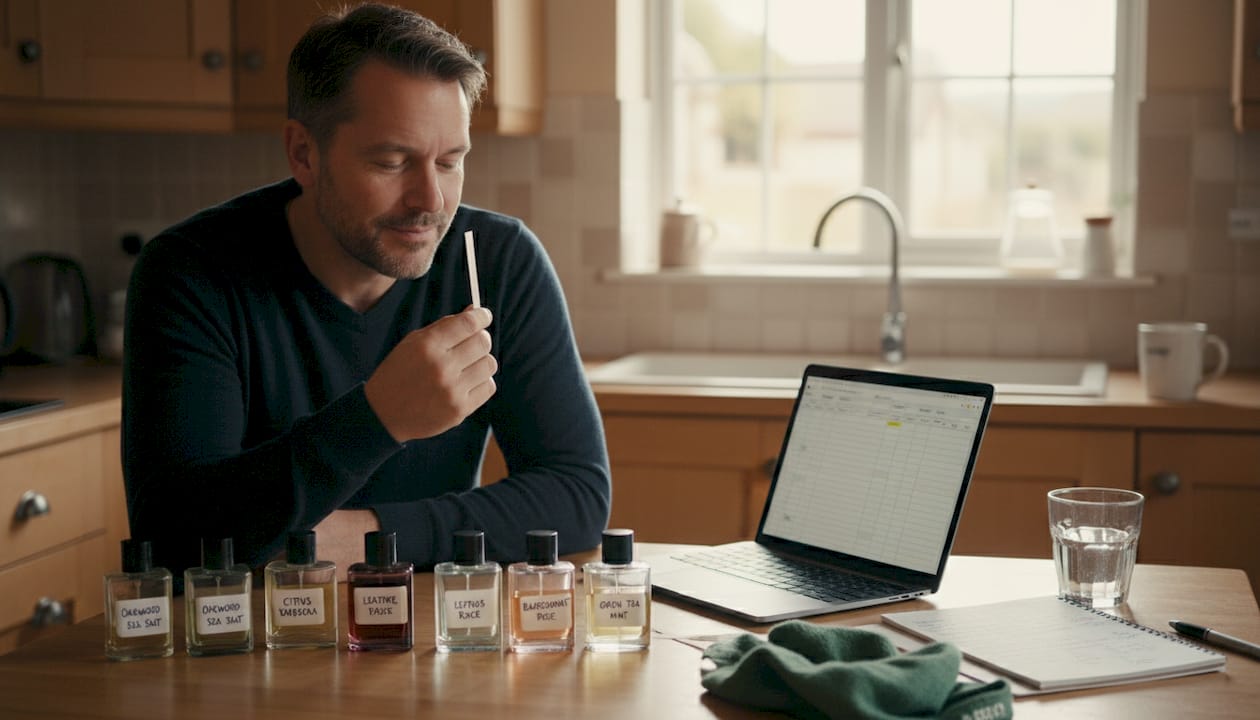
Pro Tip: Use alternate arms or wrists when comparing multiple fragrances simultaneously. This prevents scent confusion and gives each fragrance an uncontaminated area to develop naturally.
Key criteria for quality assessment
Following the process gives you raw data. Now it is time to interpret that data against defined quality benchmarks. Understanding what to look for transforms your notes into a meaningful, structured review.
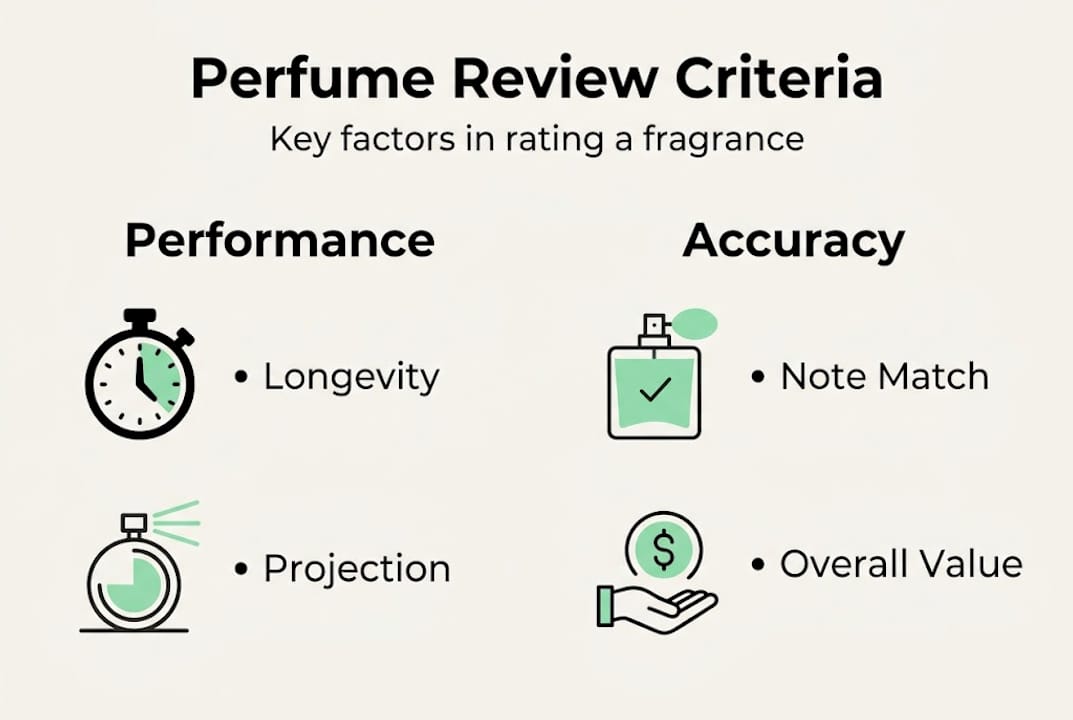
The critical aspects to score in every review are:
- Note accuracy: How faithfully does the fragrance reproduce its stated or inspiration notes? For dupes, does it genuinely echo the original’s character?
- Longevity: How long does the fragrance remain detectable on skin? A quality eau de parfum typically lasts six to eight hours, while a fine parfum concentration may exceed twelve.
- Projection: How far does the scent radiate from the body? Strong projection commands a room; subtle projection suits intimate wear.
- Sillage: The luminous trail a fragrance leaves as you move through a space. A beautiful sillage is one of the most coveted qualities in fine perfumery.
- Value for money: Particularly relevant when assessing dupes. Does the price point reflect the olfactory experience delivered?
Knowing the difference between projection and sillage is vital for a comprehensive fragrance review, as these two qualities are often conflated yet speak to entirely different performance characteristics. Projection measures intensity at close range; sillage measures the invisible wake a fragrance leaves behind you.
For longevity benchmarks, a general reference: eau de cologne lasts approximately two hours, eau de toilette three to five hours, eau de parfum six to eight hours, and parfum concentration ten hours or more. When comparing fragrance scents against these benchmarks, you can contextualise a dupe’s performance honestly.
If you are focused on finding your signature scent, these criteria also serve as a personal filter for what truly suits your preferences.
“True fragrance review recognises subtleties you may overlook in quick tests.”
Score each criterion on a scale of one to ten, and calculate an overall weighted score. Weight longevity and note accuracy most heavily, as these define whether a dupe genuinely delivers on its promise.
Reporting and sharing your fragrance review
With your evaluation complete, the final step is communicating your findings clearly and engagingly. A well-structured review earns trust; a disorganised one, however detailed, quickly loses its audience.
A credible review should follow this structure:
- Summary statement: A two to three sentence overview of your overall impression
- Fragrance profile: Top, heart, and base notes as detected, with intensity ratings
- Performance data: Longevity, projection, and sillage scores
- Dupe comparison (if applicable): Side-by-side note accuracy and performance differentials
- Value assessment: Price per wear, relative to the original
- Final verdict: A clear recommendation
Structuring your written review improves its clarity and credibility, particularly when publishing on public platforms where readers rely on your thoroughness. For quality perfume buying tips, a well-reasoned review also helps readers contextualise purchase decisions.
Here are the best platforms for sharing your reviews:
- Fragrantica and Basenotes: Dedicated fragrance communities with established review frameworks
- Personal fragrance blogs: Allows full creative expression and detailed methodology
- Reddit fragrance communities (r/fragrance): Highly engaged, enthusiast-driven dialogue
- YouTube and Instagram: Visual formats for unboxing, comparison, and reaction content
- Personal scent journal: Invaluable for tracking your own evolving preferences over time
For those interested in perfume selection tips, a personal journal doubles as a reference tool when shopping.
When you are ready to publish, follow this sequence:
- Draft your review immediately after your twelve-hour longevity check while impressions are vivid
- Edit for clarity, removing vague adjectives and replacing them with specific sensory descriptors
- Publish to your chosen platform with photographs if relevant
- Respond to comments and questions, as community engagement builds your authority as a reviewer
What most fragrance reviewers get wrong: Our expert insight
Here is a truth most review guides will not tell you: the majority of fragrance reviews are not objective assessments. They are first impressions dressed up as conclusions. Subjectivity is unavoidable in perfumery, but allowing it to dominate without acknowledgement is where credibility collapses.
The most common mistake is reviewing a fragrance in only one context. A dark, hedonistic oud might feel overwhelming on a warm summer afternoon yet feel masterfully rich on a cold winter evening. Season, temperature, humidity, mood, and even your diet that day can all alter how a fragrance sits on your skin. Many enthusiasts also underestimate the impact of identifying quality perfume ingredients versus synthetic constructions, which behave very differently across conditions.
“A rigorous fragrance review is more about disciplined observation than first impressions.”
Consistency is the mark of a reliable reviewer. Always re-test under varying conditions before assigning final ratings. Your credibility as a reviewer is built not on enthusiasm alone but on the disciplined, repeated observation that separates genuine expertise from casual opinion.
Pro Tip: Always re-test a fragrance at least three times across different weather conditions before publishing a final rating.
Discover quality fragrances and tools for reviewing
If you are inspired to build a more disciplined, satisfying fragrance review practice, the right products and resources make all the difference. Knowing your method is only half the journey. The other half is having exceptional fragrances worth reviewing.
Alexandria UK fragrances offers a curated collection of inspired and original scents, sample sets perfect for structured comparison, and resources designed for enthusiasts who take quality seriously. Whether you are assessing dupes against iconic designers or discovering new signature scents of your own, Alexandria UK provides the quality foundation your review practice deserves. Explore the collection and elevate your fragrance journey today.
Frequently asked questions
How do I avoid bias when reviewing fragrances?
Always test in neutral environments, use scent strips for unbiased comparison, and record impressions before consulting packaging or brand narratives that might colour your perception.
What are the best criteria for rating a perfume or dupe?
Key criteria include note accuracy, longevity, projection, sillage, and overall value for money. Projection and sillage are particularly vital distinctions to master for comprehensive assessments.
How can I check if a dupe matches the original fragrance?
Compare note development and longevity side by side using scent strips, and document any divergence during the drydown stage where cheaper ingredients most commonly reveal themselves.
What do ‘projection’ and ‘sillage’ mean in perfume reviews?
Projection refers to how far a scent radiates from your skin into the surrounding space, while sillage is the lingering olfactory trail a fragrance leaves as you move. Both are key review concepts for thorough evaluation.