How to create fragrance: make a designer-style perfume
TL;DR:
- Creating a 10 ml eau de parfum at home involves blending accords, aging the mixture, and documenting each step carefully. UK regulations require a Responsible Person, safety report, and notifications before selling perfumes. Proper testing, accurate classification, and transparency ensure legal compliance and successful fragrance development.
You can create a 10 ml eau de parfum at home by composing small accords, diluting them in cosmetic-grade perfumer’s alcohol, ageing the blend for one to four weeks, and documenting every test. The immediate next step is to choose a brief and select three raw materials to build your first accord. Before selling anything, UK makers must follow cosmetics regulations covering a Responsible Person, a Cosmetic Product Safety Report (CPSR), and notification via the Submit Cosmetic Product Notifications (SCPN) service. Alexandriauk’s DISCOVERY SET is a practical starting point for anyone who wants curated materials before committing to raw-ingredient sourcing.
- Compose accords of three materials before attempting a full formula.
- Dilute in perfumer’s alcohol at a typical concentration suitable for an Eau de Parfum (EDP).
- Age for at least one week before judging the finished scent.
- Document every batch with a number, date, and tasting notes.
“Set a story for the fragrance before you start formulating. Patience is not optional — it is the method.” — Nicolai Rutkowski, Scentscholar
Table of Contents
- What ingredients and tools do you actually need?
- Why should you write a brief before blending?
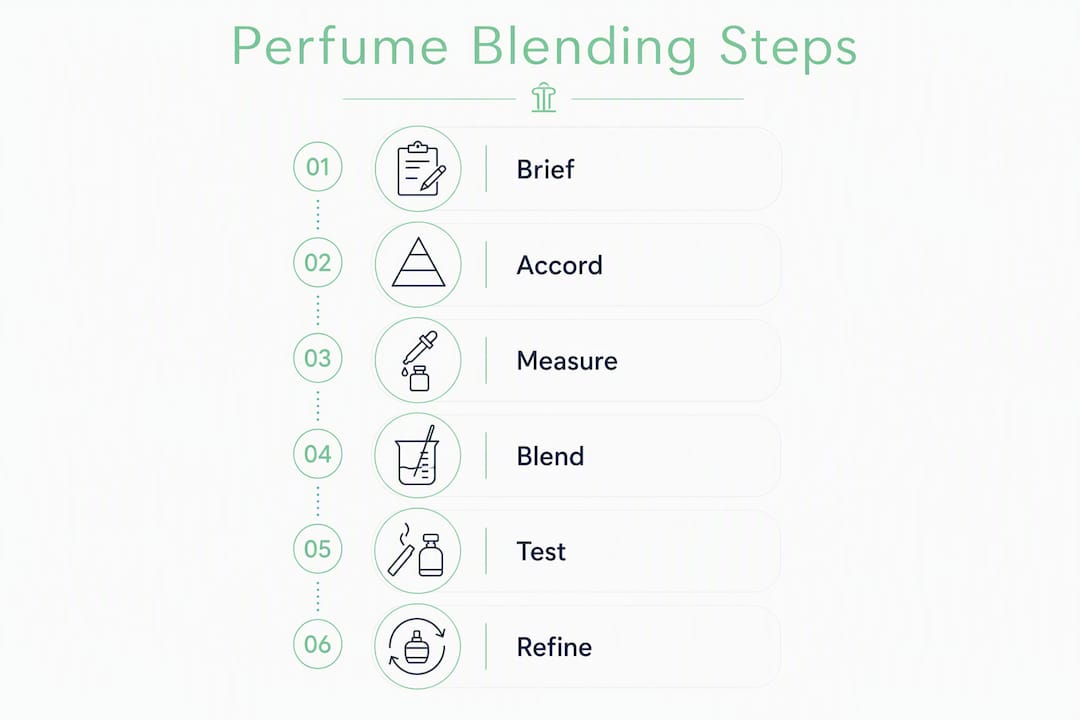
- Step-by-step blending: a beginner formula for a 10 ml EDP
- How do you test, evaluate, and refine your scent?
- What are the UK legal requirements for making and selling fragrances?
- How do you make designer-inspired scents ethically and legally?
- Key takeaways
- A perfumer’s note
- Alexandriauk: your shortcut from brief to bottle
- Recommended reading and resources
What ingredients and tools do you actually need?
Raw materials fall into three tiers. Top notes (citrus oils, aldehydes, green accords) open the fragrance and evaporate within the first thirty minutes. Heart notes (rose absolute, jasmine, spice aroma chemicals) form the character and linger for hours. Base notes (cedarwood, vetiver, labdanum, musks) anchor the blend and give longevity. The distinction between essential oils, absolutes, and aroma chemicals matters: absolutes are solvent-extracted and richer in character; aroma chemicals are single molecules that give precision and consistency unavailable in naturals.
For the carrier, perfumer’s alcohol (denatured cosmetic-grade ethanol) is the professional standard. It evaporates cleanly and gives an accurate olfactory read-out of the blend; oil-based carriers can obscure how notes develop. In the UK, cosmetic-grade ethanol is available from specialist suppliers such as The Perfumers Apprentice UK and various laboratory chemical retailers.
Tools you will need:
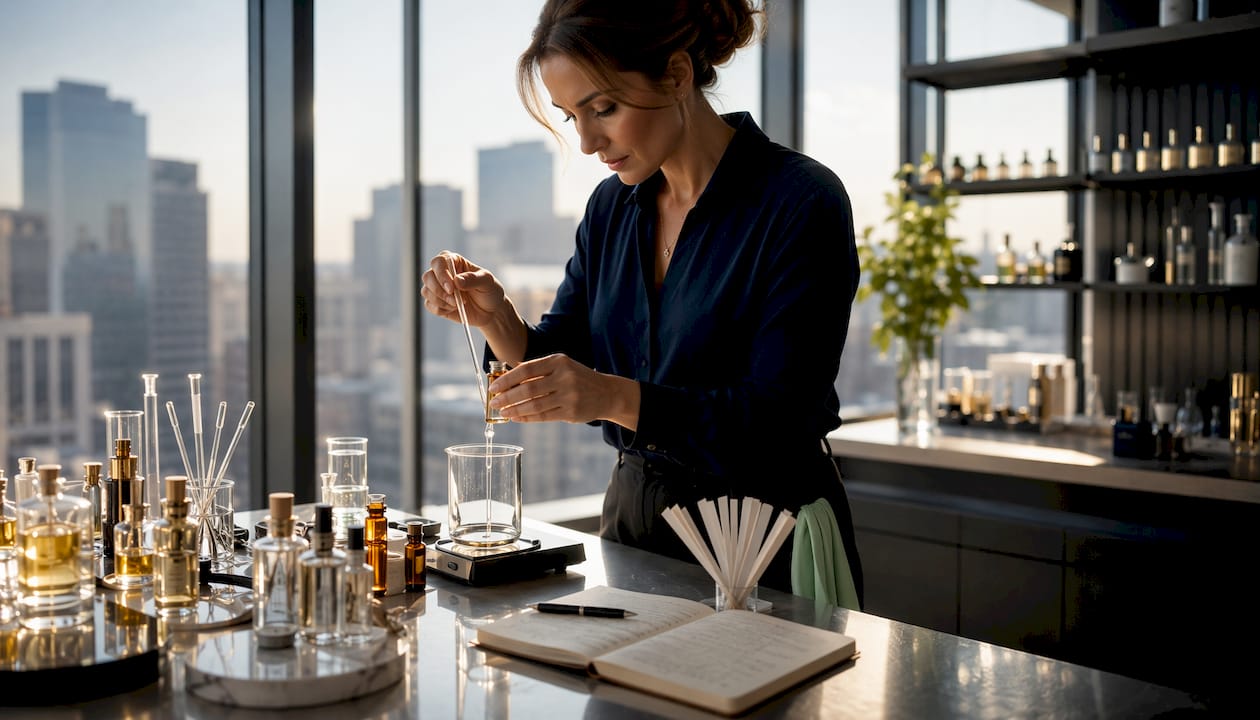
- Precision scale accurate to 0.01 g
- Glass pipettes or graduated syringes
- Amber glass vials and a 10 ml spray bottle
- Mouillettes (scent-testing strips)
- Small glass beakers and clearly labelled storage jars
A basic starter kit costs a moderate amount depending on the scale and pipette quality. Buying a curated discovery set from Alexandriauk can shorten the learning curve considerably, offering a pre-selected palette of quality materials rather than sourcing each ingredient individually.
Pro Tip: Smell each raw material on a mouillette at 1% and 10% dilution before blending anything. Training your nose on individual materials at different concentrations is how professionals build olfactory memory — and it prevents costly mistakes in the accord stage.
Why should you write a brief before blending?
A brief is one or two sentences describing the mood, the intended wearer, the longevity target, and one or two reference scents. Something like: “A warm, woody oriental for evening wear, inspired by the amber-and-sandalwood family, with moderate sillage and four-plus hours of longevity.” That single constraint prevents scope creep and keeps every blending decision purposeful.
Karen Gilbert advises beginners to start with accords — simple three-material combinations — rather than attempting a finished perfume immediately. An accord teaches you how ingredients interact: whether two materials clash, amplify each other, or create something entirely new.
Three beginner accords to try:
- Citrus-woody accord: bergamot essential oil (50%) + cedarwood (30%) + a touch of white musk aroma chemical (20%). Fresh, clean, and easy to read.
- Floral-spice accord: rose absolute (40%) + black pepper essential oil (30%) + patchouli (30%). Rich and complex without being heavy.
- Amber-resin accord: labdanum absolute (50%) + benzyl benzoate (30%) + vetiver essential oil (20%). Deep, warm, and excellent as a base layer.
Mix each accord in a 1 ml test batch, smell on a mouillette at 0, 30 minutes, and 24 hours, and record your impressions. Consult Alexandriauk’s guide on perfume scent categories to map your accord to an olfactory family before building further.
Step-by-step blending: a beginner formula for a 10 ml EDP
Understanding perfume concentrations is the foundation of any reliable formula. The table below shows standard dilution ranges and the corresponding fragrance-oil volume for a 10 ml batch.
| Concentration | Fragrance % | Fragrance oil in 10 ml | Alcohol in 10 ml |
|---|---|---|---|
| Eau de Cologne (EDC) | 3–5% | 0.45 ml | 8.5 ml |
| Eau de Toilette (EDT) | 5–15% | 1.5 ml | 8.5 ml |
| Eau de Parfum (EDP) | 15–20% | 1.5 ml | 8.5 ml |
| Parfum / Extrait | 20–30% | — | 8.5 ml |
Sample beginner EDP formula (total concentrate = 1.5 ml for a 10 ml batch at 15%):
- Bergamot essential oil: 0.45 ml (30% of concentrate — top)
- Rose absolute: 0.45 ml (30% of concentrate — heart)
- Cedarwood essential oil: 0.45 ml (30% of concentrate — base)
- Labdanum absolute: 0.15 ml (10% of concentrate — base modifier)
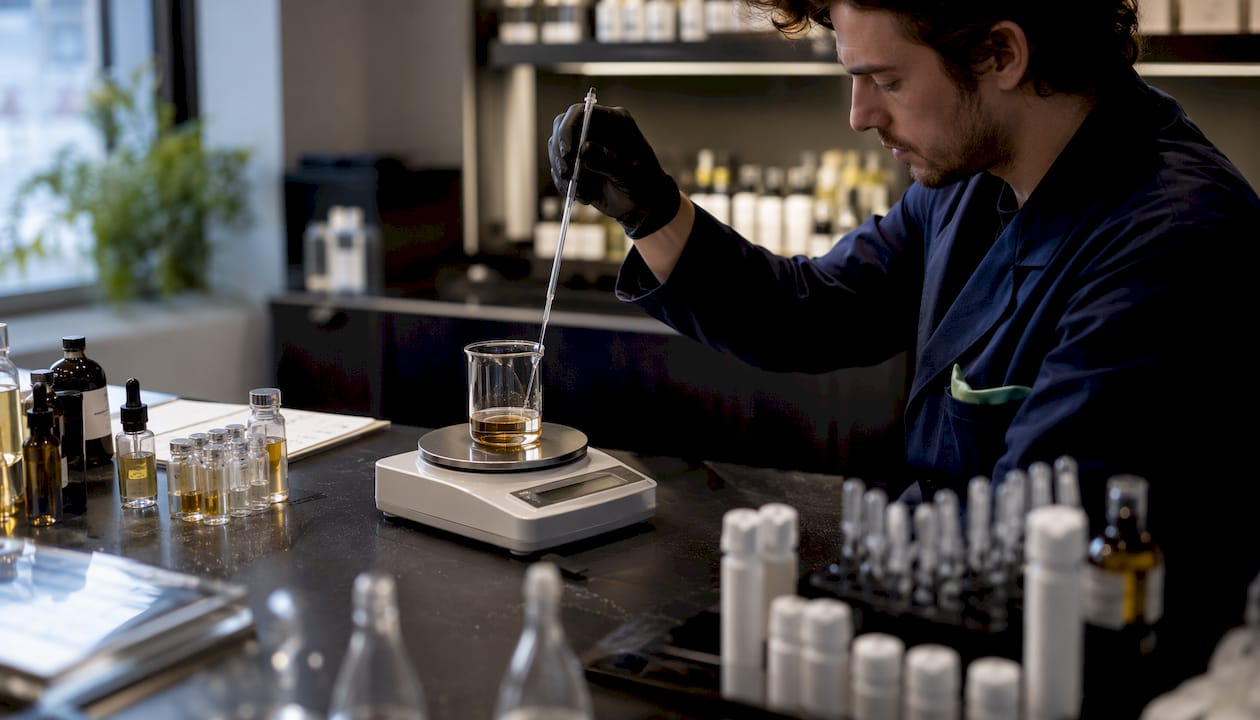
Weigh each material on your precision scale, combine in a small beaker, then add perfumer’s alcohol to reach 10 ml total. Cap the bottle, shake gently, and label with a batch number and date. Leave to macerate for at least one week; the maceration process allows materials to integrate and the alcohol note to recede.
Pro Tip: Always add the heaviest, most viscous materials first, then lighter ones. This prevents thick absolutes from clinging to the pipette and skewing your measurements.
How do you test, evaluate, and refine your scent?
Testing is where most beginners lose patience, and where most improvements are made. Follow a structured timeline rather than smelling the blend every hour.
- 0–10 minutes (immediate): Spray or dab onto a mouillette. Note the top-note character and any harshness.
- 30–120 minutes (development): The heart emerges. Record which materials are dominant and whether the accord reads as intended.
- 4–24 hours (drydown): Skin chemistry transforms the base. Test on the inner wrist for a realistic read-out; mouillettes cannot replicate this stage.
- After one week of maceration: Re-evaluate the full bottle. Blends often soften and integrate considerably.
Common issues and quick fixes:
- Top notes too sharp: reduce the citrus percentage by 5% and add a small amount of linalool to smooth the opening.
- Lack of longevity: increase the base-note percentage or add a fixative such as ambroxan or iso E super.
- Muddiness: you have likely used too many materials. Strip back to the core accord and rebuild one ingredient at a time.
Pro Tip: Keep a dedicated notebook — or a simple spreadsheet — with every batch number, formula, and tasting note. Documentation and training produce better results than spontaneous mixing; without records, a successful formula is impossible to reproduce.
What are the UK legal requirements for making and selling fragrances?
Personal use carries no regulatory burden. The moment you sell or gift your perfume, it becomes a cosmetic product under UK law, and the obligations are substantial.
- Responsible Person: every cosmetic product placed on the Great Britain market must have a UK-based Responsible Person who ensures safety compliance.
- CPSR: a Cosmetic Product Safety Report completed by a qualified safety assessor is mandatory before sale.
- PIF: a Product Information File containing the CPSR, manufacturing method, and GMP statement must be available to regulators on request.
- Notification: products must be notified via the SCPN service (Great Britain) or CPNP (Northern Ireland) before market placement.
- Labelling: labels must carry the Responsible Person’s name and address, nominal volume, batch number, ingredients in INCI format, and any required warnings.
Allergen threshold: Under Regulation 1223/2009 as retained in Great Britain, certain fragrance ingredients must be declared individually at concentrations as low as 0.001% in leave-on products.
Flammable alcohol-based perfumes also require compliant storage and shipping practices; carriers apply dangerous-goods rules to such products. Consult a qualified safety assessor and retain all supplier Safety Data Sheets (SDS) and IFRA certificates before any commercial launch. The full compliance checklist covers business registration, CLP labelling, and insurance requirements.
How do you make designer-inspired scents ethically and legally?
Creating a fragrance inspired by a designer accord is entirely legitimate. Attempting to reproduce a named commercial formula and selling it as that product is not. The distinction lies in your brief and your labelling.
Do: study the olfactory family of a beloved designer fragrance, identify its dominant accord (woody-amber, chypre, fougère), and build your own version from that family using your own materials and proportions.
Don’t: claim your product is, smells identical to, or is a substitute for a named designer fragrance. Reproducing protected artwork, bottle shapes, or brand names on your packaging creates trade mark and passing-off liability.
Pro Tip: Transparency is your strongest protection. Label your creation with its own name, your own brand, and a clear ingredient list. If a customer asks whether it resembles a designer scent, you can acknowledge the inspiration — but never make it a selling claim.
For readers who want a professionally commissioned scent rather than a DIY project, Alexandriauk’s bespoke service and the HAFEZ Exclusive Original Creation demonstrate what a fully developed, original commission looks like. Both are created to a brief, not copied from an existing formula.
Key takeaways
Building a designer-inspired perfume at home requires a clear brief, disciplined accord-building, accurate dilution in perfumer’s alcohol, patient maceration, and thorough documentation before any commercial step.
| Point | Details |
|---|---|
| Start with a brief and accords | Write a one-sentence brief; build three-material accords before attempting a full formula. |
| Use perfumer’s alcohol | Cosmetic-grade ethanol gives an accurate olfactory read-out; oil-based carriers obscure development. |
| Follow the dilution table | An EDP uses a typical fragrance concentrate suitable for Eau de Parfum; a 10 ml batch proportion is adjusted accordingly. |
| Age before judging | Macerate for at least one week; blends integrate and soften considerably during this period. |
| Alexandriauk for next steps | The DISCOVERY SET, bespoke service, and HAFEZ Exclusive Original Creation offer curated routes beyond DIY. |
A perfumer’s note
The single habit that separates a developing perfumer from a frustrated one is documentation. Every batch deserves a number, a date, and an honest set of tasting notes written at 0, 30 minutes, and 24 hours. Without that record, a breakthrough formula disappears the moment you move on to the next experiment.
There is also a tendency among beginners to judge a blend too early, before maceration has done its quiet work. A fragrance that smells discordant on day one often reveals genuine beauty by day ten. Patience, in perfumery, is not a virtue — it is a technique.
For readers who want structured learning beyond this guide, Alexandriauk’s behind-the-scenes guide to how perfumers create scents goes deeper into professional methodology. Those ready to commission an original creation rather than build one from scratch will find the bespoke route far less daunting than it sounds.
Alexandriauk: your shortcut from brief to bottle
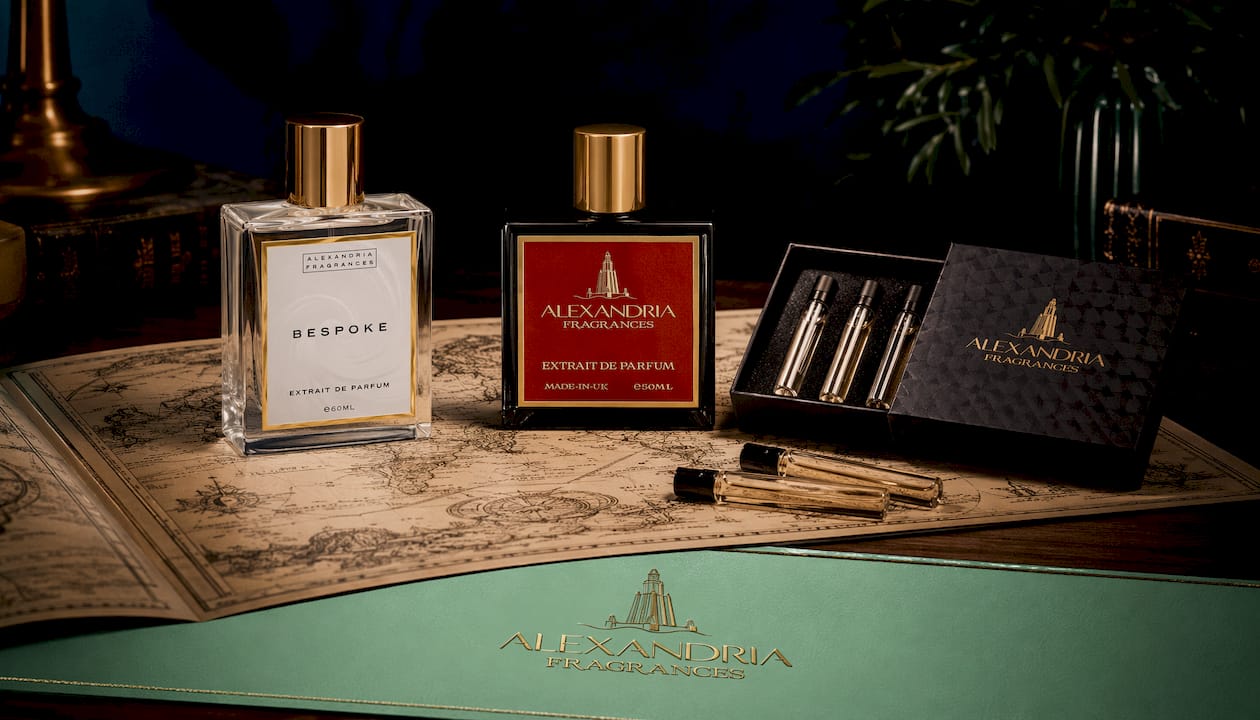
Sourcing raw materials, commissioning a safety assessor, and navigating UK cosmetics compliance is a significant undertaking for a first project. Alexandriauk offers a more direct path: the DISCOVERY SET delivers a curated palette of quality, designer-inspired fragrances so you can explore olfactory families and refine your brief before spending on raw ingredients. For those ready to go further, the bespoke commissioning service takes your brief and produces a finished, original fragrance to professional standards, with all the compliance documentation handled. Browse the full collection at alexandriauk.com and place your first order today.
Recommended reading and resources
- UK cosmetics law: GOV.UK — Making cosmetic products available in Great Britain and The Cosmetic Products (Safety) Regulations 2004
- Compliance checklist for UK sellers: Sprintlaw UK — Selling perfume from home
- Professional beginner guidance: Karen Gilbert — How to make perfume and Nicolai Rutkowski — Scentscholar
- Practical blending method: Ateneo dell’Olfatto — How to create your own perfume
- Essential oil handling basics: Root & Still — Essential oils and aromatherapy at home
- Fragrance ingredient reference: Alexandriauk — Perfume ingredient list
- Starter materials and discovery kits: Alexandriauk DISCOVERY SET and Jeffi Inc fragrance range
This article is general information, not professional legal or safety advice. Confirm current UK cosmetics regulations with GOV.UK or a qualified safety assessor before placing any product on the market.