
How to choose the right cologne: a 5-step plan for men
Pick three complementary scents, one for work, one for casual days and one for evenings, and test each on skin for a full day before you commit to a bottle. That single habit, sampling honestly rather than buying on impulse from a department store counter, separates men who wear fragrance well from men who own a shelf of regrets. This guide walks through the whole method: how to read a label, how your own skin changes a scent, when to spend on a full bottle, and how to build a small wardrobe that covers everything from Monday meetings to Saturday night.
Here’s the quick map before we go deeper:
- Learn the basics: notes, concentration labels and what they actually predict.
- Match scent families to season, occasion and the impression you want to give.
- Test properly on skin, not on paper, and give it hours before judging.
- Buy samples or decants first; save full bottles for scents that have proven themselves.
- Build a compact wardrobe of three to five colognes rather than chasing one “signature.”
Alexandriauk’s own pillar guide on choosing a cologne covers the mechanics in more depth, a PubMed study on perfume-skin interaction backs the science behind why testing on skin matters, and GQ’s piece on finding a signature scent makes the case for rotation over a single fixed choice. Treat those three as your anchors as you work through the steps below.
Key Takeaways
Choosing the right cologne comes down to testing on skin over hours and days, matching scent families to context, and buying small before buying big.
| Point | Details |
|---|---|
| Follow the 5-step method | Identify the vibe, shortlist families, sample on skin, wear for hours across days, then buy. |
| Test on skin, not paper | Skin temperature and oiliness shape how a fragrance develops far more than a paper strip ever will. |
| Sample before you commit | Use decants or samples for at least a week before spending on a full bottle. |
| Match family to occasion | Citrus and aquatic for day and warmth, woody and amber for evenings and cold months. |
| Build a small wardrobe with Alexandriauk | Rotate three to five complementary scents, and use Alexandriauk’s samples or Bespoke service to test before buying. |
Table of Contents
- How do you choose the right cologne for you?
- What are notes and concentrations, and why do they matter?
- Which scent families suit each season and occasion?
- How does body chemistry change the way cologne smells?
- How should you buy samples, decants and full bottles?
- What’s the right way to apply cologne?
- How do you build a small fragrance wardrobe?
- Where to find quality samples, decants and bespoke options
- Sources
- FAQ
How do you choose the right cologne for you?
The right cologne is the one that survives contact with your actual skin, your actual week and your actual budget, not the one that smelled best on a paper strip at a counter. Getting there is a five-step method: identify the vibe you want, shortlist two or three fragrance families, sample each on skin for hours (not minutes), wear the strongest contender across several different days, then buy a decant or full bottle only once it has proven consistent.
Step 1: Identify the vibe. Before you smell a single bottle, decide what you’re solving for. Do you need something quiet enough for an open-plan office, something with more presence for evenings, or a scent that reads as effortless on weekends? Write down three words that describe how you want to come across, confident, warm, clean, whatever fits, because that list will filter out half the counter before you spray a thing.
Step 2: Shortlist families, not brands. Pick two or three scent families (citrus, woody, amber, aquatic, fougère) that match your vibe words, and pull two or three candidates from each. This alone stops the common mistake of testing eight unrelated scents in one sitting, which fatigues your nose within twenty minutes.
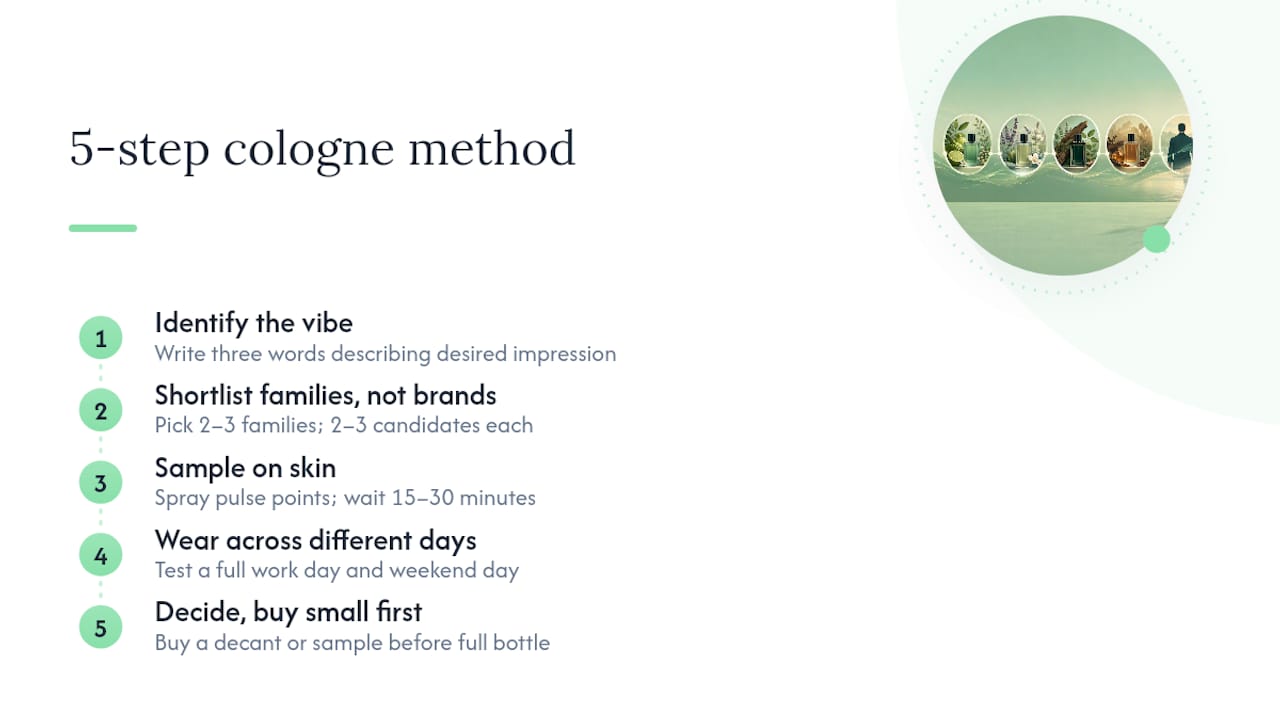
Step 3: Sample on skin. Spray, don’t dab, and use pulse points where blood runs close to the surface: wrists, inner elbow, side of the neck. Give it fifteen to thirty minutes for the initial alcohol sharpness to fade and the true heart notes to surface.
Step 4: Wear it for hours, on different days. A cologne that smells brilliant at 9am can vanish by lunch or turn sour by 6pm. Wear your top contender through a full working day at least once, and through a weekend day separately, since your skin’s temperature and activity level shift the story.
Step 5: Decide, then buy small first. Once a scent has survived multiple wears without disappointing you, buy a sample or decant of the full-size product before committing to a bottle. According to Neiman Marcus’s editorial guidance on cologne selection, this test-first approach, rather than a single sniff-and-buy decision, is what separates a fragrance you wear for years from one that sits half-used in a drawer.
Pro Tip: Keep your impressions honest by testing blind where possible. Ask a partner or friend to hand you unlabelled samples, avoid heavily scented deodorants or aftershave balms on testing days, and rest your nose for a few minutes between scents by sniffing your own forearm or a piece of coffee.
What are notes and concentrations, and why do they matter?
A fragrance unfolds in three stages, called top, heart and base notes, and understanding that structure is the difference between judging a scent fairly and judging it after thirty seconds in a shop. Top notes are what you smell in the first five to fifteen minutes, usually citrus, light spices or aromatic herbs. They’re designed to grab attention and then fade. Heart notes, often floral, spicy or fruity accords, emerge as the top notes settle and form the true character of the fragrance for the next few hours. Base notes, woods, musks, amber, resins, are what lingers on your skin and clothing long after the top and heart have gone, sometimes for many hours.

This is precisely why testing on a paper strip in a shop tells you almost nothing useful. Paper doesn’t warm up, doesn’t have oils, and doesn’t hold onto base notes the way skin does.
Concentration labels are the other piece of the puzzle, and they’re widely misunderstood. Eau de Cologne, Eau de Toilette, Eau de Parfum and Parfum simply describe the percentage of fragrance oil dissolved in the alcohol and water base, which broadly correlates with strength and lasting power but is not a guarantee of quality.
| Concentration | Typical oil content | Expected longevity | Best suited to |
|---|---|---|---|
| Eau de Cologne (EDC) | A low concentration of fragrance oils | Generally a few hours | Hot weather, subtle daytime presence |
| Eau de Toilette (EDT) | A moderate concentration of fragrance oils | Typically several hours | Everyday office and casual wear |
| Eau de Parfum (EDP) | A higher concentration of fragrance oils | Often longer lasting throughout the day | Evenings, colder months, occasions needing presence |
| Parfum/Extrait | Generally the highest concentration of fragrance oils | Typically designed for extended wear | Special occasions, cold weather, maximum longevity |
These ranges, drawn from industry guidance on understanding cologne, toilette and parfum concentrations, are helpful benchmarks rather than fixed rules. A well-composed EDT with high-quality raw materials can easily outlast a cheaply constructed EDP. As FragranceAdvice’s comparison of concentration labels points out, composition and the raw materials used matter as much as the percentage on the box, sometimes more. Don’t assume a higher number on the label means a better fragrance; it only means more concentrated oil.
Which scent families suit each season and occasion?
Fragrance families communicate something before you’ve said a word, so matching the family to the moment is as much about impression management as personal taste. Citrus and aquatic scents read as fresh, approachable and low-key, which makes them ideal for warm weather, daytime office settings and any situation where you want to seem easy to talk to rather than commanding. Woody and amber families project maturity and quiet confidence, which is why they work so well for evenings, colder months and situations where you want to be remembered. Gourmand scents, built around vanilla, cocoa or spice, feel warm and comforting, better suited to intimate settings than boardrooms. Fougère and aromatic families sit in the middle: versatile enough for daily wear across most seasons, which makes them a strong starting point if you’re only building your first bottle.
A few practical do’s and don’ts for shared spaces:
- Do choose lighter EDT or EDC strengths for enclosed offices, lifts and public transport.
- Do save heavier amber or gourmand scents for evenings when you have more room to project.
- Don’t apply a fresh spray immediately before a meeting in a small room; give it time to settle beforehand.
- Don’t assume louder is better in professional settings; subtlety often reads as more considered.
Gentleman’s Gazette’s cologne guide makes a similar point: matching the fragrance family to the desired mood or impression, rather than simply picking what smells strongest, is what separates confident dressing from overcompensation. Alexandriauk’s occasion-based fragrance guide breaks this down scenario by scenario if you want a deeper reference for specific events.
How does body chemistry change the way cologne smells?
Skin temperature and oiliness are the primary factors influencing how a fragrance develops on your skin, more so than differences in skin pH. Warmer, oilier skin tends to accelerate projection and hold onto base notes longer, while drier or cooler skin can cause a scent to fade faster and read thinner throughout the day. The narrow pH range of healthy skin, typically around 4.5 to 5.5, means pH differences are rarely the real explanation for why a fragrance smells different on two people, whatever internet forums claim.
A PubMed study examining perfume behaviour on skin used headspace analysis and solvent swabbing to compare how fragrance evolves on skin versus inert surfaces, and found that physical interactions, primarily temperature and sebum, played a significant role in how a scent developed over time. Chemical transformation of the fragrance itself was generally low under normal conditions, though the study noted microbially catalysed changes could occur in areas like the underarm. In plain terms: your skin doesn’t usually rewrite the fragrance chemically, but it absolutely changes how that fragrance releases and lingers.
Here’s a testing method that accounts for this:
- Spray on a pulse point, wrist or inner elbow, never on clothing if you want to judge true skin performance.
- Wait 15–30 minutes before forming any first impression; you’re waiting for the top notes to clear.
- Re-evaluate at the 2–4 hour mark, when heart notes should be dominant.
- Check again after a full day to judge base notes and overall longevity.
- Repeat on at least two separate days, since diet, activity level and even weather shift how your skin behaves.
Pro Tip: Limit the variables while testing. Skip heavily fragranced deodorants, scented body wash and spicy or garlicky meals on the days you’re evaluating a new cologne, since all three can distort how a fragrance actually reads on your skin.
How should you buy samples, decants and full bottles?
Buying fragrance responsibly starts with refusing to commit to a full bottle until a scent has proven itself across multiple wears, which is exactly why samples and decants exist. A decant, a small portion of a full bottle sold separately, lets you live with a fragrance for a week or two at a fraction of the cost, and it’s the single best money-saving habit in this entire hobby.
Before handing over money, run through this checklist:
- Confirm the concentration (EDC, EDT, EDP or parfum) matches what you tested, not a different version of the same name.
- Check for a batch code, which indicates freshness; fragrances do degrade over years, especially once opened.
- Ask about return or exchange policy before buying a full bottle sight unseen.
- Look for authenticity signals, official retailer, sealed cellophane, consistent bottle weight and font.
- Compare price-to-volume rather than sticker price alone; a 50ml bottle at a lower price isn’t always cheaper per millilitre than a 100ml.
Alexandriauk’s fragrance shopping checklist expands on these try-before-you-buy tactics if you want a printable reference. Reserve full-bottle purchases for scents that have earned a place through repeat testing, an emotional pull you keep noticing, frequent enough use to justify the size, or genuine signature-scent potential. Everything else stays a decant.
What’s the right way to apply cologne?
Application is where good fragrance choices get undone by bad habits, so the rules here matter as much as the scent itself. Spray on pulse points, wrists, inner elbows, the base of the throat, where warmth helps the fragrance develop naturally through the day. Avoid spraying directly onto clothing if you want the true skin development described earlier; fabric holds scent differently and can trap it unevenly.

On quantity, less is genuinely more: one to three sprays depending on concentration is enough for most situations, with EDC needing more (and more frequent reapplication) than a concentrated parfum. If you need to top up, carry a small atomiser rather than reapplying the full amount, which avoids overwhelming a room by mid-afternoon.
Pro Tip: If you can smell your own cologne after the first hour, others have likely stopped noticing it entirely; your nose adjusts to your own scent far faster than everyone else’s does. Resist the urge to reapply based on what your own nose tells you.
Etiquette matters more in enclosed spaces than most men realise. Colleagues with fragrance sensitivities, small meeting rooms, lifts and public transport all call for restraint. A scent that feels perfectly judged walking into a bar can feel invasive in a quiet office by 11am. Adjust strength to the room, not just the occasion.
How do you build a small fragrance wardrobe?
A compact wardrobe of three to five colognes covers more real-world situations than any single “signature scent” ever will, and it costs less over time than repeatedly replacing a scent that no longer fits. Build it around three anchors: a subtle, low-sillage option for work and daily wear, a fresh or aromatic option for casual weekends, and a richer, more characterful scent for evenings and dates.
The trick to avoiding clashing notes is balance, not variety for its own sake. If your work scent leans citrus and clean, your evening scent should lean warmer, amber or woody, rather than another light citrus, so the two feel like different tools rather than duplicates. Alexandriauk’s seasonal fragrance wardrobe guide offers specific seasonal pairings if you want a ready-made starting framework.
Pro Tip: Store bottles away from direct sunlight and heat, ideally in their original boxes, and rotate through your wardrobe regularly rather than letting one bottle sit untouched for months. Fragrance oxidises slowly even unopened, and light exposure accelerates the process noticeably.
Why a curated wardrobe beats chasing one signature scent
A single signature scent sounds appealing in theory, distinctive, memorable, simple, but in practice it asks one fragrance to do a job that three or four could do far better. Rotating scents by mood and occasion gives you actual control over the impression you make, rather than hoping one bottle happens to suit a job interview, a first date and a Sunday brunch equally well. It also solves a problem nobody mentions enough: scent fatigue, both yours and everyone else’s around you.
There’s a quieter benefit too. Wearing the same fragrance every day for years means your own nose stops registering it almost entirely, so you lose the ability to judge how strong it’s actually reading to other people. A rotation keeps that awareness sharp, and it lowers the odds of an awkward moment where you and a colleague or friend turn up wearing the exact same scent. Editorial voices across the industry, including GQ’s own reporting on signature scents, have increasingly landed on the same conclusion: variety isn’t indecision, it’s expertise.
Where to find quality samples, decants and bespoke options
Testing properly, as this whole guide has argued, means resisting the urge to buy a full bottle on a first impression. Alexandriauk builds its whole approach around that reality, offering sampling and decant options so you can live with a scent for days before spending on a full size. For men who’ve tested widely and want something that’s genuinely theirs rather than another interpretation of a popular release, the Bespoke service takes your preferences from that testing process and builds a fragrance around them directly, no guessing which off-the-shelf option comes closest.
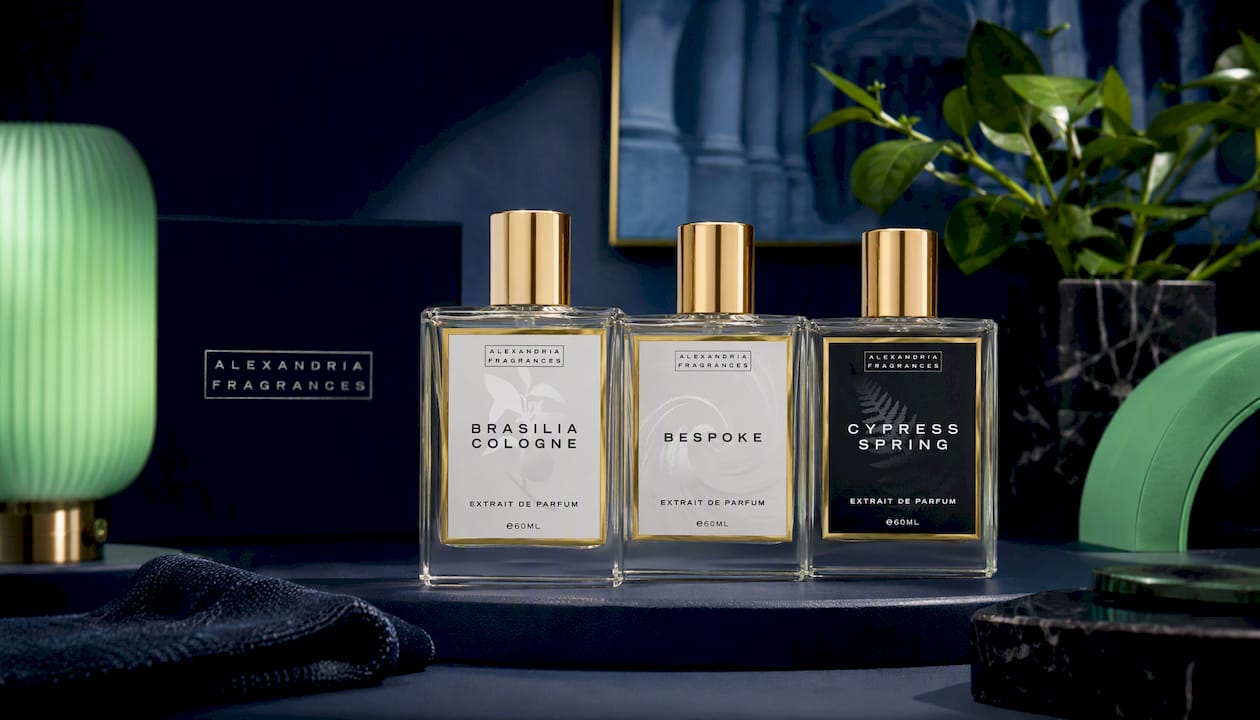
If you’d rather start with something ready-made, the Brasilia Cologne is a solid entry point for a versatile daytime option, while Cypress Spring, inspired by Amouage’s Bracken Man, gives you a familiar, well-regarded style at a more accessible price for readers who prefer a proven profile over an unknown. Alexandriauk’s full guide to choosing a cologne walks through the sampling process in more detail if you want a second reference alongside this one, and readers comparing wider retail options can also browse Jeffi’s fragrance category for additional context on what’s available elsewhere. Start with a sample, wear it properly, and only move to a bottle or a bespoke build once it’s earned that step.
Sources
- Perfume behaviour on skin: physical and chemical interactions (PubMed)
- Signature scent: how to find your scent (GQ)
- Perfume vs cologne vs toilette: what’s the difference? (FragranceAdvice)
- Understanding eau de cologne, eau de toilette & eau de parfum (Scentake)
- Cologne guide: how to choose and wear fragrances (Gentleman’s Gazette)
FAQ
How do you know what cologne is right for you?
The right cologne survives a full day of wear on your skin without disappointing you and matches the impression you want to give in that context. Test candidates on pulse points across multiple days rather than judging from a paper strip in a shop.
How do I choose the right men’s cologne?
Identify the vibe you want, shortlist two or three fragrance families that fit it, sample each on skin for hours, then buy a decant before committing to a full bottle. Alexandriauk’s pillar guide on choosing a cologne walks through this process step by step.
What are the concentration levels of cologne?
The main concentration levels are Eau de Cologne (roughly 2–8% oil), Eau de Toilette (roughly 5–15%), Eau de Parfum (roughly 10–20%) and Parfum or extrait (often above 20%). Higher concentration generally means longer wear, but composition and raw materials affect performance just as much.
What’s a good starting set of colognes for men?
A practical starting wardrobe includes a subtle option for work, a fresh or aromatic scent for casual days, and a richer option for evenings. Alexandriauk’s Brasilia Cologne and Cypress Spring both work well as accessible entries into such a set.
Why does the same cologne smell different on different people?
Skin temperature and oiliness are the main drivers of how a fragrance develops, with warmer, oilier skin generally increasing projection and longevity. The commonly cited “pH difference” explanation is largely a myth, since healthy skin sits in a narrow pH range for almost everyone.