
How to Choose a Perfume Online: A Connoisseur's Guide
Choosing a perfume online comes down to four things: knowing the scent families you love, reading notes and reviews with a discerning eye, sampling before you commit to a full bottle, and checking the practical details of the order. Do those four well and a screen can become a surprisingly reliable fragrance counter. What follows is the method we would hand to a friend, from first instinct to final checkout.
TL;DR
- Identify the one or two scent families, or the favourite notes, that you return to again and again, then shop within them.
- Treat the top, heart and base pyramid as a guide to the journey of a scent, not a rulebook.
- Trust reviews that describe the smell in specific terms, and look for several reviewers describing it the same way.
- Sample on skin before buying a full bottle, no more than two fragrances at a time, and give each hours to unfold.
- Before ordering, check what exactly is being sold, the returns terms for opened bottles, and how damage is handled.
Table of Contents
- Begin with the families you already love
- Read the notes as a story, not a pyramid
- Learn to read reviews like a perfumer
- Sample before you commit to a full bottle
- Check the practical details before you order
- Our perspective
- Choosing a fragrance for someone else
- Where to begin with us
- A simple checklist before you click “buy”
- FAQ
- Sources
Begin with the families you already love
The single most useful thing you can do before opening a browser tab is to understand your own palette. Perfumer Susan Wai Hnin tells Elle UK that the first step is understanding your scent preferences and how they sit within the main olfactory families. Trying a range across floral, woody, fresh and amber styles helps narrow the field.
The Perfume Society describes the families as follows:
| Family | Typical character | Notes you may recognise |
|---|---|---|
| Fresh | Uplifting, bright, clean | Citrus |
| Floral | Romantic, petal-soft | Rose, jasmine, peony, gardenia |
| Ambrée (formerly Oriental) | Warm, resinous, enveloping | Amber, resins |
| Woody | Dry, smooth, grounded | Sandalwood, cedar, oudh |
| Fougère | Aromatic, herbal, crisp | Lavender, geranium, oakmoss |
| Chypre | Elegant, earthy, layered | Bergamot, oakmoss, patchouli, labdanum |
| Gourmand | Edible, indulgent, sweet | Caramel, chocolate, vanilla |
A quick way to find your own territory is to look at what you already own and wear. Which bottle do you reach for on the best days? Which candle, hand cream or room spray do you secretly adore? A love of vanilla in a candle often points towards gourmand and ambrée perfumes. A fondness for freshly cut grass or bergamot tea points towards fresh and fougère styles.
If you want a deeper walk through the territories, our guide to popular perfume families pairs each one with the occasions and seasons it suits best.
Follow the notes, not only the family
Families are a map, but individual notes are the landmarks. Arabelle Sicardi, founder of Perfumed Pages, suggests in The New York Times that you first pinpoint the one or two notes you love most, then sample a range of fragrances featuring them. The pleasure lies in discovering how differently a single note can behave: a rose can be dewy and green in one composition, dark and jammy in another, spiced and smoky in a third.
Write your two notes down. They become the filter for everything that follows, from the product pages you read to the samples you order.
Read the notes as a story, not a pyramid
Online product pages almost always list top, heart and base notes. They are helpful, but worth reading with a little nuance.
According to Elle UK’s expert, top notes fade within the first couple of minutes, middle notes are most present in the heart of a fragrance, and base notes linger longest on the skin. That is the classic account, and it is a good way to anticipate how a perfume will evolve through the day: sparkling citrus at the start, a floral or spiced heart, then a warm, woody or musky finish.
Perfumers themselves are more relaxed about the diagram. In Bustle, a perfumer explains that the pyramid is an oversimplification: you smell the whole composition, and over time the pyramid flattens, with molecular size governing where a scent sits and how quickly it evaporates from skin.
What does that mean when you are shopping?
- Pay most attention to the base notes. They are what you will live with for the longest part of the day, and what lingers on a scarf the following morning.
- Do not dismiss a perfume for one unfamiliar top note. It may vanish in minutes.
- Look for the accord, not just the list. A gourmand accord of vanilla, tonka and praline reads very differently from the same ingredients softened by sandalwood.
- Notice descriptive words. Terms such as luminous, smoky, powdery, creamy or salty tell you more about the experience than a bare list of ingredients.
If you would like a step-by-step companion for this stage, our guide to choosing a new perfume walks through it in more detail.
Learn to read reviews like a perfumer
When you cannot smell a fragrance, reviews become your nose by proxy. They are only as good as their detail, however.
Maiya Nicole, founder of the fragrance community Black Girls Smell Good, advises in Bustle that a review earns your trust when it describes specific sensory experiences, for instance noting that a particular rose or geranium came across as slightly medicinal. A vague “smells amazing!” tells you about the reviewer’s mood, not the perfume.
Here is a simple filter to apply:
- Specifics beat superlatives. Look for named notes, textures and moments: “the opening is peppery, the drydown is soft amber”.
- Look for agreement. If several different reviewers describe a scent in the same way, you can be reasonably confident that description is accurate.
- Read the middling reviews. A three-star comment that explains why a perfume was too sweet may describe exactly what you are hoping for.
- Check the reviewer’s taste. Someone who loves powdery florals will describe a rose differently from someone who prefers fresh woods. Find reviewers whose likes match yours.
- Be wary of longevity claims in isolation. Skin chemistry, weather and the number of sprays all shape performance, so treat a single report as one data point.
Performance is also tied to concentration. Our own formulas are designed with high oil concentrations in mind, aimed at long-lasting wear, so when you compare perfumes, it is worth comparing the concentration alongside the price.
Sample before you commit to a full bottle
The most dependable way to remove risk from online buying is not a cleverer search, it is a small vial. The Perfume Society’s FAQs say that online buying is perfectly fine for replenishing a favourite, but recommend trying a sample first, and note that discovery boxes exist to help online shoppers do exactly that.

The same source recommends a sensible order of testing. Start with blotters to eliminate no-hopers, then move to your skin, ideally with no more than two fragrances at a time, one on each wrist, and live with the sample before buying.
A sampling routine that works
- Choose a small shortlist. Three to five perfumes from your favourite family or built around your favourite notes is plenty.
- Wear one or two per day. One on each wrist is the limit. More than that and your nose, and your judgement, will tire.
- Judge at intervals. Notice the first spray, then the heart an hour or two later, then the drydown at the end of the day.
- Make notes. A line or two on how it made you feel is worth more than a star rating.
- Wear the winner more than once. Try it on a different day and in different weather before you commit to the full bottle.
Also allow time. A perfume on skin is a slow performance, and the first ten minutes are only the overture.
Our own guides on the best ways to test perfume and testing several perfumes without confusion go further into the practicalities.
Check the practical details before you order
Once you have a scent in mind, a few minutes of due diligence protect your purchase.
Know exactly what is on offer. Look at the product page for the size, concentration (eau de parfum, extrait and so on), the full ingredient list and clear photographs of the packaging. If a listing is vague about what you will receive, ask before you buy.
Read the returns policy. Many fragrance retailers treat opened or sprayed bottles differently from sealed ones, because a used perfume cannot be resold. That is a good reason to sample first and to read the terms on the page before you pay.
Look at delivery and damage terms. Glass can break in transit. Check how the seller handles damaged parcels and how quickly you must report a problem.
Consider allergies and sensitivity. If you are prone to reactions, read the ingredient list carefully. In Europe, IFRA notes that every cosmetic product must undergo a complete safety assessment before sale, and that fragrance allergens must be listed once they exceed very small thresholds. If you have a known allergy or a skin condition, speak to your GP or pharmacist before trying a new product.
Pay safely. Use a payment method that offers a clear dispute process.
Our perspective
We believe that a beautiful fragrance should not depend on a designer price tag. Inspired-by perfumery is, at its best, a form of homage: a respectful reading of an iconic scent, composed with its own quality and care.
That is the standard we hold ourselves to. Our inspired perfumes are made with high oil concentrations designed for long-lasting performance, and our production is ethical, cruelty-free and IFRA-compliant. Quality is the point, not an afterthought.
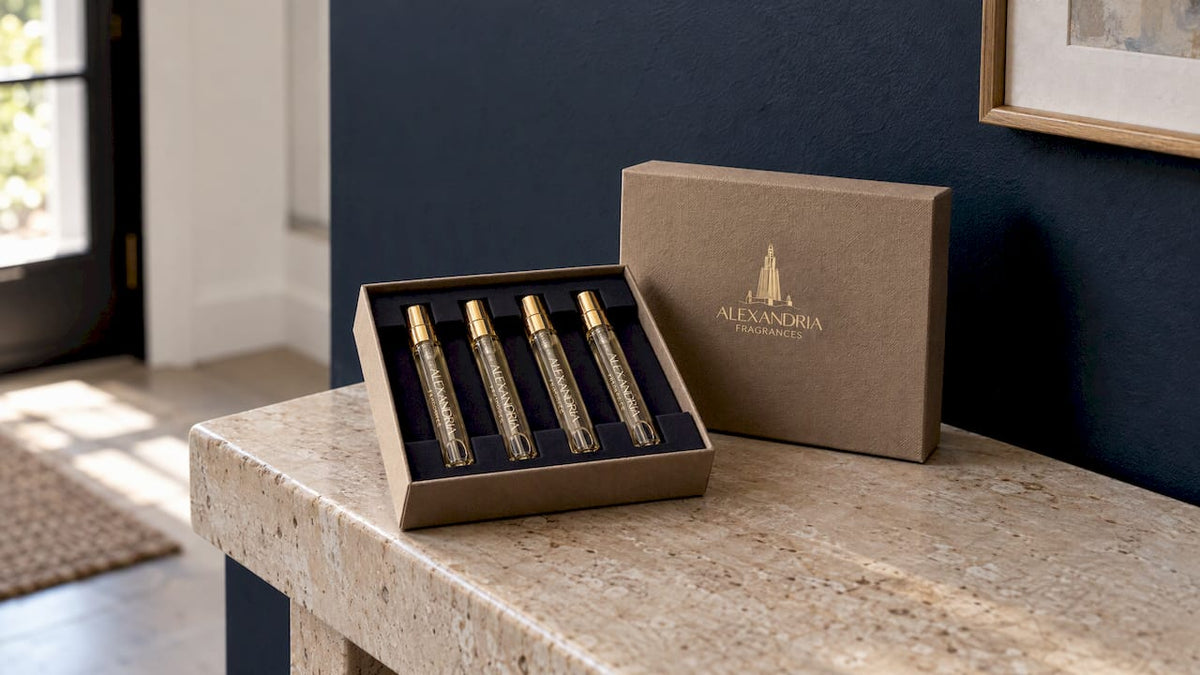
This is why we think the smartest way to shop online is to explore widely and cheaply first. A sample pack lets you meet six different compositions at once and discover which accords you return to, so that your eventual full bottle is a choice made with your nose rather than a gamble made with your eyes. And if nothing quite captures what you imagine, our bespoke service exists to create a personal blend that is yours alone.
Choose by family, follow your favourite notes, and let your skin have the final say.
dave
Choosing a fragrance for someone else
Buying blind is hard enough for yourself. Buying for another person adds a layer of guesswork, but the experts agree on a few principles, gathered by Byrdie.
- Find out what they already wear. Givaudan perfumer Adriana Medina suggests learning which fragrances the recipient likes, then matching those notes with something new and distinctive to complement their collection.
- Choose for them, not for you. Medina’s advice is to make sure the fragrance suits the other person’s taste rather than your own.
- Think about sensitivities. Byrdie’s experts suggest considering allergies or headaches before you choose.
- When in doubt, go bigger. Expert Shapiro’s safe bet is a large bottle of something they already own.
A discovery set can be a graceful solution here, too, because it lets the recipient explore and choose a favourite themselves. For ideas on matching a scent to a personality, see our guide to choosing a perfume for a woman.
Where to begin with us
If you are ready to put this method into practice, our Sample Pack 6 x 5ml is priced at £59.99, and our Discovery Set is priced at 83 USD. Both are designed to let you explore several compositions, from fresh and floral to warm and gourmand, before you commit to a full bottle.

Start with the Sample Pack 6 x 5ml or the Discovery Set, or browse the women’s, men’s and unisex collections. If you would like something entirely your own, take a look at our bespoke blends.
A simple checklist before you click “buy”
- I know my favourite family and one or two favourite notes.
- I have read the notes as a story, paying most attention to the base.
- I have read reviews that describe the scent in specific terms and agree with one another.
- I have sampled on skin, one or two at a time, and lived with my favourite.
- I know what is being sold, what the returns terms are and how damage is handled.
If all five are ticked, you are buying with the same confidence as someone standing at the counter. For a wider set of ideas, our fragrance discovery tips and our guide to finding the best perfume for you continue the journey.
FAQ
How do I choose a perfume I will like without smelling it?
Start with the families and notes you already enjoy, then read reviews that describe the scent in specific terms. Order a sample rather than a full bottle, and wear it on your skin for a full day. This combination removes most of the guesswork.
How many perfumes should I test at once?
The Perfume Society suggests no more than two on skin at a time, one on each wrist, after using blotters to rule out the obvious no-hopers. Testing fewer at once keeps your nose fresh and your impressions clear.
Are top, heart and base notes really that important?
They are a useful guide to how a perfume evolves, with top notes fading within minutes and base notes lingering longest. Perfumers also point out that the pyramid is a simplification, so pay particular attention to the base and to the overall feel of the composition.
What should I do if I am buying perfume as a gift?
Find out which fragrances the person already wears and choose something with similar notes, thinking of their taste rather than yours. If you are unsure, a larger bottle of a scent they already own is a safe choice, or a discovery set lets them explore for themselves.
Is it safe to buy perfume online if I have sensitive skin?
Read the full ingredient list before you order, as fragrance allergens must be listed in Europe once they pass small thresholds. If you have a known allergy or skin condition, ask your GP or pharmacist for advice before wearing a new fragrance.
Sources
- A Complete Guide To Finding Your Signature Scent, Elle UK
- Fragrance families: what are they? The Perfume Society
- How to Find Your Signature Scent, The New York Times
- How To Buy Perfume Online & Avoid Buyer’s Regret, Bustle
- FAQs, The Perfume Society
- The hidden science that keeps scented products safe, IFRA
- 12 Tips For Choosing A Fragrance Gift, Byrdie