

Best Ways to Test Perfume for Better Fragrance Choices
Finding your ideal scent does not have to break the bank when you use the smart methods beloved by thrifty British fragrance lovers. With over 60 percent of shoppers in the UK preferring to test perfumes before buying, creating a proper testing routine saves money and prevents regret. Discover how a strategic environment and simple tools can help you assess every fragrance note and performance detail with the confidence of a skilled British perfumista.
Table of Contents
- Step 1: Prepare Your Testing Environment
- Step 2: Sample Fragrances On Paper And Skin
- Step 3: Assess Perfume Notes Over Time
- Step 4: Compare Scents For Uniqueness And Quality
- Step 5: Verify Scent Longevity And Performance
Quick Summary
| Key Insight | Explanation |
|---|---|
| 1. Ensure a neutral testing area | Use a well-ventilated room with no competing scents to accurately assess perfumes. |
| 2. Use paper strips first | Start testing with scent strips for an initial fragrance impression before skin application. |
| 3. Test on skin for authenticity | Apply perfume to pulse points to see how it develops and interacts with your body chemistry. |
| 4. Evaluate scent evolution | Note how top, heart, and base notes evolve over time to understand the fragrance better. |
| 5. Track performance throughout the day | Assess projection, longevity, and sillage to determine the practical wear of the fragrance. |
Step 1: Prepare your testing environment
Testing perfumes requires a strategic approach to creating the ideal sensory evaluation space. Your goal is to establish a neutral environment that allows you to assess fragrance nuances accurately and consistently.
Start by selecting a well-ventilated room with minimal external odours. Controlled testing conditions are crucial for reliable fragrance assessments. Choose a space with consistent temperature and humidity levels, avoiding areas near open windows, cooking spaces, or strong air currents that might interfere with scent perception.
Your testing area should be clean and free from competing fragrances. Remove scented candles, air fresheners, or recently worn clothing that could contaminate your olfactory environment. Position yourself near neutral surfaces like a plain table or desk, ensuring good natural lighting but avoiding direct sunlight that might warm the perfume samples.
Prepare your testing materials in advance. Have clean paper strips or blotters, a notebook for recording impressions, and water for cleansing your palate between different fragrance tests. Consider wearing unscented clothing and avoiding strong personal care products that might interact with the perfume samples.
Here’s a concise summary of ideal perfume testing conditions and their impact:
| Condition | Why It Matters | Effect on Scent Evaluation |
|---|---|---|
| Neutral room environment | Prevents external odour influence | Allows for accurate scent analysis |
| Consistent temperature | Avoids scent volatility | Maintains fragrance stability |
| Unscented clothing | Removes personal scent conflicts | Preserves perfume integrity |
| Clean surfaces | Blocks contamination | Improves reliability of results |
Professional Advice: Keep a cup of ground coffee nearby to help reset your sense of smell between different fragrance evaluations.
Step 2: Sample fragrances on paper and skin
Testing perfumes effectively requires understanding the nuanced process of fragrance sampling, which involves strategic application techniques to reveal a scent’s true character. Your primary objective is to experience how a fragrance interacts with different surfaces and develops over time.
Begin by using paper testing strips as your initial evaluation method. Comprehensive perfume testing involves first sampling on scent strips to get an immediate impression of the fragrance profile. Spray or dab a small amount of perfume onto the paper strip, holding it at a slight distance to prevent oversaturation. Allow the fragrance to develop for approximately 30 seconds before bringing the strip close to assess its initial notes.
Next, transition to skin testing which provides the most accurate representation of how a perfume will actually perform. Apply the fragrance to your inner wrist or forearm areas where skin temperature naturally fluctuates. These pulse points help activate and reveal the perfume’s complex layering. Wait approximately 10 to 15 minutes to experience how the scent transforms through its top, middle, and base notes as it interacts with your unique body chemistry.
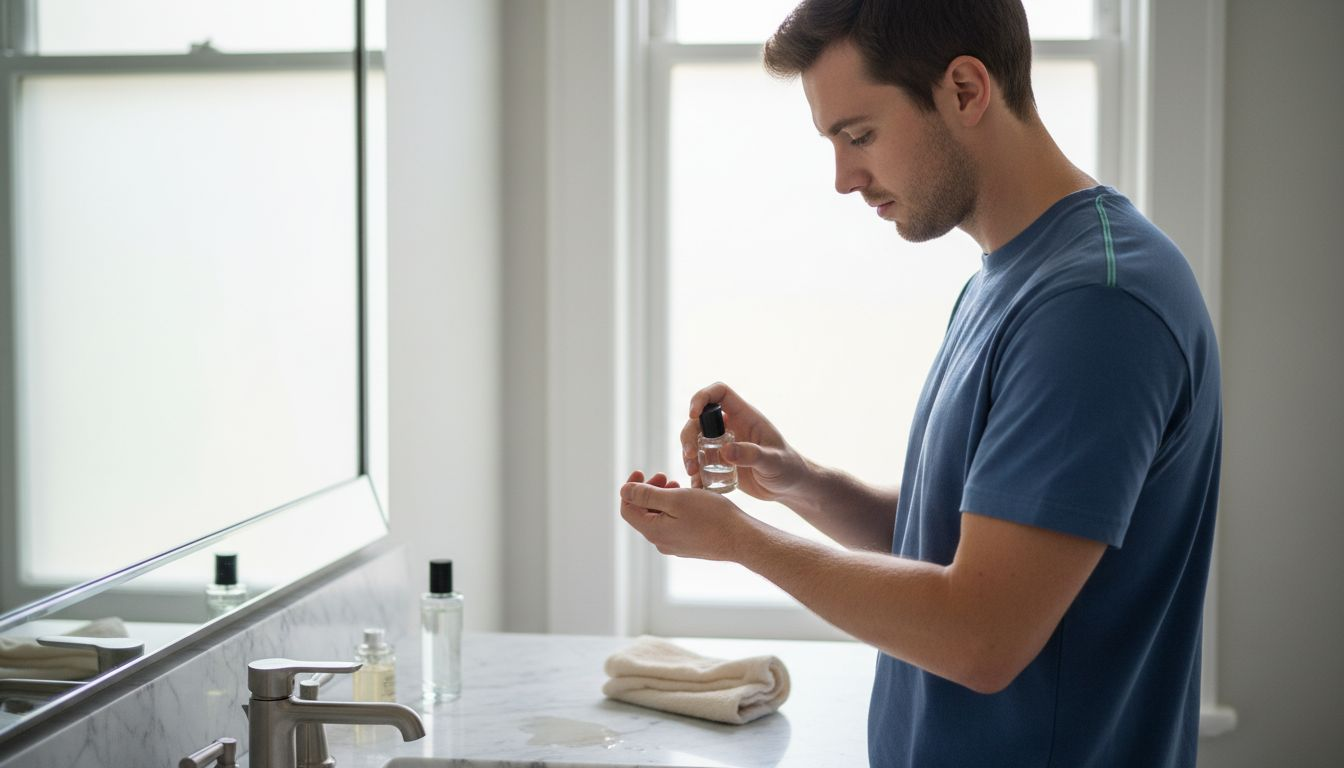
Remember that individual skin chemistry dramatically influences fragrance perception. What smells extraordinary on one person might smell entirely different on another. This variability makes personal skin testing crucial for making an informed purchasing decision.
Professional Advice: Wait at least 15 minutes between testing different fragrances to allow your olfactory senses to reset and prevent scent confusion.
Step 3: Assess perfume notes over time
Understanding how a fragrance evolves requires patience and a systematic approach to evaluating its complex olfactory journey. Your goal is to discover the perfume’s intricate transformation from its initial impression to its lasting character.
Perfume note progression follows a distinctive sequence where top, heart, and base notes emerge sequentially. Begin by noting the immediate top notes these are the volatile, quick-releasing scents that first greet your senses. These initial impressions typically last 10 to 15 minutes and provide a bright, often citrusy or fresh introduction to the fragrance.
As the perfume settles, heart notes become prominent around 20 to 30 minutes after application. These middle notes represent the core of the fragrance, revealing deeper floral, fruity, or spicy characteristics that define the perfume’s personality. Pay close attention to how these notes interact with your skin chemistry some fragrances will bloom beautifully while others might become muted or transform unexpectedly.
The final stage involves base notes which emerge after approximately one hour. These are the richest, most complex notes that provide depth and longevity to the fragrance. Woody, musky, or vanilla undertones characterise this stage and often determine the perfume’s overall lasting impression. Take careful notes about how these final notes make you feel and whether they complement your personal style.
Professional Advice: Wear the fragrance for at least four hours to fully understand its complete olfactory narrative and how it performs throughout an entire day.
Step 4: Compare scents for uniqueness and quality
Evaluating perfumes requires a strategic approach to understanding their distinctive characteristics and overall performance. Your mission is to develop a discerning eye for identifying what makes each fragrance truly exceptional.
Sensory comparison techniques involve creating a neutral environment where fragrances can be assessed objectively. Begin by arranging your test samples in a clean, unscented space with consistent lighting and temperature. Place each fragrance sample on separate testing strips or skin areas to prevent olfactory interference.
Approach your comparison methodically by evaluating key sensory dimensions. Consider the fragrance’s opening notes their initial impression and immediate impact. Assess the complexity of middle notes how they unfold and interact with your personal body chemistry. Examine the base notes for depth, longevity, and overall character. Pay attention to how each perfume transitions between these stages and whether the progression feels smooth and intentional.
Look beyond mere scent profile to understand the fragrance’s unique qualities. Consider projection how far the scent travels from your skin. Evaluate sillage the trail left behind as you move. Assess longevity how many hours the fragrance remains detectable. These elements distinguish an ordinary perfume from an extraordinary one, revealing the craftsmanship behind each blend.
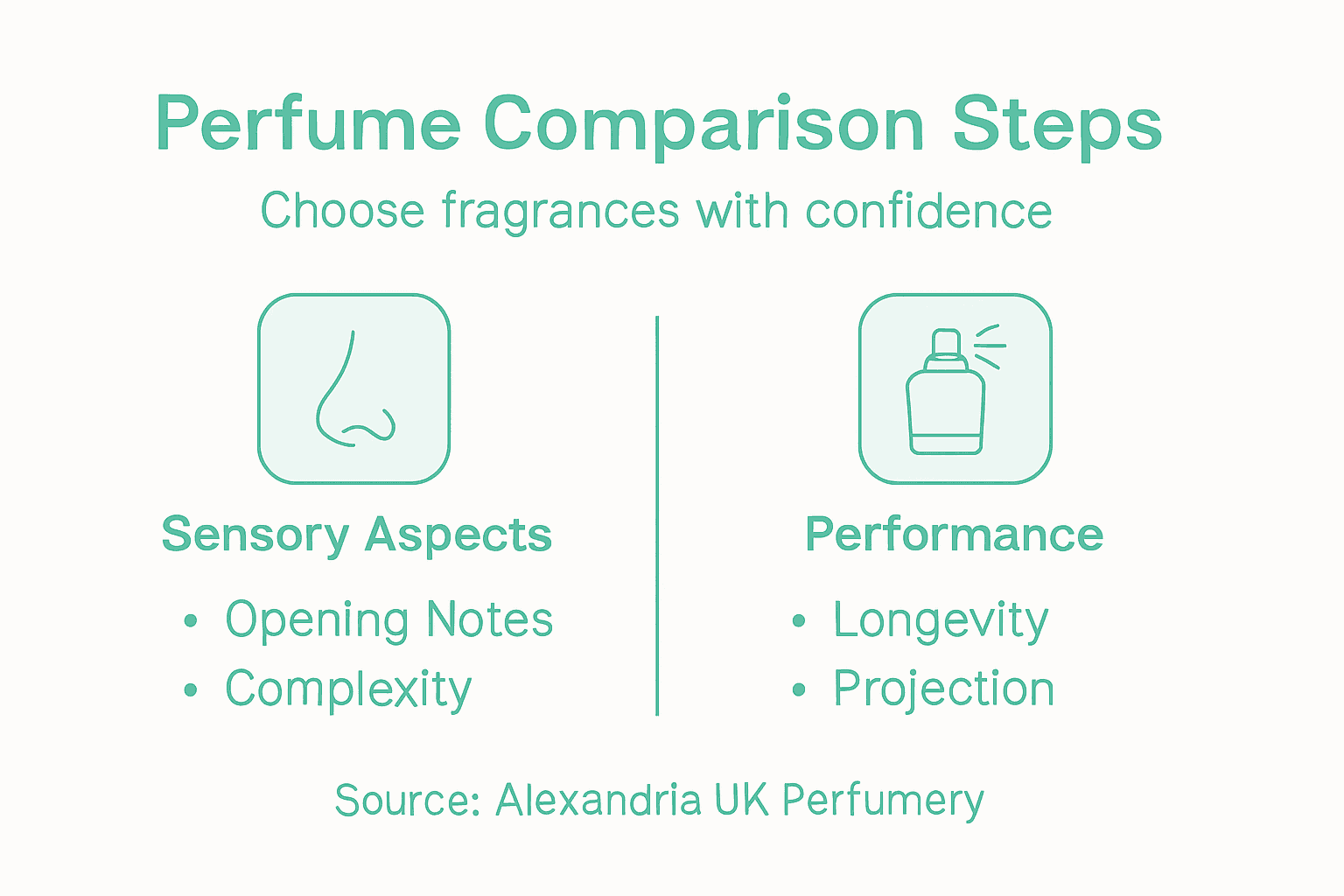
Professional Advice: Create a simple scoring system with categories like initial impression, complexity, longevity, and unique character to systematically compare different fragrances.
Step 5: Verify scent longevity and performance
Testing a perfume’s true performance goes beyond its initial impression. Your goal is to understand how the fragrance behaves throughout an entire day under different conditions and environments.
Perfume performance testing requires strategic wear across various settings. Apply the fragrance in the morning and intentionally track its evolution through different activities. Notice how the scent responds during physical movement, temperature changes, and varying humidity levels. Pay special attention to how the fragrance adapts to your body chemistry as the day progresses.
Evaluate the perfume across multiple dimensions beyond simple duration. Assess its projection the distance the scent travels from your skin. Consider sillage the lingering trail you leave behind as you move. Measure how many hours the fragrance remains detectable without becoming overwhelming or fading completely. Some fragrances might start strong but diminish quickly while others develop a subtle yet persistent presence.
Document your observations systematically. Note the time intervals when the fragrance transforms most noticeably. Record how the scent interacts with your clothing, how it performs in different environments like office spaces, outdoor settings, or social gatherings. Understanding these nuanced performance characteristics will help you determine whether the perfume truly matches your lifestyle and personal preferences.
You can use this table to compare fragrance performance factors:
| Dimension | Description | Example Impact |
|---|---|---|
| Projection | How far scent radiates from skin | Perfume detectable across a room |
| Sillage | Trail left by fragrance movement | Scent lingers after leaving space |
| Longevity | Hours a fragrance remains perceptible | Lasts morning to evening |
| Adaptability | Reaction to body/environment changes | Smells different outdoors vs. office |
Professional Advice: Wear the fragrance during a typical workday to get the most authentic representation of its real-world performance and longevity.
Discover Your Signature Scent with Confidence
Choosing the perfect perfume means overcoming the common hurdles of scent evaluation such as understanding projection, sillage, and longevity. This article highlights how a controlled testing environment and careful note assessment can help you avoid disappointment and find a fragrance that truly complements your unique chemistry. Don’t let uncertainty hold you back from experiencing a scent that feels perfect on your skin.
Experience quality and expertly curated fragrances tailored to your preferences at Alexandria UK. Our collection offers a diverse range of premium perfumes and inspired dupes designed to satisfy your desire for distinctive and long-lasting scents. Whether you are assessing base notes or seeking that elusive perfect fragrance trail, our selection simplifies your journey.
Take the next step in refining your fragrance choices by exploring our collection today. Visit Alexandria UK to browse expertly selected perfumes and find the scent that tells your story. Embrace your individuality with confidence and enjoy great perfume shopping made simple and trustworthy.
Frequently Asked Questions
What is the best way to set up a testing environment for perfumes?
Creating a neutral testing environment is essential for accurate fragrance evaluation. Select a well-ventilated room, free from competing scents, and ensure consistent temperature and humidity levels to prevent scent distortion.
How do I effectively sample fragrances on paper and skin?
Start by applying the perfume to testing strips for an initial evaluation, then transition to skin application on pulse points for a more accurate representation. Allow sufficient time, around 10 to 15 minutes, to experience the fragrance’s progression and how it reacts with your skin chemistry.
What should I look for when assessing perfume notes over time?
Pay attention to how the fragrance evolves from top notes to heart and then base notes, as they reveal different aspects of the scent. Observe how the aroma changes over at least four hours to ensure a comprehensive understanding of its character.
How can I compare different perfumes for uniqueness and quality?
Comparing perfumes effectively involves assessing their initial impression, note complexity, and longevity. Use a simple scoring system to evaluate dimensions like projection, sillage, and overall character to distinguish which fragrances resonate with you.
What factors should I consider when verifying a fragrance’s longevity and performance?
Measure the fragrance’s duration, projection, sillage, and how it adapts to different environments throughout the day. Document your observations systematically, noting significant transformations at intervals to understand the perfume’s real-world performance better.
How long should I wait between testing different fragrances?
It’s advisable to wait at least 15 minutes between testing different perfumes to allow your olfactory senses to reset effectively. This practice helps prevent scent confusion and enables a clearer assessment of each fragrance’s unique characteristics.


