How to choose a new perfume: a step-by-step guide
The fastest reliable route to a new perfume is this: identify your preferred scent family, shortlist three fragrances, test each one on skin across two separate days, then commit to a sample or discovery set before buying a full bottle. That single process eliminates the most common and expensive mistakes.
Before you read further, here is a checklist you can use right now:
- Identify one or two fragrance families that appeal to you (floral, woody, oriental, fresh, gourmand, chypre, fougère, leather).
- In-store or online, shortlist no more than three scents that match those families.
- Test each on skin, not just on a paper blotter, and wait at least 30 minutes before judging.
- Limit each session to three fragrances to avoid olfactory fatigue.
- Use samples or a discovery set to wear each fragrance across a full day before buying.
Table of Contents
- How do scent profiles and fragrance families actually work?
- How to match a fragrance to your lifestyle and occasions
- What is the right way to test a perfume before buying?
- Does concentration really affect how long a perfume lasts?
- How do you narrow down to a final choice?
- How do you recognise quality and avoid costly mistakes?
- Key takeaways
- Why correct testing matters more than any other factor
- Start with a sample, not a commitment
- Useful sources
How do scent profiles and fragrance families actually work?
A scent profile is the complete map of a fragrance: its family, its dominant accords, and the sequence of notes that unfold over time. As Joan Tanis, national training director at Maison Francis Kurkdjian, explains, olfactive families are a way to classify how a perfume smells rather than what it contains. Knowing your preferred family is the single fastest shortcut when picking a new fragrance.
Notes are the building blocks, and they reveal themselves in three stages. A useful educational framework divides the perceptual experience of a fragrance into three parts: heart notes form the main character, top notes provide the initial brightness, and base notes create the lingering foundation. Top notes are what you smell in the first few minutes, bright and immediate. Heart notes, sometimes called middle notes, form the true character of the fragrance and emerge after 15–30 minutes. Base notes are the deep, lingering foundation that can remain on skin for hours. As perfumer Kilian Hennessy puts it, the heart and dry-down notes are the true signature of the scent.
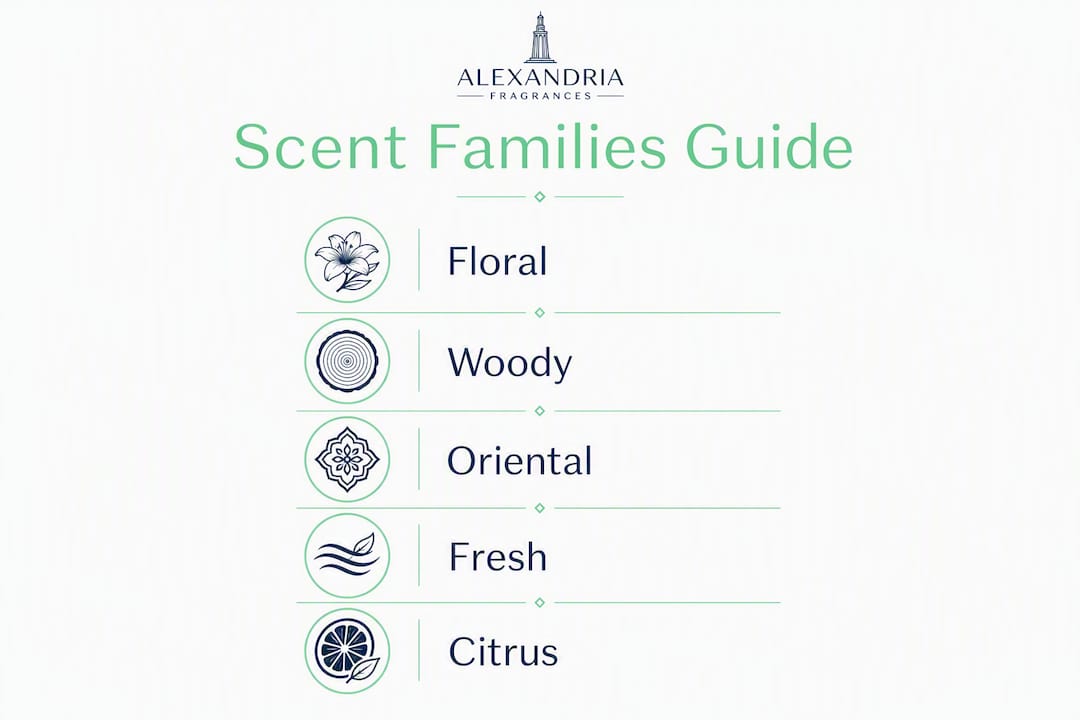
Here are the eight principal families, each with a recognisable character:
- Floral — rose, jasmine, peony; romantic and feminine, though not exclusively so.
- Woody — sandalwood, cedarwood, vetiver; grounded, warm, and versatile across seasons.
- Oriental — amber, vanilla, spice; rich, sensual, and long-lasting.
- Fresh/Citrus — bergamot, lemon, neroli; clean, energising, and ideal for warmer months.
- Gourmand — tonka bean, caramel, cocoa; edible-sweet and deeply comforting.
- Chypre — oakmoss, labdanum, bergamot; sophisticated and complex, bridging warm and fresh.
- Fougère — lavender, coumarin, oakmoss; classic and aromatic, often associated with masculine accords.
- Leather — birch tar, suede, smoke; bold, distinctive, and unmistakably luxurious.
| Family | Typical mood | Best season | Signature notes |
|---|---|---|---|
| Floral | Romantic, soft | Spring, summer | Rose, jasmine, lily |
| Woody | Grounded, warm | Autumn, winter | Sandalwood, cedarwood |
| Oriental | Sensual, rich | Autumn, winter | Amber, vanilla, oud |
| Fresh/Citrus | Energising, clean | Spring, summer | Bergamot, lemon |
| Gourmand | Comforting, sweet | Winter | Tonka, caramel, cocoa |
| Chypre | Sophisticated | Autumn | Oakmoss, labdanum |
| Fougère | Aromatic, classic | Year-round | Lavender, coumarin |
| Leather | Bold, distinctive | Autumn, winter | Birch tar, suede |
How to match a fragrance to your lifestyle and occasions
Fragrance is not one-size-fits-all. The same person might wear a luminous citrus accord to the office and a dark, hedonistic oriental for a winter evening out. Matching projection and longevity to context is as important as choosing the right family.
Projection is how far a fragrance radiates from your skin. Longevity is how long it lasts. A high-projection scent in a confined office can overwhelm colleagues; a low-projection parfum on a night out may feel too intimate. The practical trade-off: prioritise longevity for long days and travel, and moderate projection for professional settings.
| Occasion | Recommended family | Practical note |
|---|---|---|
| Office / daytime | Soft floral, clean woody, fresh | Low projection; choose EDT or light EDP |
| Date night | Oriental, chypre, leather | Medium-high projection; EDP or parfum |
| Weekend / casual | Gourmand, woody, fresh | Personal preference; EDT works well |
| Travel | Fresh, light floral | Compact; use a travel atomiser |
| Formal events | Oriental, chypre, woody | Long-lasting; parfum concentration |
Pro Tip: When choosing between projection and longevity, ask yourself: “Will I be in close quarters for most of the day?” If yes, choose a lower-projection formulation with strong base notes for longevity rather than a high-sillage scent that announces itself across a room.
What is the right way to test a perfume before buying?
Testing is where most people go wrong, and getting it right is the difference between a fragrance you love for years and a bottle that sits unused on a shelf.
In-store protocol
- Start with paper blotters to screen families and eliminate obvious mismatches. Spray from 15–20 cm distance to avoid alcohol overload on the strip.
- Shortlist no more than three scents that intrigue you.
- Apply one fragrance to each wrist and, if needed, one to the inner elbow. Never test more than three on skin per session.
- Do not rub your wrists together. Friction breaks down fragile top and heart notes, altering the perfumer’s intended balance.
- Wait at least 30–60 minutes before judging. The top notes will fade; what remains is the true heart and base.
- Leave the shop before deciding. Fresh air gives your nose perspective.
At-home protocol
- Use samples or a discovery set to test one fragrance per day across different contexts: morning commute, afternoon desk work, evening.
- Note your impressions at 1 hour, 4 hours, and end of day. Base notes often reveal the most about long-term wearability.
- Repeat across at least two different days before committing. Skin chemistry, diet, and even stress levels can subtly shift how a fragrance develops.
Managing olfactory fatigue
Olfactory fatigue, sometimes called nose blindness, is physiological: your receptors simply stop registering a scent after repeated exposure. The maximum advisable limit is three fragrances per session; beyond that, discrimination collapses and poor decisions follow.
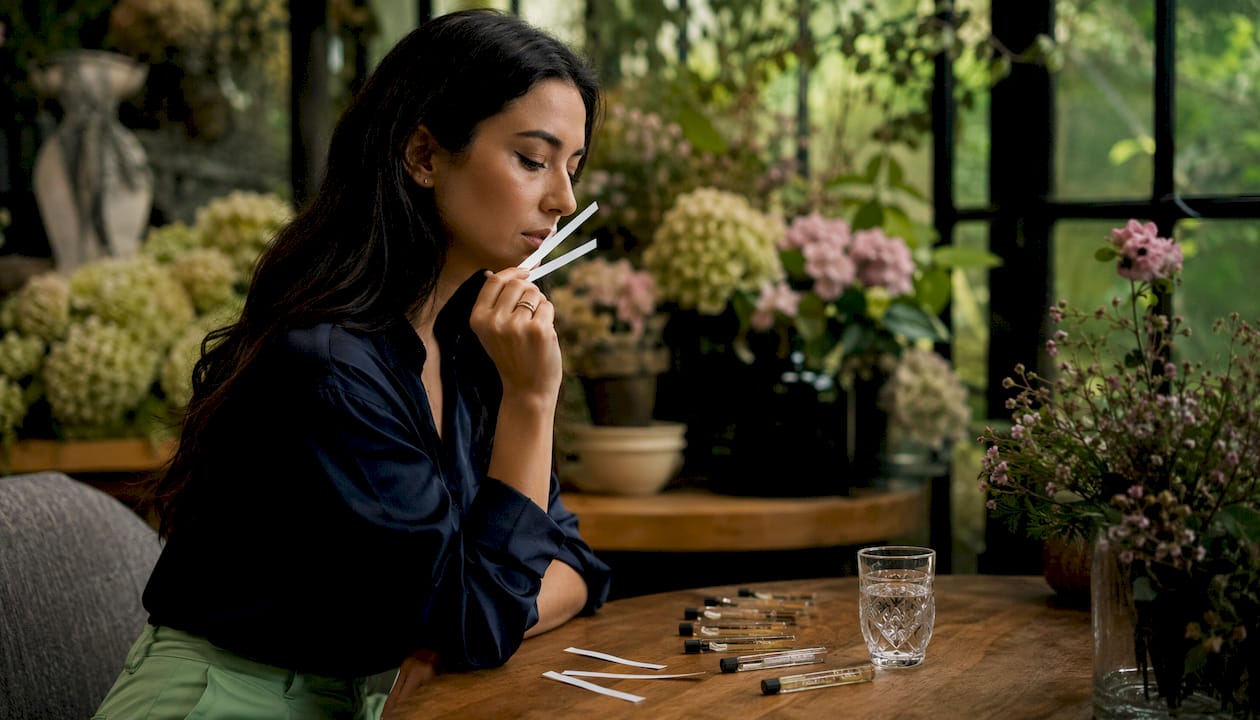
Pro Tip: The popular belief that sniffing coffee resets your nose is a myth. Step outside for fresh air or rinse your nasal passages with plain water. Both are more effective than any aromatic counter-remedy.
Does concentration really affect how long a perfume lasts?
Yes, significantly. Concentration determines the ratio of aromatic compounds to carrier, which directly shapes longevity and projection.
- Eau de Cologne (EDC): 2–4% concentration; light, refreshing, lasts 2–3 hours. Best for casual, warm-weather use.
- Eau de Toilette (EDT): 5–15% concentration; moderate projection, lasts 4–6 hours. Versatile for daytime and office wear.
- Eau de Parfum (EDP): 15–20% concentration; richer sillage, lasts 6–8 hours. A strong all-rounder for day-to-evening wear.
- Parfum/Extrait: 20–30% concentration; intimate projection, exceptional longevity of 8–12 hours or more. Worth the premium for signature or evening use.
Skin chemistry, season, and application point all modify these figures. Dry skin absorbs fragrance faster and projects less; pulse points (wrists, neck, inner elbow) amplify warmth and diffusion. In summer, a lighter concentration often performs better because heat already amplifies projection.
How do you narrow down to a final choice?
Indecision is the enemy of a great fragrance wardrobe. A structured narrowing process ends it.
- Reduce your shortlist to three finalists after initial testing.
- Test each finalist on a separate day, in the context you intend to wear it most.
- If two finalists feel equally compelling, wear them on alternate days for a week before deciding.
- Apply the “one-week sleep” rule: if you are still thinking about a fragrance a week after testing, that is a genuine signal of compatibility.
- Never buy a full bottle blind. Samples and discovery sets solve the problem of time-pressured in-store decisions by letting you experience a fragrance over hours and days.
The Alexandriauk Discovery Set is designed precisely for this process, offering a curated selection of quality-inspired fragrances to test at home across multiple days. For readers who want a more personal route, the Bespoke service offers a tailored consultation. The EMPTY Travel Atomiser at £8.99 is a practical companion for decanting a sample into a portable format, particularly useful when the TSA 3-1-1 rule applies to carry-on liquids.
For a deeper look at how to sample fragrances like an expert, the Alexandriauk Fragrance Academy has a dedicated guide.
How do you recognise quality and avoid costly mistakes?
Quality in a fragrance is not about price. It is about balance, evolution, and harmony across the dry-down.
Signs of quality:
- Smooth, harmonious transitions between top, heart, and base notes with no jarring chemical edges.
- Complexity in the base: quality base notes deepen and evolve rather than simply fading.
- Longevity appropriate to the concentration level.
- Sillage that suits the intended occasion without overwhelming.
Common mistakes to avoid:
- Judging a fragrance in the first five minutes. Top notes are designed to impress quickly; they are not the full story.
- Rubbing wrists after application. This is one of the most persistent myths in fragrance and one of the most damaging to accurate testing.
- Trusting packaging or price as proxies for quality. Some of the most complex, lasting fragrances come at accessible price points; some expensive bottles disappoint on skin.
- Testing too many scents in one session. Three is the reliable maximum before fatigue distorts perception.
A higher price does not guarantee a better fragrance. What it often buys is rarer raw materials, a more complex formulation, or a prestigious name. When those elements genuinely matter to you, the premium is justified. When they do not, a quality-inspired fragrance at a fraction of the cost can be indistinguishable on skin.
Key takeaways
The most reliable way to choose a new perfume is to identify your preferred scent family, test no more than three fragrances on skin per session, and use samples or a discovery set across multiple days before committing to a full bottle.
| Point | Details |
|---|---|
| Start with scent families | Identify one or two preferred families before testing to avoid wasted sessions. |
| Test on skin, not just paper | Blotters screen options; only skin reveals true longevity and evolution. |
| Limit sessions to three scents | Olfactory fatigue sets in beyond three fragrances, leading to poor decisions. |
| Use samples before buying | Discovery sets let you wear a fragrance across days and contexts before committing. |
| Alexandriauk Discovery Set | A curated, low-risk way to test quality-inspired fragrances at home before buying a full bottle. |
Why correct testing matters more than any other factor
There is a tendency in fragrance writing to focus on notes, families, and concentration as the primary decision tools. They matter, but they are secondary to one thing: time on your skin. A fragrance that reads beautifully on paper, ticks every family preference, and carries an impressive concentration can still disappoint if you have never worn it through a full day.
The testing protocol outlined here is not pedantry, and understanding how to layer serums with facial devices effectively can similarly enhance your overall fragrance and skincare routine. It reflects how fragrance actually works: as a living, evolving accord shaped by your skin chemistry, your body heat, and the context you wear it in. Rushing that process, or trusting a blotter and a first impression, is how expensive mistakes happen.
Discovery sets exist precisely because the industry knows this. They are not a marketing gimmick; they are the most honest way to sell fragrance. A brand confident in its quality offers samples. That is worth remembering when you are choosing where to spend.
For a thorough, practical walkthrough of in-store testing technique, the Alexandriauk guide on how to test perfume in store is the place to start.
Start with a sample, not a commitment
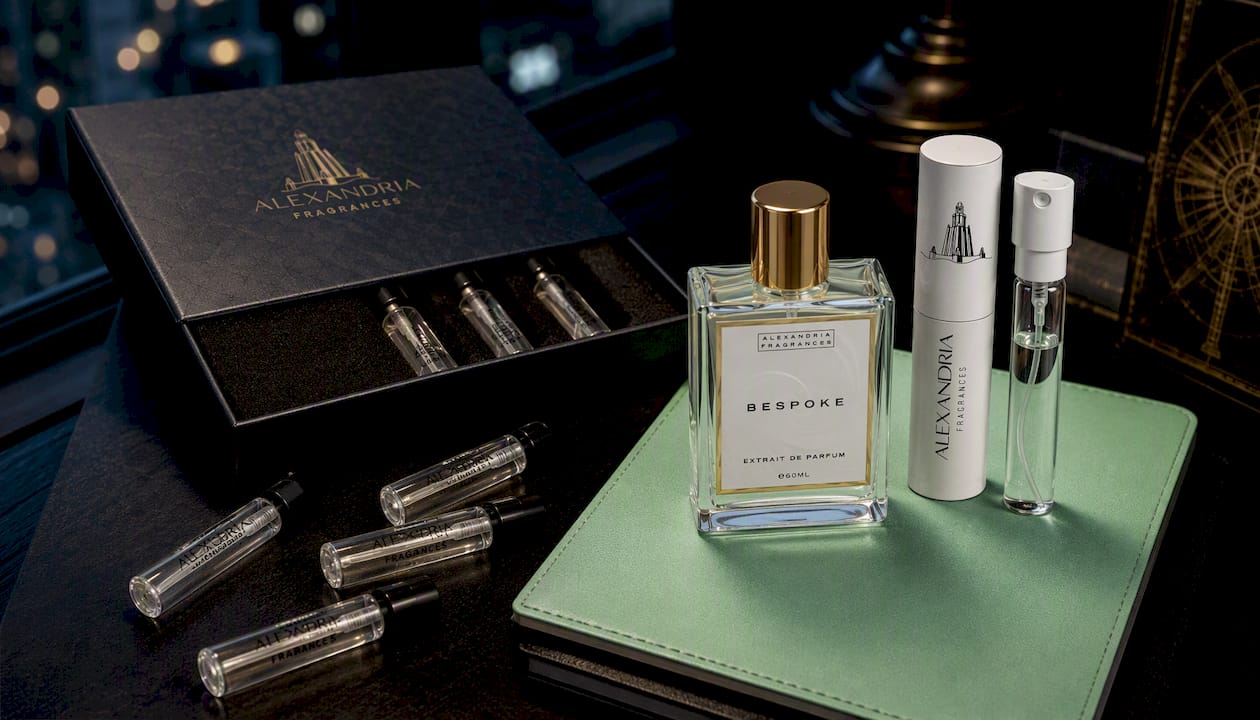
Alexandriauk offers a curated Discovery Set built for exactly the process described in this guide: a selection of quality-inspired fragrances you can wear at home, across multiple days, before deciding on a full bottle. No pressure, no guesswork, and no expensive regrets. For readers who want something entirely personal, the Bespoke service provides a tailored consultation to match a fragrance to your personality and lifestyle. Travelling soon? The EMPTY Travel Atomiser at £8.99 decants your chosen sample into a carry-on-friendly format. Browse the Discovery Set today and let the fragrance earn its place on your skin before it earns a place on your shelf.
Useful sources
- How to Test Perfume Properly — Parfinity: Core guidance on skin testing, session limits, and olfactory fatigue.
- How to Test Perfumes Properly — Perfume Cultures: Explains why paper blotters are screening tools only and how skin chemistry shapes dry-down.
- How to Test Perfume Before Buying — Noùmeno: The case for samples and multi-day testing over in-store snap decisions.
- The Fragrance Families, Decoded — Fragnatique: Maps eight fragrance families to seasons, occasions, and moods.
- Perfume Rules Explained: 50/30/20 — Luxaro: Educational breakdown of the perceptual phases of a fragrance’s development.
- How to Properly Test Perfume — MioLook: Blotter technique, spray distance, and why skin temperature changes perception.
- TSA 3-1-1 Liquids Rule — Transportation Security Administration: Official guidance on carrying liquids, including fragrance, in carry-on luggage.
- What Is a Scent Profile? — Vogue: Expert perspectives from perfumers and fragrance writers on scent profiles and selection.
- How to Test Perfume in Store — Alexandriauk Fragrance Academy: Alexandriauk’s practical, step-by-step in-store testing protocol.