How to apply perfume oil so it lasts all day
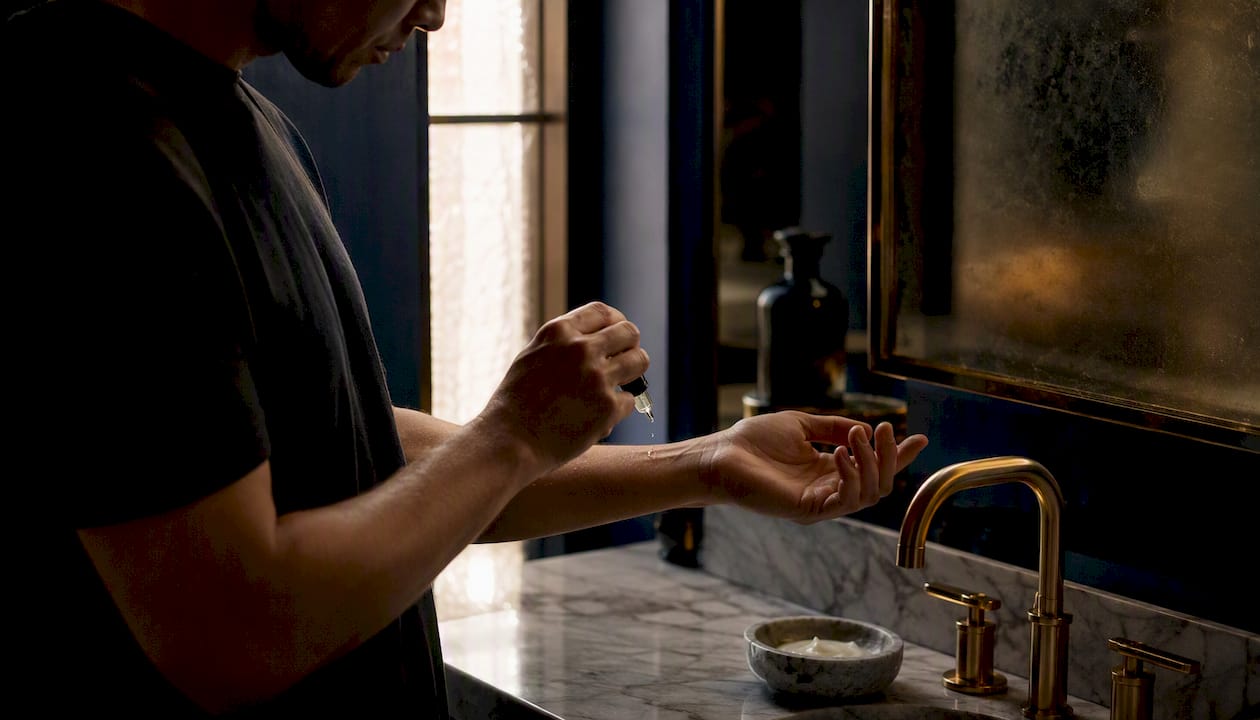
Moisturise your skin, press 1–3 drops onto warm pulse points, and resist every urge to rub. That single routine, done consistently, is how to apply perfume oil to last all day. Because perfume oils are oil-based and warm with body heat, they evaporate far more slowly than alcohol sprays, which means the technique you use at the moment of application has an outsized effect on how long the scent stays with you.
Quick dos and don’ts:
- Do apply immediately after a warm shower, while skin is still slightly warm
- Do moisturise first with an unscented lotion or light body oil
- Do press the oil gently onto pulse points and let it absorb for 15–30 minutes
- Don’t rub wrists together — friction destroys top notes
- Don’t apply to completely dry, flaky skin
- Don’t douse multiple points heavily; 1–3 drops total is enough
Pro Tip: Dab a pea-sized smear of petroleum jelly (Vaseline works perfectly) onto one pulse point before applying your oil. The occlusive layer acts as an anchor, slowing absorption and giving the fragrance something to cling to throughout the day.
Key takeaways
Moisturised skin, precise pulse-point placement, and the press-don’t-rub technique are the three non-negotiable foundations of all-day perfume oil wear.
| Point | Details |
|---|---|
| Moisturise before applying | Unscented lotion or a smear of Vaseline prevents rapid absorption and anchors the oil. |
| Use 1–3 drops only | More oil does not extend longevity; it overwhelms the nose and flattens the accord. |
| Press, never rub | Rubbing destroys top notes through friction; press gently and leave the oil to absorb for 15–30 minutes. |
| Choose base-note-heavy oils | Woody, resinous, and musky blends outlast citrus or floral oils by several hours on most skin types. |
| Alexandriauk Oriental Leather | A rich oud and leather oil built for all-day wear; available directly to UK customers from Alexandriauk. |
Table of Contents
- Why moisturised skin holds perfume oil so much better
- Which pulse points give you the best diffusion and longevity
- The right dosage and technique: how to set your oil correctly
- How to layer perfume oil with skincare for extended wear
- Applying oil to hair, beard and clothing: what works and what to avoid
- How fragrance structure determines how long your oil will last
- Common mistakes that shorten your perfume oil’s wear time
- Dave’s expert notes: a practical routine for all-day wear in the UK
- The one habit that makes the real difference
- Oriental Leather by Alexandriauk: a base-note rich oil built for all-day wear
- Sources
Why moisturised skin holds perfume oil so much better
Dry skin absorbs oil almost instantly, pulling the fragrance molecules deep into the epidermis before they have a chance to diffuse into the air around you. Moisturised skin, by contrast, creates a slightly occlusive surface that slows that absorption and allows the oil to sit closer to the surface, where body heat can gently lift the scent throughout the day.
The best moment to apply is directly after a warm shower. Your pores are open, your skin temperature is elevated, and any light moisturiser you apply will absorb quickly without leaving a heavy film. Choose an unscented lotion or a light body oil — anything with a strong competing fragrance will muddle the accord you are trying to wear. For very dry skin, a thin layer of petroleum jelly on a single pulse point provides a particularly effective anchor without altering the scent profile.
A brief note on storage, because it affects what lands on your skin: keep your oils in dark glass bottles with airtight caps, away from heat and direct sunlight. Oxidation degrades fragrance molecules and weakens the oil before it even reaches your skin.
Which pulse points give you the best diffusion and longevity
Pulse points are sites where blood vessels run close to the skin’s surface, generating warmth that continuously volatilises the fragrance molecules above them. That gentle, sustained heat is what turns a static oil into a living, evolving scent.
The most effective pulse points, in rough order of projection:
- Base of the throat — the highest-projecting point; ideal for social wear
- Inner wrists — classic and accessible, though frequent hand-washing reduces performance
- Inner elbow — excellent for close, intimate projection; less affected by washing
- Chest — warm and central; scent rises naturally with body heat
- Behind the knees — underused but remarkably effective; heat rises from the legs all day
- Behind the ears — close-range projection; good for personal wear
Apply 1–3 drops total across your chosen points, pressing gently rather than pooling the oil in one spot. For a projecting, social wear, combine the throat and chest. For something more intimate and close, the inner elbow and behind the ears work beautifully together.
One caveat on wrists: if you wash your hands frequently throughout the day, the inner wrist is a poor primary placement. Shift your main application to the inner elbow or chest, and use the wrist only as a secondary point.
The right dosage and technique: how to set your oil correctly
The correct amount is smaller than most people expect. For a concentrated perfume oil, 1–3 drops across all chosen points is sufficient. Applying more does not extend longevity; it overwhelms the nose and can actually make the scent feel flat rather than rich.
Step-by-step technique:
- Warm the application site briefly by pressing your clean hand against it for a few seconds
- Apply 1 drop per point using a roller, dabber, or the bottle’s stopper
- Press the oil gently into the skin using a fingertip — do not rub
- Allow 15–30 minutes for the oil to absorb and the top notes to settle before assessing the scent
- Avoid touching the area during that initial absorption window
Rubbing generates heat and friction that disrupts fragrance structure, physically removing oil from the skin and accelerating the evaporation of the volatile top notes you paid for. Press, set, and leave it alone.
How to layer perfume oil with skincare for extended wear
Layering is one of the most underused tools for long-lasting perfume application. The principle is simple: build a scented base from the ground up so that each layer reinforces the one above it.
The layering ladder:
Shower gel (lightly scented or matching) → unscented moisturiser → perfume oil
Layering an unscented moisturiser with matching or neutral body products increases perceived longevity by giving the oil a prepared surface to adhere to. For woody or resinous fragrances, a light unscented body oil beneath the perfume oil deepens the base and extends the drydown beautifully. For citrus or floral oils, keep the base neutral; anything scented risks clashing with the lighter top notes.
Pro Tip: A light, unscented base layer is almost always the better choice over a matching scented product. Matching products are rarely identical in concentration, and the difference can create a discordant accord rather than a reinforced one. Neutral is safer and often more effective.
For a deeper look at layering fragrance dupes to build a truly personal accord, the Alexandriauk guide on crafting a signature scent is worth reading alongside this one.
Applying oil to hair, beard and clothing: what works and what to avoid
Hair holds fragrance exceptionally well because it has a large surface area and does not absorb oil the way skin does. The scent lingers in the fibres and releases gently with movement, creating a soft trail.
Safe techniques for hair and beard:
- Apply a single drop to a hairbrush and run it through the mid-lengths and ends
- Avoid applying directly to the roots — oil at the scalp looks greasy and can irritate sensitive skin
- For beards, one small dab pressed into the mid-section of the beard is enough
Clothing can also hold scent for hours, particularly natural fibres like wool, cotton, and cashmere. A light dab on a collar or the inside of a scarf works well. However, applying oil to hair or fabric requires care to prevent greasiness or staining — always test on an inconspicuous area first, and never apply directly to silk, satin, or pale delicate fabrics. Oil stains on fine fabric are permanent.
How fragrance structure determines how long your oil will last
Not all perfume oils are created equal in terms of longevity, and understanding fragrance note theory) helps you choose oils that are inherently longer-lasting.
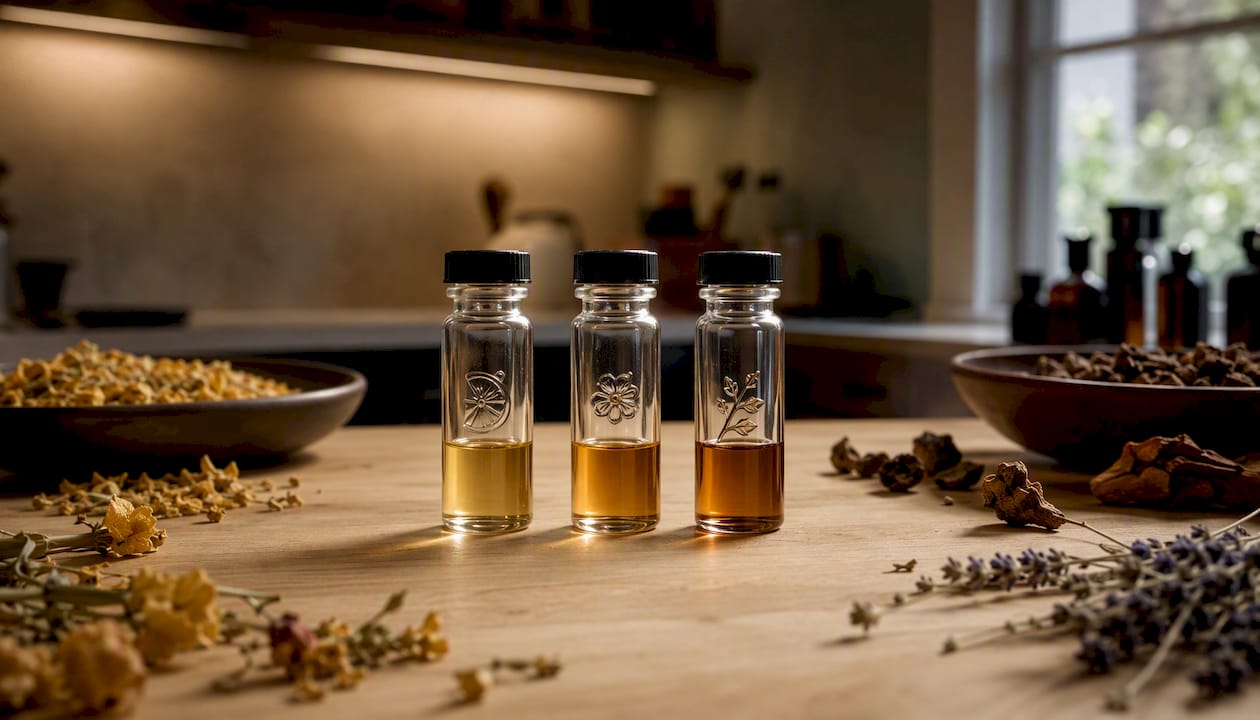
Fragrance is structured in three layers. Top notes (citrus, light herbs) are the first impression — vivid but brief, lasting 15–30 minutes. Heart notes (florals, spices) form the body of the scent and last 2–4 hours. Base notes (woods, resins, musks, ambers) are the foundation, and they are what you smell at the end of the day.
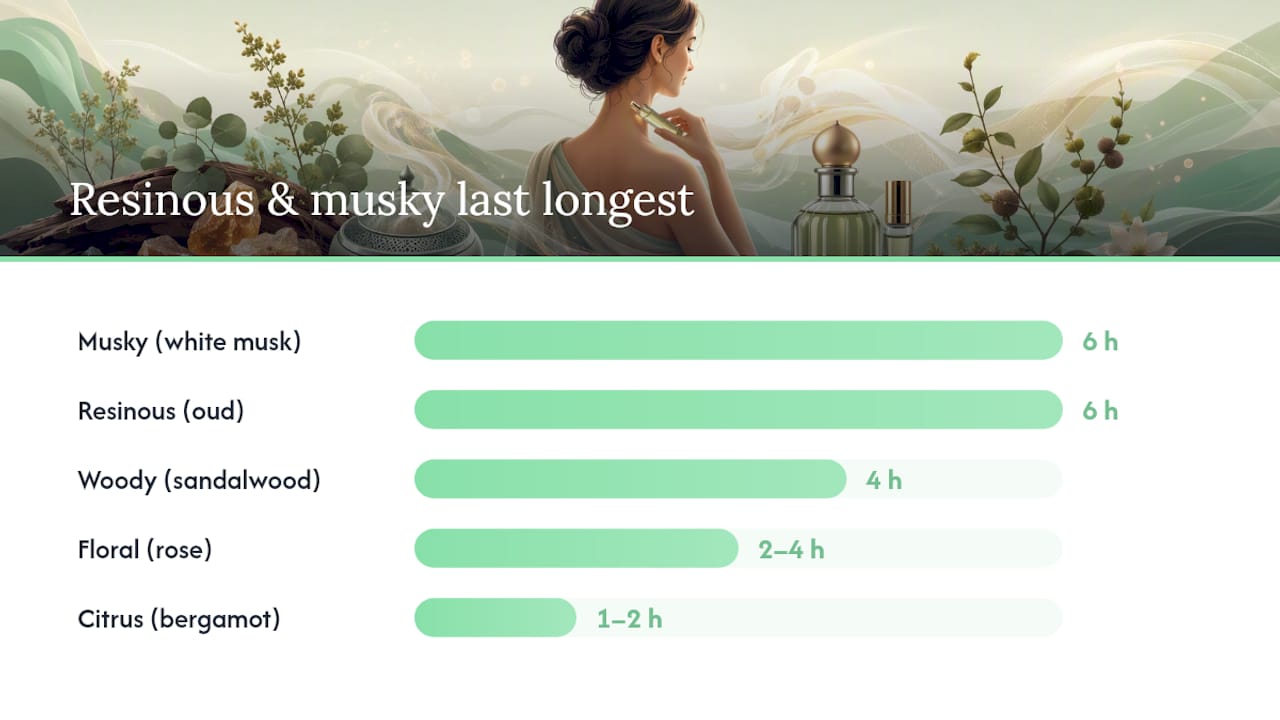
Concentration and the weight of base notes are the primary factors affecting how long a fragrance lasts on skin. An oil rich in patchouli, sandalwood, oud, or resinous musks will outlast a light citrus or aquatic blend on almost any skin type.
| Note family | Relative longevity | Examples |
|---|---|---|
| Citrus / fresh | Short (1–2 hrs) | Bergamot, lemon, grapefruit |
| Floral | Moderate (2–4 hrs) | Rose, jasmine, iris |
| Woody | Long (4 hrs) | Sandalwood, cedarwood, vetiver |
| Resinous / oriental | Very long (6 hrs) | Oud, amber, benzoin |
| Musky | Very long (6 hrs) | White musk, ambrette, iso E super |
To evaluate an oil before committing: apply a small amount to your inner wrist, then check the intensity at 15 minutes, 1 hour, and 3 hours. That three-point test reveals how the oil performs on your specific skin chemistry, which varies considerably from person to person.
Common mistakes that shorten your perfume oil’s wear time
Most longevity problems trace back to a handful of repeatable errors, all of which are easy to correct once you know what to look for.
- Applying to dry skin — the single most common mistake; oil absorbs too fast and disappears
- Rubbing the application site — applying to dry skin, rubbing wrists together, and over-applying are the most frequent errors that reduce wear
- Over-applying — more oil does not mean longer wear; it means olfactory fatigue and a flat scent
- Applying immediately after exfoliation — freshly exfoliated skin absorbs oil aggressively; wait at least an hour
- Storing bottles in the bathroom — heat and humidity degrade the oil; use a cool, dark drawer instead
- Reapplying before the oil has developed — the base notes need time to emerge; adding more too soon creates a muddled accord
For a midday refresh without overdoing it, carry a small roller and apply a single drop to the inner elbow only. That is enough to revive the scent without layering competing concentrations on top of each other.
Climate matters, too. In the cooler, damper conditions typical of the UK, fragrance tends to sit closer to the skin rather than projecting outward. Apply to slightly warmer points (chest, throat) in winter, and consider a single extra drop on a cold day to compensate for the reduced diffusion.
Dave’s expert notes: a practical routine for all-day wear in the UK
Dave, fragrance writer at Alexandriauk, has spent years testing oils across the full spectrum of note families in British conditions. His go-to routine for reliable all-day wear is deliberately compact:
- Moisturise with an unscented lotion immediately after showering
- Apply one drop to the inner elbow and one to the base of the throat, pressing gently to set
- Leave it alone for at least 20 minutes before assessing — the oil needs time to marry with your skin chemistry
For readers who want to go deeper on building a layered scent wardrobe, the Alexandriauk Scent Layering 101 guide is the pillar resource worth bookmarking. It covers everything from complementary note pairings to building a signature accord across multiple products.
The one habit that makes the real difference
The single habit worth adopting above all others: moisturise before every application, without exception. Everything else in this guide — pulse point placement, the press-don’t-rub technique, layering — amplifies that foundation. Without it, even the finest oil will disappear within a couple of hours.
The routine for tomorrow morning: apply an unscented lotion after your shower, dab a pea-sized smear of Vaseline onto your inner elbow, then press two small drops of your chosen oil onto the elbow and the base of your throat. Walk out the door and let the fragrance do the rest.
Oriental Leather by Alexandriauk: a base-note rich oil built for all-day wear
If you are looking for a perfume oil that puts the longevity principles above into practice from the first drop, Oriental Leather Inspired by Dior Oud Ispahan from Alexandriauk is a compelling place to start. This is a dark, hedonistic accord built on oud, leather, and resinous rose — precisely the base-note-heavy structure that clings to skin and evolves beautifully across a full day.
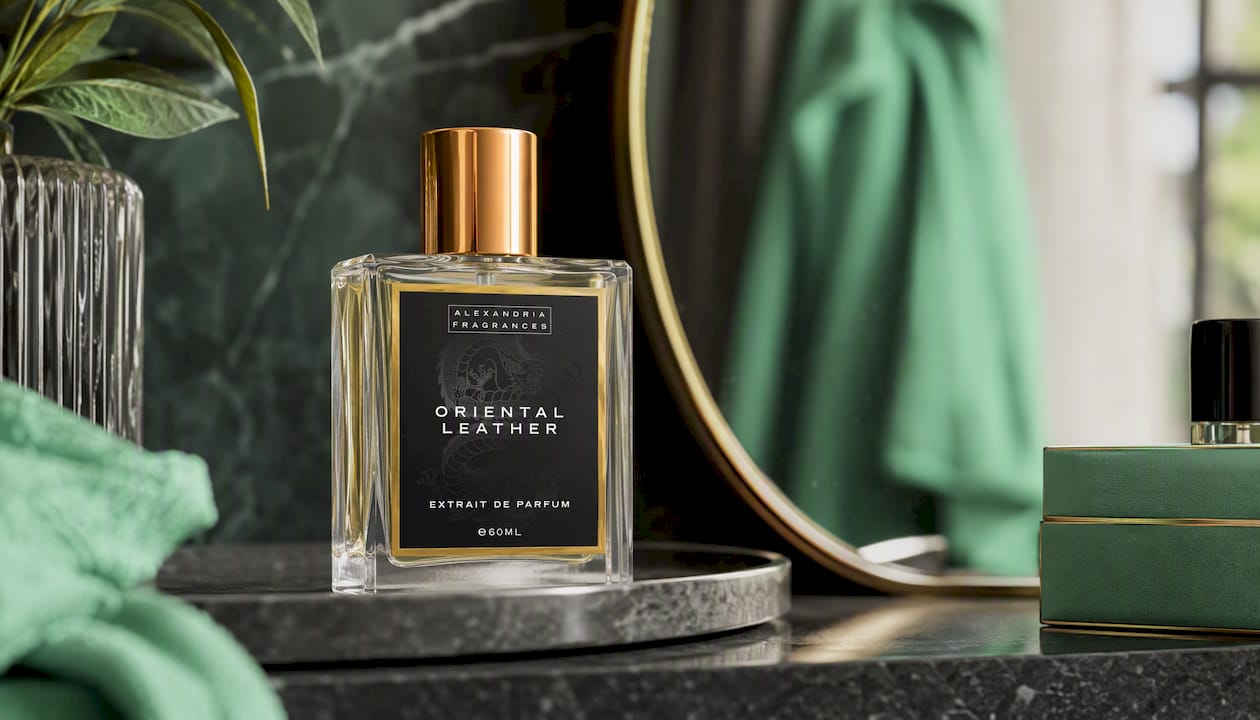
Available to UK customers directly through the Alexandriauk website, it arrives in a format designed for precise pulse-point application. The concentration is generous, which means the 1–3 drop routine is not just sufficient — it is ideal. For those who prefer to sample before committing, Alexandriauk’s product pages include guidance on available options. Visit the Oriental Leather product page to find out more, or browse the wider fragrance collection at Jeffi for additional options.
Sources
- How to Apply Perfume Oil (And Make the Scent Last All Day)
- How to Apply Perfume Oil for Lasting Scent
- Long-Lasting Perfume Fragrance Oils: Tips to Increase Longevity
- How to Make Perfume Last Longer (The Science + the DIY Advantage) — SCENT + ART